The Qadiriya Boutchichiya tariqa
The Qadiriya Boutchichiya tariqa is a Sufi path born in Morocco, descending from the Qadiriya founded in Baghdad in the twelfth century. Its seat is Madagh, a village in the Berkane plain at the foot of the Beni Snassen mountains. In France, where it has been established since the late 1980s, it brings practitioners together each week in eight cities around meditation and dhikr. A path of inner transformation, it rests on a particular alliance: a very old initiatic transmission joined to a way of teaching suited to modern life.
Origins: the Qadiriya and the Beni Snassen
The name of the path already tells the essentials of its genealogy. Tariqa literally means ‘the way’: in the Sufi tradition the word denotes an initiatic order gathered around a guide, whose teaching passes from heart to heart. Qadiriya points to Moulay Abd al-Qadir al-Jilani (1077-1166), the saint of Baghdad around whom one of the oldest and most widespread of Muslim brotherhoods took shape. His sanctuary in Iraq remains a major place of pilgrimage to this day.
The Boutchichiya branch is far more recent. It arose in the mid-eighteenth century in north-eastern Morocco, when Sidi Ali al-Qadiri, a descendant of the founder who had come from Iraq, settled in a village of the Beni Snassen massif and built his zawiya there. The massif was then a meeting ground between Berber and Arab tribes, and Sidi Ali’s zawiya soon became a refuge. During a famine that struck the region, he had dchicha, a crushed-barley soup, distributed to the poor. The people nicknamed him ‘Sidi Ali Boutchich’, the soup man. The name stayed with the family and the path: it says, better than any discourse, what this tradition understands by service.
The family’s genealogy goes back to the Prophet Muhammad, through his grandson Hasan. Several generations of saints marked the region’s history, among them Sidi al-Mukhtar al-Boutchichi, great-grandfather of Sidi Jamal, a figure of sanctity throughout Morocco’s Oriental region and an emblem of resistance to colonial encroachment.
The initiatic chain and the transmission of the secret
A tariqa is not decreed: it is authenticated by its silsila, the unbroken chain of masters running back, disciple to guide, to the Prophet. In the Boutchichi line, full access to the ‘secret’ (sirr), that is, the capacity to transmit initiation, was lost after Sidi Ali: only a sainthood of blessing (tabarruk) remained, honoured but deprived of the function of guidance.
It was Sidi Abu Madyan al-Qadiri (born 1873), a distant cousin living in retreat in the Beni Snassen mountains, who brought the sirr back into the lineage. He had received it after long years of discipleship under two masters: Sidi Ben Ariane, of the Tijaniyya, counted among the Malamati, those ‘people of blame’ who conceal their spiritual state, and Sidi Ahmed Lahlou, a disciple of Sidi Muhammad ben Ali, of the Shadhiliyya. The Qadiriya Boutchichiya thus belongs to a threefold initiatic filiation: Qadiri by name and blood, Tijani and Shadhili by the effective transmission of the secret. The chain in detail, master by master, can be read on the initiatic chain page (in French).
The successive guides
Four guides have carried the path since Sidi Abu Madyan restored the transmission to it.
Sidi al-Hajj al-Abbas (1890-1972), a disciple of Sidi Abu Madyan alongside the master’s own son, directed the zawiya of Madagh after the master’s death. A great landowner respected across the region, he was accustomed to being served and to serving no one: the story his son told, of Sidi Abu Madyan ordering him to serve tea to the fuqara’ while the notables looked on in astonishment, remains in the path’s memory as a lesson in stripping away the ego. His spiritual testament, which hands the direction of the path on to his son Sidi Hamza, is one of its founding texts.
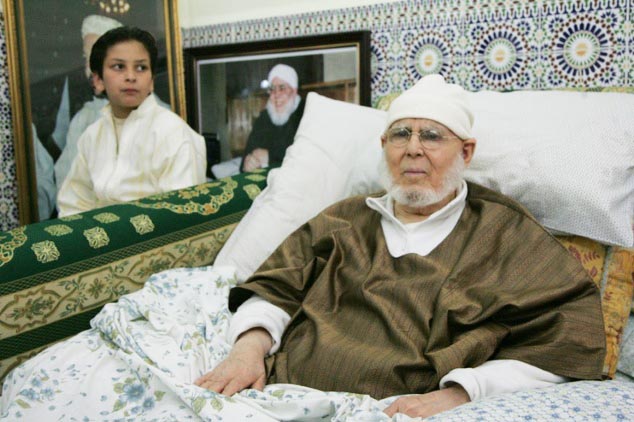
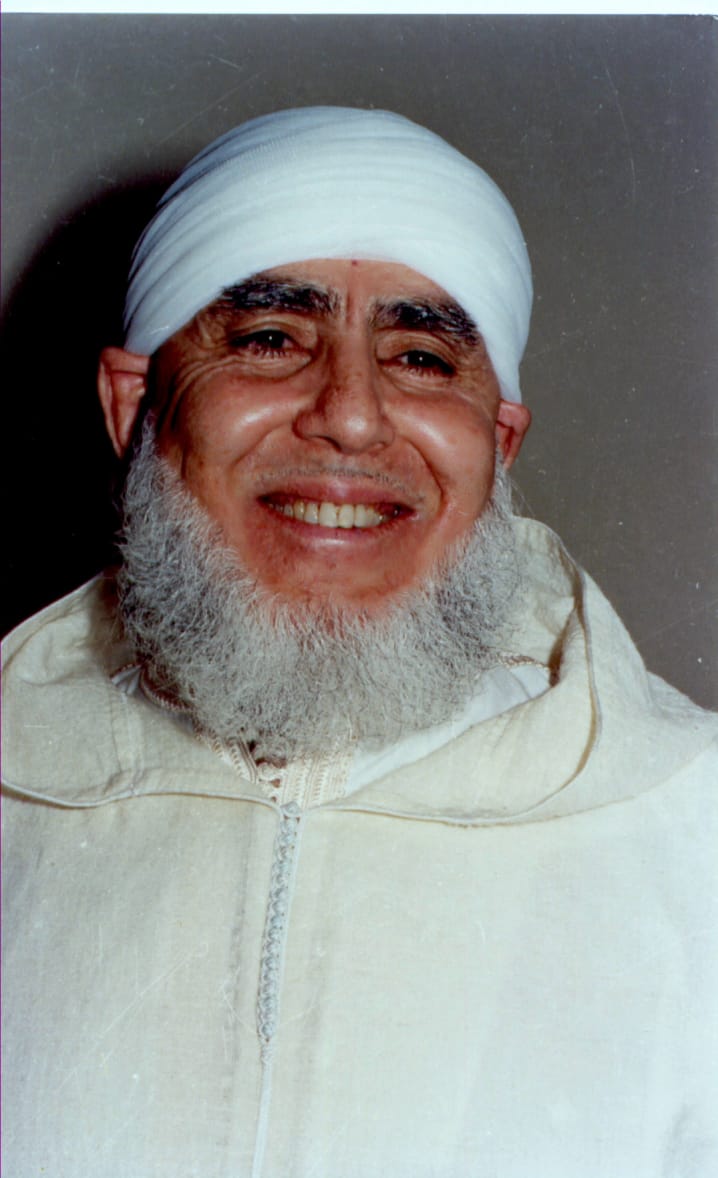
Sidi Hamza (1918-2017), the son of Sidi Abbas, entered the path at twenty-four, in 1942, and spent fourteen years beside Sidi Abu Madyan. Guide from 1972 until his death, he turned a rural brotherhood into one of the most thriving Sufi paths in the world. Under him, the modest zawiya of Madagh became in the 1980s a vast retreat centre, financed by the revenues of the farmland and able to serve tens of thousands of meals a year. He died on 18 January 2017 and was buried at Madagh, the funeral attended, the Moroccan press reported, by royal advisers and ministers.
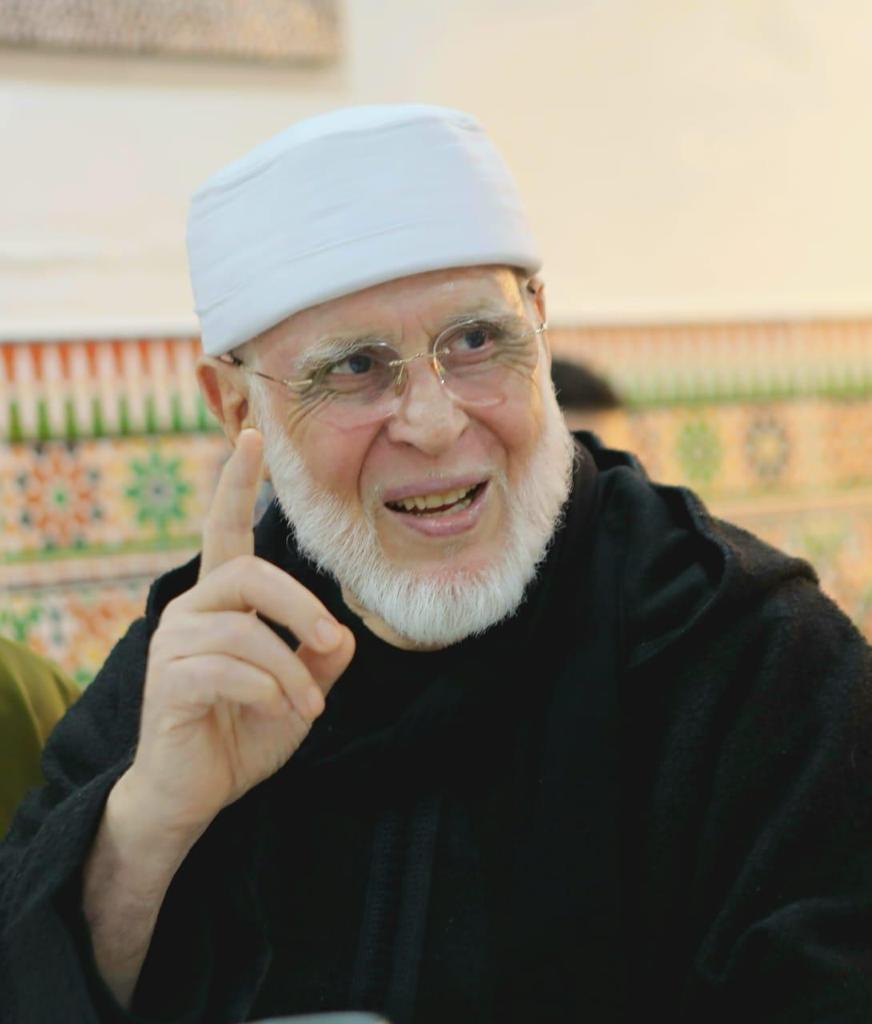
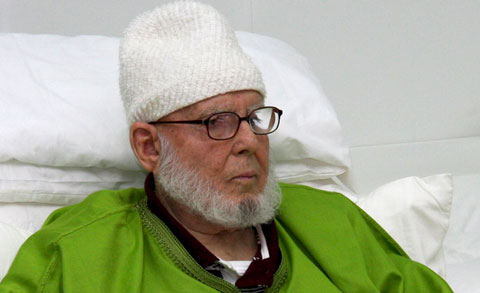
Sidi Jamal (1942-2025), the son of Sidi Hamza, had been formed by his grandfather and then by his father. He guided the path from 2017 until his death on 8 August 2025. Over those eight years he consolidated the tariqa’s international reach and left his disciples talks and a spiritual testament written at Madagh in December 2024 (in French).
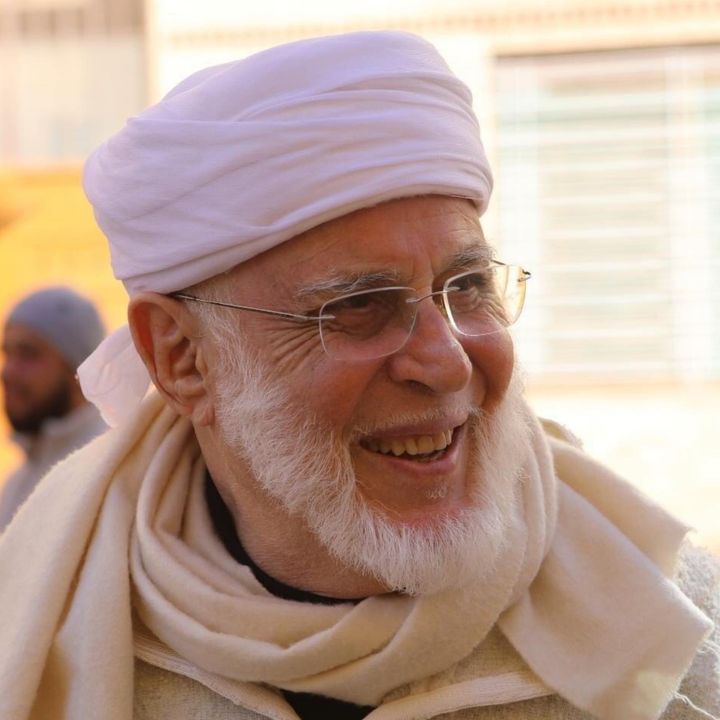
Sidi Mounir has guided the path since August 2025. Sidi Jamal’s eldest son, he was designated by the spiritual testaments of his father and his grandfather. At the 2025 dikra, the commemoration ceremony of Sidi Hamza, Sidi Jamal had already presented him to the assembly, taking up his own father’s formula: ‘What I hold, Sidi Mounir holds too.’
The teaching: the path of Beauty
What sets the Qadiriya Boutchichiya apart in the contemporary Sufi landscape comes down to a shift: from the path of Majesty (jalal), built on austerity and trial, to the path of Beauty (jamal), built on welcome and love. The sociologist Karim Ben Driss, author of Le Renouveau du soufisme au Maroc, has drawn out three reforms carried through by Sidi Hamza.
The first: the teaching is addressed to all. Where classical Sufism reserved guidance for a prepared elite, Sidi Hamza opened it to whoever asks for it in sincerity, including those who seek only to live their ordinary faith better. The second: the relationship between master and disciple has been reversed. ‘In the old days it was the disciple who sought the master; today it is the master who seeks the disciple,’ Sidi Hamza used to say, and he summed it up another way still: ‘There is no trial in this path; the trial is replaced by invocation (dhikr).’ The third: beautification comes before stripping away. The novice’s heart is compared to a dark room that must first be lit; once he has ‘tasted’, the disciple finds within himself the momentum to shed his vices, rather than having to shed them as a precondition.
In this light, the relationship to the guide is not submission: the path indeed prefers the word ‘Guide’ to ‘Master’. The guide is the companion (sahib) who travelled the way before the disciple and accompanies him on it through suhba, companionship. One saying of Sidi Hamza catches the tone of the teaching: ‘Despise neither Jew nor Christian nor atheist! But keep a watchful eye on your own ego, for it is truly your only enemy.’ See also the spiritual guide in Sufism and the renewal of Sufism for a detailed analysis of this turning (in French).
The practices of the path
Daily practice rests on the wird, the private invocation of morning and evening: divine names and Qur’anic formulae recited under the breath at home, a regular ‘drinking’ to which the disciple returns each day. To this is added collective dhikr: weekly gatherings where the participants invoke aloud together, then listen to a teaching before closing the session with song.
The sama’ holds a particular place. The poems sung in honour of God and His Prophet, the qasaid, are no ornament: in this path, singing is an instrument of spiritual education, reaching the being where discourse cannot reach. Several qasaid can be heard on the site, with their translations (in French).
Lastly, the life of the path punctuates the year: retreats at Madagh, where the zawiya welcomes residents from every country; the celebration of the mawlid, the anniversary of the Prophet’s birth, which draws tens of thousands of disciples to the village each year; and the dikra, the commemoration of the departed guides.
Madagh, the seat of the path
Everything begins at Madagh (pronounced ‘Madar’), a village in the Berkane plain in north-eastern Morocco, not far from Oujda. That is where the family’s ancestors built their zawiya, and where the guides of the path are buried. The place still works as it did in Sidi Hamza’s day: farmland whose revenues pay for the welcome, kitchens serving free meals to visitors, dhikr halls and lodgings for retreats. At mawlid, the village takes in tens of thousands of disciples from Morocco, Europe and beyond, under the gaze of the national media. Every year, Western practitioners come to make retreats there, alone or with their local group.
The path in France and around the world
The tariqa’s Western presence grew from the 1980s onwards, carried first by Moroccan disciples settled in Europe and North America. It then reached a different public: Europeans by birth, converts or simply people looking for a living practice of meditation. The Qadiriya Boutchichiya is often cited as the Moroccan tariqa most firmly established in the West, present in France, Belgium, Britain, Spain, the United States and Canada.
In France, the path is lived today in eight cities, through associations such as Isthme and VSMF, and through two landmark events: the World Gatherings on Sufism, which bring researchers and practitioners together at Madagh, and the Festival of Sufi Cultures at Fez (in French). Public figures have helped carry its message beyond the circle of practitioners: the anthropologist Faouzi Skali, the scholar of Islam Eric Geoffroy, the sociologist Karim Ben Driss.
This presence rests on a clear position: a Sunni Sufism, apolitical, that asks no one to break with their culture. The disciple remains an ordinary citizen, active in family and at work; the path prescribes neither distinctive dress nor withdrawal from the world. No doubt that is one reason for its rootedness: it offers a practice of the sacred compatible with contemporary French life, without renouncing anything of the initiatic demand.
Joining in and going further
The simplest way in is a dhikr session. These are weekly in several cities, monthly or occasional in others, and open to all without prerequisites: you can come and listen without asking for anything more. Times, venues and contacts appear on the city pages: Paris, Lyon, Marseille, Montpellier, Nice, Antibes, Avignon, Yvelines, and on the gatherings calendar (in French).
For those who wish to go further, the path offers companionship: a lasting relationship with the guide and with the community of practitioners, sealed in the tradition by a pact of allegiance (bay’a). That is the heart of what the tariqa means by walking the path: not administrative membership but a progressive education of the heart, at each person’s own measure. On how to recognise and approach an authentic path, see the guide Finding a Sufi master in France (in French).
Frequently asked questions
Do you have to be Muslim to attend a meditation session?
No. The dhikr sessions are open to all, practitioners of the path and the simply curious alike. That is indeed how many people first discover Sufism: coming to listen on a Friday evening in Paris or another city.
Who guides the path today?
Since August 2025, the order has been led by Sidi Mounir al-Qadiri Boutchich, son of Sidi Jamal and grandson of Sidi Hamza, designated by the spiritual testaments of his father and his grandfather.
Is the Qadiriya Boutchichiya tariqa a school of thought or a brotherhood?
Both: it is an initiatic order (a tariqa, literally ‘a way’) whose transmission has run from master to disciple for centuries, and a spiritual teaching articulated around dhikr, suhba and sama’.
Can you practise without committing to the path?
Yes. Many people attend the sessions for years without any further step. Commitment to the path, through the pact of allegiance, comes only at the practitioner’s own request, when they feel ready.
Articles in this section
- 'A Sufi sage amongst us': Faouzi Skali on Sidi Hamza (2000)
- 'Sidi Hamza, the living saint': a portrait from the Moroccan press (2000)
- Tribute to Sidi Jamal al-Qadiri Butshish (2): the Qur'an, the sama' and the mudhakara
- Tribute to Sidi Jamal al-Qadiri Butshish (1): the master of poverty
- The spiritual testament of Sidi Jamal
- Sidi Jamal's speech at the dikra 2025
- 'O you who ask to attain the Truth', a qasida by Sidi Hamza
- Extracts from Sidi Jamal's speech, mawlid 2024
- Sayings of Sidi Hamza on love and humility
- Sayings of Sidi Hamza on the wayfaring and the heart
- Sidi Jamal, the master of beauty (1942-2025)
- Sayings of Sidi Hamza on the path and spiritual practices
- Sayings of Sidi Hamza on knowledge and the initiatic method
- The spiritual testament of Sidi Hamza
- The renewal of Sufism according to Sidi Hamza
- The universal dimension of Sidi Hamza
- Sidi Hamza, or the living teaching