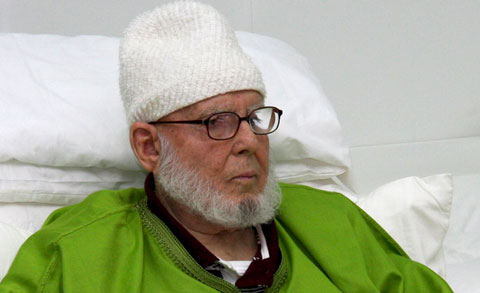
The renewal of Sufism according to Sidi Hamza
Contents
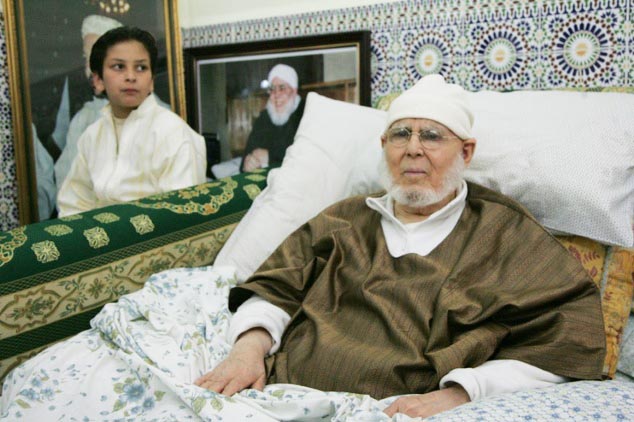
When he officially took over the direction of the Qadiriya Boutchichiya tariqa in 1972, Sidi Hamza al-Qâdirî Bûtshîsh brought about the spiritual turning point announced by his father, Sidi Hajj ’Abbas.
He thereby established a spiritual practice more flexible than that of classical Sufism, known for its rigour, whilst keeping within the frame of Sunnism. In Sufi terms, this turning point marks the passage from a practice of Majesty (jalal) to one of Beauty (jamal), whose chief consequence is the suppression of the preliminary trials for disciples, as Sidi Hamza himself makes clear: ‘There is no trial in this path; the trial is replaced by invocation (dhikr).’
Among the factors behind this renewal is, first of all, the kind of spiritual authorisation (idhn) with which the master is invested, and which enables him to adapt the teaching to the socio-historical conditions of the age. For the predisposition of the spiritual conscience has considerably weakened over the modern era. Twenty-first-century man’s attraction towards materiality has unbalanced his twofold primordial nature. The balance between these two dimensions, spirit and body, is becoming harder and harder to achieve. We thus live in a situation where matter overflows the spirit, which results in a crisis of ethics (akhlaq) and an alteration of religious conscience. In this context, the overly heavy demands of the teaching of jalal are, according to Sidi Hamza, then master of the tariqa, a thing of the past. The reign of Beauty, as inaugurated by this renewed Sufism, is intended as the answer to the reality of an age. A renewal of Sufism as a science of ethical life thus emerges from the teaching of the Qadiriya Boutchichiya path. In this regard, three fundamental aspects of this renewal can be distinguished.
Teaching open to all
The first is the extension of the living spiritual master’s teaching: it is no longer addressed solely to a spiritual elite, but to Muslims as a whole. Traditionally, the ultimate aim of the Sufi master is to lead his disciples towards the highest degree of realisation of the being, whereas the ordinary Muslim performs practices that require no spiritual guidance, since they are within everyone’s reach. Yet in the spiritual crisis we know today, the very practice of the pillars of Islam is endangered by a misunderstanding of the spirit of religion. Sidi Hamza, as the spiritual master of the age, therefore no longer addresses himself only to a religious elite, but to all Muslims. He thus takes in hand, for whoever so desires, the realisation of the people of islam as well as that of iman (faith) and ihsan (excellence). To this end, he behaves differently according to the request and the spiritual level of each person.
The master who seeks the disciple
The second aspect of this revivification corresponds to a change in the master-disciple relationship. As Sidi Hamza puts it: ‘In former times, it was the disciple who sought the master; today, it is the master who seeks the disciple.’ The usual meaning of the mystical quest had the disciple go in search of a master, so that the latter might help him achieve his desire to attain perfect knowledge. The term murid (disciple) derives from irada, meaning will. The whole meaning of the quest is contained in this notion of will. Under the impetus of this loving will, the aspirant, equipped with a bowl and a staff, would leave his family and his country to go in search of a master. The initiatic trial began with the quest itself, for it was generally only after several years of wandering that the disciple met his master. Since the trial has been removed from contemporary Sufi teaching, it is understandable that the quest, regarded as a preliminary trial, should be removed too. This is a veritable ‘revolution’ in the teaching of Sufism.
Beautification before emptying
The third aspect is the reversal of the principle of ‘emptying-beautification’ (takhalli-tahalli). In classical Sufism, before being able to taste the fruits of the heart’s embellishment, the disciple first had to work to rid himself of his vices, inner and outer alike. He had to fight the desire for the riches of this world, as well as the love of glory and power. The Sufis of old gave the example of the young bride, who first had to be stripped of her old clothes before she could be clothed in her finest adornments. Yet ridding oneself of one’s vices requires a high level of sincerity, strength of character and devotion. The spiritual conscience is, as we have seen, weakened by an overflow of materiality. To orientate modern man’s slumbering conscience towards spirituality, Sidi Hamza therefore proceeds in the opposite way and places beautification before emptying. He explains it in these terms: ‘The novice’s heart is like a dark room. The first thing to do, before thinking of tidying this room, is to light it up. Once his heart is filled with light, once he has been able to “taste” this embellishment, he is predisposed for the second stage, that of emptying.’
Thus, the widening of the function of spiritual master, the overturning of the modalities of the mystical quest and the reversal of the ‘emptying-beautification’ principle constitute the three fundamental points of the reform of Sufism carried out by Sidi Hamza al-Qadiri Butshish. These three points turn chiefly around one central question: man’s predisposition to spiritual teaching is no longer the same today as it once was. Throughout its history, Sufism has always known how to adapt to the conditions of its time so as to keep its capacity for transmission. Whilst remaining within the limits of the religious Law, Sunni Sufism has readily changed its methods of teaching. The content, for its part, remains the same. It is precisely in order to preserve this content, which the Qur’an calls the ‘deposit’ (amana) (XXXIII, 72), that the Sufis have always been concerned to adapt to the contingencies of the moment. This deposit, so magnified, so sung and so praised by the mystics of love, is called in Sufi language the Secret (sirr) and is communicated specifically from heart to heart.
Karim Ben Driss is a sociologist, director of the Institut Soufi de Montréal and author of ‘Le renouveau du soufisme au Maroc’ (Al Bouraq / Archè).

Further reading
- A path of rigour, a path of beauty
- Sidi Hamza, or the living teaching
- The spiritual testament of Sidi Hamza