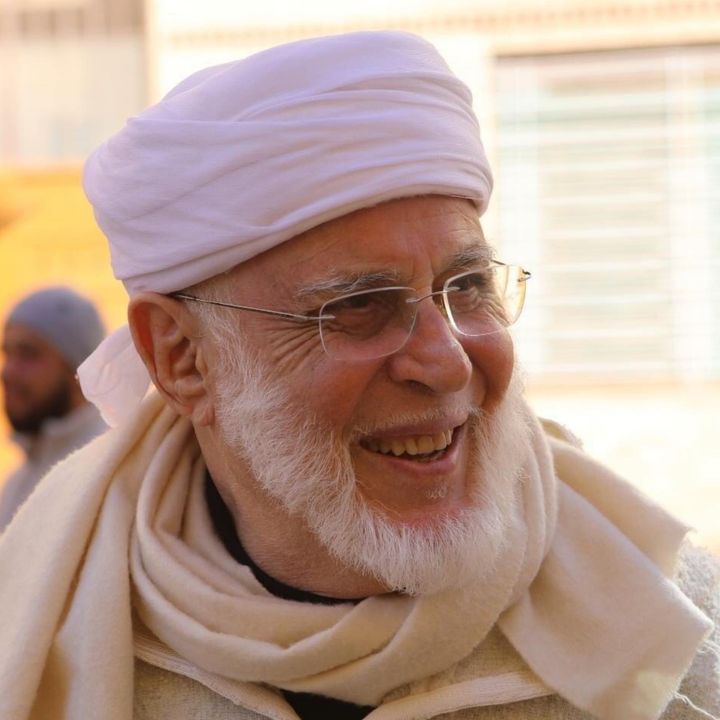
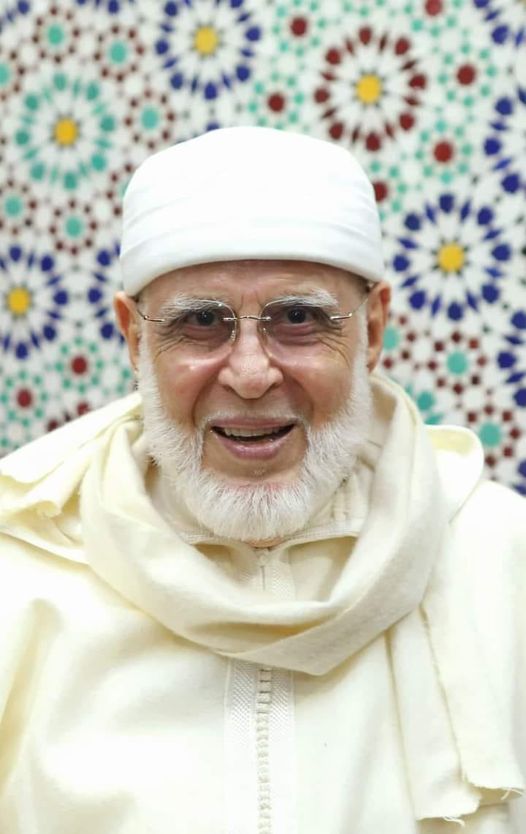
Tribute to Sidi Jamal al-Qadiri Butshish (2): the Qur'an, the sama' and the mudhakara
Contents
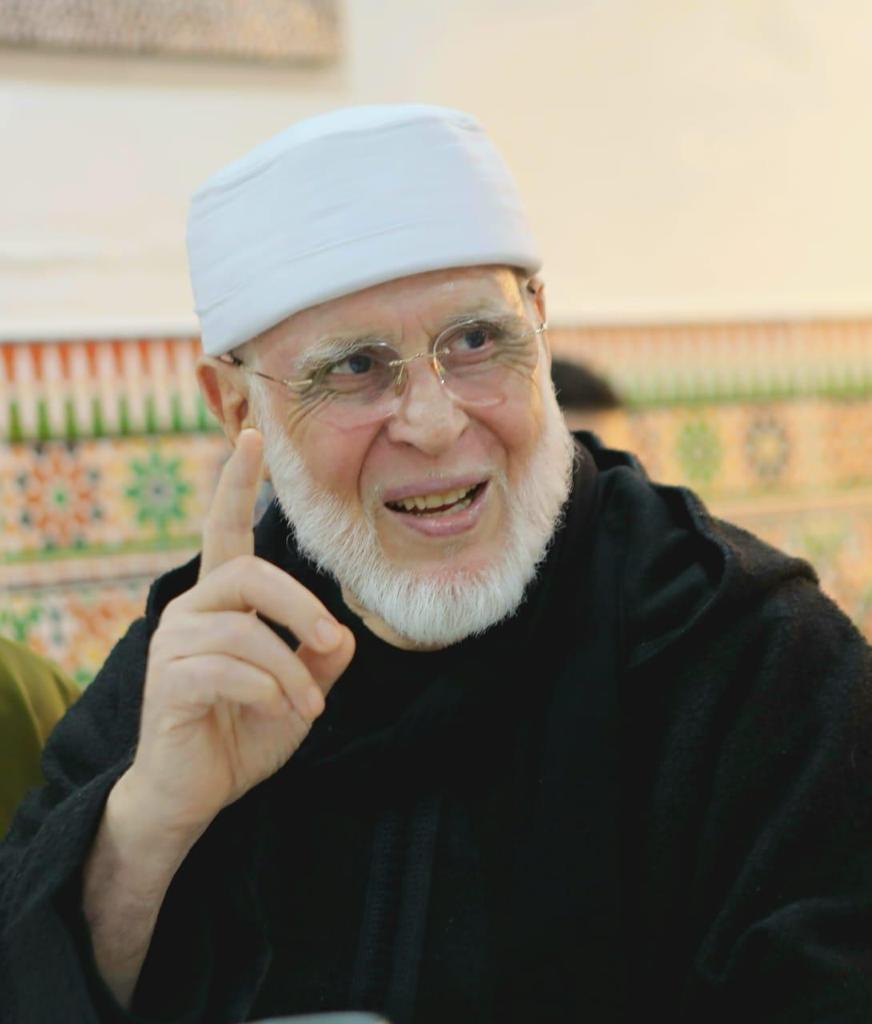
The Qur’an, a living presence
Sidi Jamal al-Qadiri Butshish’s attachment to the Qur’an al-karim was absolute: he did not approach it merely as a founding text, but as a living presence, an inexhaustible source of beauty, guidance and inner transformation. His whole spiritual life was ordered around this Book, which he recited with fervour, meditated with depth and contemplated down to its scriptural forms. The practice of calligraphy became for him a veritable visual dhikr: each letter appeared to him as the epiphany of a divine name, each stroke as the reflection of a transcendent reality. He summarised his hierarchical and mystical conception of the Qur’an in these terms:
’All the secrets contained in the revealed Books are found in the Qur’an: the Books given to Sayyiduna Musa and to Sayyiduna ‘Isa. All the secrets of the Qur’an are found in the Fatiha. The Fatiha is of immense worth. All the secrets of the Fatiha are found in the Basmala: Bismi Llah al-Rahman al-Rahim. All the secrets! And all the secrets of the Basmala are found in the ba’. Finally, all the secrets of the ba’ reside in the nuqta, the dot placed beneath the ba’.’
This vision belongs to the lineage of the Sufi masters: like Junayd, for whom the Sufi is ‘the one who takes the Qur’an as master and the Prophet as guide’, and Ibn ’Arabi, who saw in each letter a theophany, Sidi Jamal regarded the Qur’an not as a mere object of study but as a matrix of transformation of the being, calling for its wisdom to be interiorised into the depths of the heart.
The sama’, a pedagogy of the soul
Likewise, his love of the sama’ amounted to a genuine pedagogy of the soul. Far from being a merely aesthetic pleasure, he regarded listening to poems as an instrument of inner formation, capable of arousing spiritual states (ahwal). He affirmed:
‘The words of the saints bear multiple meanings. They rest upon al-mabna, the structure and the composition; al-ma’na, the profound meaning; and al-maghna, the melody and the rhythm. They spring from the hadra, the divine Source. The words of the saints are like those of the prophets, for they proceed from the hadra ilahiyya, the divine Presence.’
For Sidi Jamal, the Qur’an represented the revealed Word, matrix and norm of all spiritual orientation, whilst the sama’ was its inner resonance: a living speech, able to make buried truths surge back up in the heart. In this he joined Ibn ‘Arabi who, in his Futuhat al-Makkiyya (the chapter on sama’), affirmed that mystical listening reveals ‘the truest things’ (al-ashya’ al-ahaqq), for it brings back to consciousness what the soul already bears as a divine imprint. Qur’an and sama’ were thus not opposed but complementary: the first orients and structures the being, the second awakens its affective and existential dimension, so that both work together towards the purification of the heart and the awakening of spiritual depths. Sidi Jamal excelled in the art of establishing correspondences between the symbolic language of Sufi poetry and the primary sources of Islam. He could quote a mystical verse and then illuminate it with a Qur’anic passage or a prophetic saying, making manifest the unity between Revelation, spiritual tradition and the lived experience of the saints. For his disciples, every bit as fond as he of these secret resonances, each connection became a source of inner joy, like the assembling of a vast spiritual puzzle in which the scattered signs of the Divine fall into place.
No compulsion in religion
Sidi Jamal’s spiritual education was characterised by a demanding fidelity to the Qur’anic principle of spiritual freedom: ‘La ikraha fi l-din’, ‘No compulsion in religion’ (Qur’an II, 256). In the image of the Prophet (peace and blessings upon him), he welcomed each being in the state in which he found him, constraining nothing and imposing nothing, but gently inviting him towards a transformation that only has meaning if it is born of intimate consent. This welcome, of a disarming simplicity, stripped the soul of its masks and placed it in an inner nakedness that made it possible to receive the teaching as an act of pure freedom. His was the pedagogy of a master of unveiling: through a subtle word he revealed the shadowed zones of the heart, not to blame but to awaken, leaving each person the sacred freedom to respond or to turn away. In this he joined Junayd, for whom ‘what is taken by compulsion does not remain’, and Ibn ‘Ata’ Allah, who affirmed that ‘the fruits of effort only last when they proceed from an inner consent’. Meeting Sidi Jamal then became a space of grace in which the soul, in the secrecy of its choice, found itself called to be reborn.
The mudhakara, converse in the remembrance of God
Sidi Jamal’s initiatic pedagogy proposed an integral formation, uniting dhikr with the mudhakara, those gatherings in which master and disciples came together in the remembrance of God. For him, speech was always more than discourse: an effusion rooted in the Presence, capable of bringing the heart to life. He liked to recall:
‘Al-hadra, al-hadra, the words. The words of the men of God are the food of hearts. Through them the heart is quickened. The secret also resides in the mudhakara with the shaykh: they allow us to call the saints and the virtuous to mind; and when they are cited, a peace descends and the difficulties of the path melt away.’
Thus the mudhakara became for his disciples a collective dhikr, in which the evocation of the saints and inspired speech acted as catalysts of inner transformation.
Dhikr rooted in ethics
Sidi Jamal’s teaching placed dhikr at the heart of the spiritual journey: in particular the recitation of the awrad, the central invocation of divine unicity, ‘La ilaha illa Llah’, and the wadhifa. For him, as for his father Sidi Hamza, these gatherings were places of grace where hearts are polished and where the divine presence manifests itself more clearly. Dhikr thus became a genuine work of inner purification, by which the heart, freed of its veils, is transformed into a mirror of divine light. This practice was not detached from a demanding ethical frame: sincerity (ikhlas) in word and deed, daily examination of conscience (muhasaba), gentleness and kindness in relationships, love and respect for every creature. He stressed that dhikr could only bear fruit if it was rooted in observance of the shari’a and in following the Prophet (ittiba’ al-nabi), so that the remembrance of God might unify existence in all its dimensions. To repeat ‘La ilaha illa Llah’ whilst keeping falsehood, envy or jealousy appeared to him, therefore, as a contradiction. The one who invokes is called to purify his character, to shed vices and to clothe himself in the prophetic virtues, so that dhikr may fecundate the soul and translate into deeds. In this perspective, the awrad, the dhikr and the wadhifa are not mere rituals, but instruments of transformation that bring the Word down into life, until life itself becomes wholly an act of presence to God.
‘Strong and sound’: the last recommendations
So ends the account of an existence turned entirely towards God. We shall not forget, Sidi Jamal, your repeated counsel to place God foremost in our lives, to live each instant beneath His gaze. We shall not forget your discreet smile that soothed hearts, your gentleness that reconciled souls, your detachment that freed us from the illusions of this world. We shall not forget the frankness of your speech, your gaze inhabited by mercy, your refined adab and your constancy in service. And above all, dearest Sidi Jamal, we hold precious in our hearts your last recommendations, those you addressed to us on Friday 17 January 2025: to remain ‘strong and sound’, a call of striking relevance in these troubled times; to remember that the tariqa is above all a path of love; and to persevere towards the maqam of khulla, intimacy with God, the summit of the spiritual journey. Your word continues to resonate within us, like a compass orienting our steps towards that sacred intimacy.
By divine order, you entrusted the sirr, that spiritual secret, to your son and successor, Sidi Mounir al-Qadiri Butshish, may God be pleased with him, thereby ensuring the continuity of the guidance of souls towards their Lord. You told us that you were a shaykh nashat (joyful) and that you would make us nashat; we are intimately convinced that, as you announced, what follows will be glorious in God, under the luminous guidance of Sidi Mounir. To you, great one brought near to God, we do not say farewell but until we meet again, confident that this new chapter of the path will lead us to a still greater nearness to the One.
Further reading
- Tribute to Sidi Jamal (1): the master of poverty
- Sidi Jamal’s speech at the dikra 2025
- The spiritual testament of Sidi Jamal