'Sidi Hamza, the living saint': a portrait from the Moroccan press (2000)
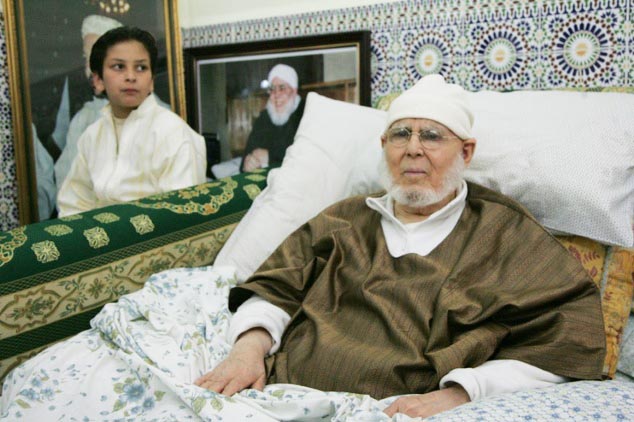
Article by Zakia Zouanat published in Le Journal (Morocco), issue of 27 May to 2 June 2000, reproduced from the tariqa.fr press review.
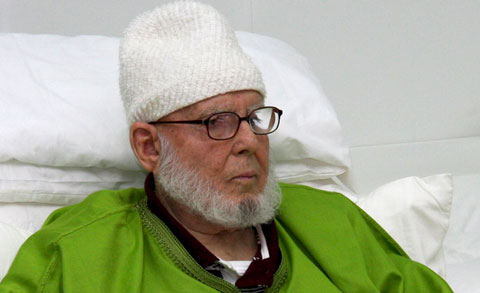
My fingers stumble over the keys of the keyboard. To speak of an exceptional person who rightly inspires a feeling of reverential awe makes my expressions uncertain. Of great simplicity, with a majestic bearing, a fresh complexion and a face dazzling with light, al-Shaykh Hamza al-Qadiri al-Butchichi, Sidi Hamza to the fuqara, his disciples, radiates the serenity of those who have cut their moorings to this lower world, and whoever has seen him once cannot forget him. He is like a living archetype, a survivor of the splendid times of our culture. Surrounded by his disciples, he recalls those miniatures depicting Jalal al-Din al-Rumi amid the Mevlevi dervishes. Let us look at the geographical and historical origins of this Sufi master who speaks to women with lowered eyes.
On a slope overlooking the verdant plain of Trifa, at the foot of the Bani Iznassen mountains, stands the Boutchichiya Qadiriyya zawiya of Madagh, where Sidi Hamza has received and educated thousands of disciples since succeeding in that mission his father Sidi al ’Abbas, who died in 1972.
On the wall of one of the zawiya’s rooms hangs a photograph taken from the magazine L’Illustration, dated January 1908, showing an old man of lordly bearing seated beside his horse. The man is Sidi al-Mukhtar al-Butchichi, Sidi Hamza’s grandfather, forced to lay down his arms after a fierce resistance to the French military penetration of the Bani Iznassen region. He is awaiting General Lyautey, with whom he is about to bury the hatchet. The document tells of the glorious past of the Butchichi family in the struggle against the occupier, and lays to rest the prejudices about “collaborationist marabouts”.
After this, the Butchichi, who owe their patronymic to the abundance of victuals in times of scarcity, leave the mountain where for six centuries they enjoyed the veneration due to the descendants of the great shaykh of Baghdad, Mawlay ’Abd al-Qadir al-Gaylani.
At Madagh, al-Shaykh al-’Abbas renews the quest of the ancestors alongside a great master of the path, Sidi Bu Madian al-Munawwar, of Darqawi affiliation, so scrupulous that he refused to eat at the table of the wealthy whose fortunes were doubtful, and known for his asceticism and orthodox rigour. In his company the young Hamza is initiated into Sufi doctrine and receives an abundant share of spiritual influx.
In Sidi Hamza one recognises a “Muhammadan heir”, a man with a doctrine, an ethic, a politics, an aesthetic, yet who remains elusive to anyone who does not enter his spiritual filiation, that grace which enables sinners to attain inner purity.
Sidi Hamza shares one driving idea with political doctrines: the aspiration to freedom. But where politics seeks to rise against man’s servitude to man, the preliminary work of Sufi doctrine aims to liberate the person from himself, from his weaknesses, his shortcomings, his ego; for the essence of the pact (al-musafaha) is an ontological and deontological responsibility.
To a hostile questioner who asked him “are you a man of God?” he replied “no. But I can show you a man of God among my companions.” A reply worthy of the wisdom of a great master, and an echo of the Sufi adage that only a saint can know a saint. In other words, there is no point in claiming sanctity in words before someone incapable of knowing it in essence.
Al-Shaykh Hamza places great hope in what has come to be called the new era in our country. He knows that he can now go for his check-ups in Casablanca, or visit his brothers and disciples in Paris, London or Montreal, without having to request authorisations, that his brotherhood’s gatherings will no longer be banned or followed by interminable interrogations, and that his disciples will no longer be dismissed from their jobs because of their affiliation. Gone are the abuses and the other oppressive practices endured by the members of the path in silence, under the yoke of a provisional freedom, notably since the breaking away in 1975 of the former disciple Abdeslam Yassine. For his part, Sidi Hamza asserts through his teaching that no deviation is to be feared, for he knows better than anyone that the last leader of the seventeenth-century Dila’iyya zawiya laid claim to temporal power only because he was not a perfect initiate in matters of spiritual authority.
Sidi Hamza’s work is an effort to bring up to date an ethic inspired by Sufism and adapted to the times: an ethic of stripping away, sobriety and detachment. Its perpetuation comes about through his disciples. Affiliated to the path, and whether neutral social actors or members of political parties, they are true regulators of the fundamental principles, even if programmes and models of development may divide them. Abhorring all conformism, Sidi Hamza asserts that “divergences over details are a grace”. The master of Madagh stands for the protection of women against abuse. In them he places great expectations for the propagation of the path’s principles. He stands for openness and comprehensive tolerance (al-was’). Perhaps the most eloquent illustration of this openness is that perception of mercy which shapes the ending of Ahmed Toufiq’s novel Jarat Abi Musa, inspired directly by lived experience of the path at the side of this master.
Like a master of the Hour, this octogenarian, whose freshness of mind fascinates the young and whom the weighty conventions of tradition cannot restrain, proves open to the novelties of the age. With him, all of Sufism accomplishes its mutation to become once again what it has always been: “the essential part”. For Sidi Hamza, who loves sacred song (al-sama’), the rigorously mastered “trance” is an edifying state, literally “imara”.
Knower (’arif) and sage, he fascinates the learned, who have faith in the eloquence of his inner silence and know in their spiritual intimacy that he holds that other science, the medicine of the maladies of hearts, the legitimate origin and support of sanctity in Islam. Beyond the contradictions of logos and intellect, he gives access to a truth that radiates over the being to draw it out of its uncertainties, gathering up its scattered pieces and restoring its original unity. Pure water offered to each according to the degree of his thirst. It is then for the seeker to accompany with his heart the master who has already made the journey. A method common to the great men of our spirituality, the near-mutes such as Abu Ya’za and the prolix such as Ibn ’Arabi. The disciples, in Morocco and elsewhere, of this man irrigated by the Names of majesty and beauty see in him the peer of such figures.
That is already a historical fact. In his proximity, it becomes natural to believe in the saint who makes you remember God, for he has that enveloping aura and that “power” which he himself likens to a gentle “chemotherapy” to which one must expose oneself to receive its effects.
His particularities are disconcerting. He is familiarity itself when he converses with the fellahs about the mandarin or artichoke harvests. And although his disciples recount his spiritual gifts (karamat) by the hundred, his own adage is that formula inherited from the great orthodox masters: “rectitude is the greatest virtue that can be attributed to a man of God. A true saint is truly alive only when he is dead… dead to his self.” Let anyone rival that who can!
Zakia Zouanat
Further reading
- Biography of Sidi Hamza
- The guides of the path
- The zawiya of Madagh and the Tariqa Qadiriya Boutchichiya