The universal dimension of Sidi Hamza
Contents
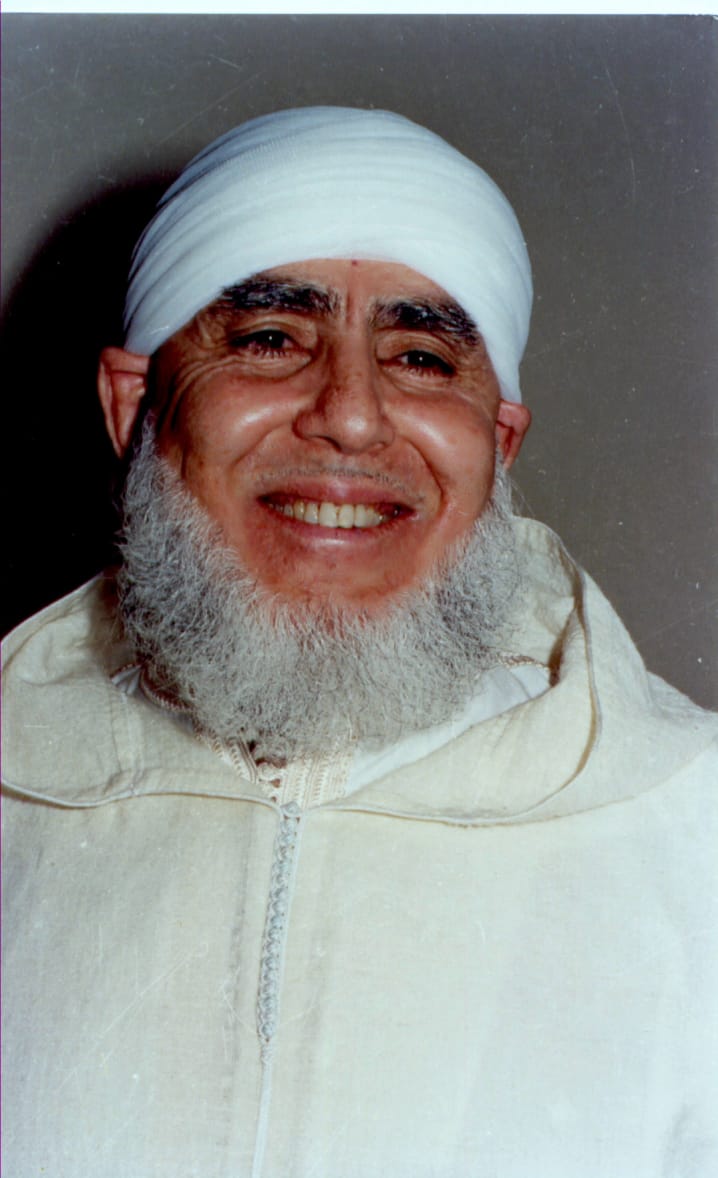
Sidi Hamza al-Qâdirî Bûtshîsh was born in 1918 in the small village of Madagh, in the Berkane region of north-eastern Morocco.
An education between the land and learning
He grew up in a climate of devotion and piety within the spiritual centre, the zawiya, founded by his forebears. Sidi ’Abbas (1890-1972), Sidi Hamza’s father, owned farmland and took his son to the fields every day so that he would grow used to working the land. From the age of seven, Sidi Hamza began religious studies at the zawiya of Madagh. At fourteen he had finished learning the Qur’an. He went on to Oujda to study grammar, Islamic jurisprudence, Qur’anic exegesis and the prophetic traditions (hadith). Back in Madagh, he deepened his book learning for a further four years under two great scholars from Fez settled at the zawiya. Sidi Hamza’s vast learning could have opened the gilded doors of the judiciary or of teaching, but worldly success mattered little to the brilliant student, who chose to remain with his family. In truth, from his earliest years he aspired to the quintessence of inner knowledge, which cannot be assimilated through books. His spiritual thirst was soon to be quenched by the encounter with the man who would become his guide, Sidi Abu Madyan (1873-1957), a distant cousin living humbly in the neighbouring mountains of the Beni Snassen.
Fourteen years beside Sidi Abu Madyan
In the course of 1942, Sidi Hamza undertook, following his father, to receive the direct teaching of Sidi Abu Madyan. Sidi ’Abbas was past fifty; his son, a young husband, had just turned twenty. Sidi Hamza’s case was in this respect an exception, for at that time one of the criteria for admission to the great Sunni brotherhoods (tariqa) was having reached the age of maturity, after first surmounting a number of preparatory trials. This peculiarity was the providential sign that a very particular destiny awaited the young man, and at the same time foreshadowed the transformations in the teaching that would come about once he himself became the guide of the tariqa. Sidi Abu Madyan left the mountains where he lived and accepted Sidi ’Abbas’s invitation to settle at Madagh. The outward conditions were thus brought together for a transmission of a subtle order to take place between the master and his two new disciples. For Sidi Abu Madyan was one of those great saints who had received the spiritual deposit inherited from the Prophet Muhammad, and whose teaching aimed to transmit it to whoever proved worthy of receiving that precious secret.
Sidi Abu Madyan had a great affection for Sidi Hamza and confided to him one day: ‘This love I have for you is the love the prophet Jacob felt for his son Joseph.’ Sidi Hamza stayed fourteen years beside Sidi Abu Madyan, sharing his meals and watching over his health. He followed every one of his master’s instructions to the letter and devoted entire nights to the invocation of the divine names (dhikr). During those years he tasted every stage of spiritual progress, up to the highest summits of the inner realisation of unity. After Sidi Abu Madyan’s death, Sidi Hamza became, together with his father, heir to the spiritual deposit. A respectful son and an accomplished disciple, he would nevertheless only take up the office to which he was destined at the moment willed by God, and in total respect for his father’s directions. Sidi Hamza therefore rooted himself in the path in a state of deep humility and a spirit of service, until the moment when he was authorised to take over the spiritual direction of the tariqa, on his father’s death, in 1972.
From rigour to mercy
If Sidi Abu Madyan’s path was placed under the sign of trial and rigour, Sidi Hamza’s unfolded around mercy and beauty. Likewise, if Sidi Abu Madyan’s teaching was destined for a handful of disciples, Sidi Hamza’s took on a broader, universal character. In the course of the 1980s, the modest zawiya of Madagh was transformed into a vast place of retreat, intended to welcome disciples whose numbers kept growing. Sidi Hamza supervised all the works, with constant care that the building project should keep pace with the new needs of a tariqa that was very soon to become the most dynamic spiritual path in Morocco, gathering thousands of new disciples, men and women from every section of society. The income generated by the zawiya’s farmland allowed new buildings to be put up and tens of thousands of meals to be prepared, served free of charge throughout the year to those who stopped over, drawn by the holy man’s reputation.
Since the 1990s, Sidi Hamza’s teaching has spread beyond the borders of Morocco. First impelled by Moroccan disciples living in Europe and America, the path gradually spread, and managed in particular to draw hundreds of people of non-Muslim faith, touched by a message stamped with authenticity, openness, respect and brotherhood. It has now taken on an international and universal dimension, measurable each year at the celebration of the birthday of the Prophet Muhammad (mawlid an-nabawi), which draws to Madagh tens of thousands of disciples from the four corners of the globe, as well as the media, attentive to the international reach of this spiritual gathering.
The last years
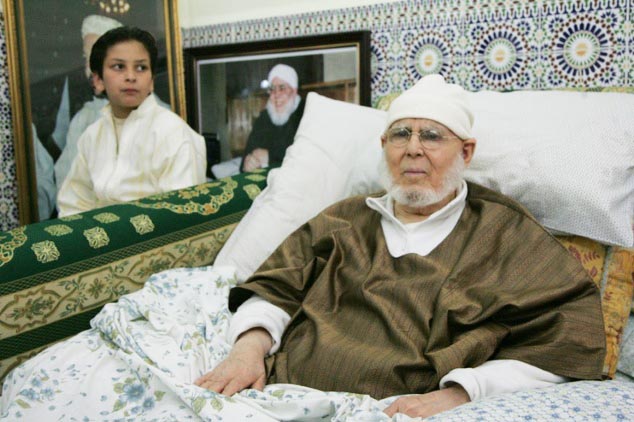
In the early 2000s, Sidi Hamza took up residence near Oujda, in the vast expanses of the Angad plateau, and travelled to Madagh occasionally to attend the main ceremonies. Despite his great age, he remained very active and received his disciples at home daily, who came to ask his advice or even simply to exchange a look. In his own words, it was from this relationship of companionship and from rootedness in daily practices that his teaching operated, a teaching that no book and no departed master could distil.
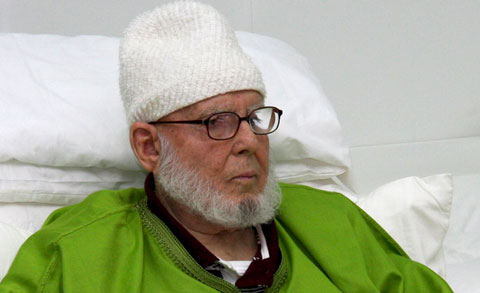
In the course of 2016, respiratory complications forced Sidi Hamza to remain bedridden most of the time. In December he was admitted to hospital in Oujda for intensive care. Remaining nonetheless at the head of the brotherhood, he continued to pass on instructions to his disciples, changing nothing of the posture that had been his throughout the 45 years of his spiritual guidance. On the morning of 18 January 2017, his heart ceased to beat, and he joined his glorious predecessors beside his Lord, having authorised his son Sidi Jamal to succeed him as holder of the spiritual secret.