'A Sufi sage amongst us': Faouzi Skali on Sidi Hamza (2000)
Interview conducted by Marc Boudet with Faouzi Skali, published in La Nouvelle Tribune (Morocco), 31 May 2000, reproduced from the tariqa.fr press review.
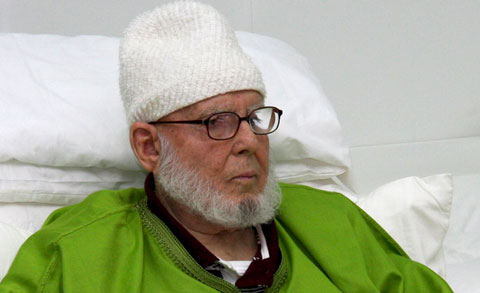
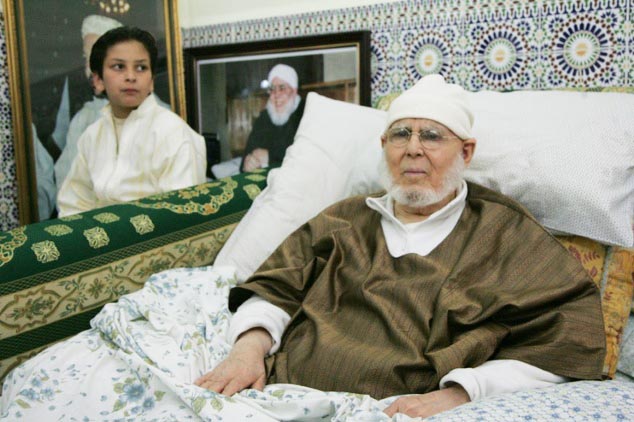
As the Mouloud (the Prophet’s nativity) approaches in mid-June, thousands of people make their way to the zawiya of Madagh to take part in prayers and invocations. We put our questions to Mr Faouzi Skali concerning the shaykh Sidi Hamza al Boutchichi al Qadiri, master of the brotherhood of the same name.
La Nouvelle Tribune: who is the Shaykh Sidi Hamza?
Faouzi Skali: for me and for the many people who follow his teaching, in Morocco and throughout the world, he is an authentic teacher of Sufism, in the vein of the great spiritual masters this country has produced through the centuries: Abou Medienne al-Ghawth, Moulay Abdel Assalam ibn Mashish, Abu al-Hasan al-Shadhili, to name but these.
What exactly, for you, are the criteria of such authenticity?
Sufism is that spiritual education which has produced men and women of great wisdom and profound sanctity, the figures I have just mentioned. One does not confer such a degree of accomplishment upon oneself. It requires the recognition of one’s own spiritual educator, and hence a place within a “silsila” (a “chain” of transmission of spiritual initiation); and of course the teaching such a person imparts must be recognised by the disciple himself, who feels its impact and influence in the depths of his being.
Who was Sidi Hamza’s Shaykh?
First of all his own father, Sidi el Hajj Abbas, and before that, Sidi Abou Medienne, whose disciples they both were for fourteen years.
Is the path or tariqa transmitted in a hereditary fashion?
No, since Sidi Abou Medienne could have designated one of his own sons as his successor; they were all his disciples at the time. In the event, Sidi Hamza simply proved to be the person best suited to that succession, which, incidentally, he never sought in any way. A written recommendation by Sidi el Hajj Abbas formally attests to this.
How do you explain that the Shaykh Yassine claims allegiance to Sidi el Hajj Abbas?
It is not for me to give an explanation of that. As I told you, there is a formal document on the subject, known to everyone. But in any case, that is not the real question. What matters most is that the Shaykh Sidi Hamza continues a teaching in the spirit of Sidi el Hajj Abbas’s, a teaching that champions above all a spiritual education, touching the hearts of individuals, particularly deep and effective, a teaching in the universal spirit of Sufism as bequeathed to us by al-Junayd and Hasan al-Basri.
Can Sidi Hamza be described above all as a scholar or a theologian?
For some twenty years he received a religious education, first at the zawiya of Madagh (near Berkane), then at a branch of the Qarawiyyin University in Oujda. He had prestigious masters, among them Sidi Bouchta Jamai, then in exile at Oujda, who was at once one of the greatest theologians of his day (at the Qarawiyyin, precisely) and a leading figure of the resistance (Sidi Hamza’s grandfather, Sidi El Hajj al Mokhtar Boutchichi, was, it must be said, a legendary figure of the resistance against the French occupation throughout the Oriental region). But once again, his true function, the one that distinguishes him as such, is to bring a spiritual education and “awakening” to persons and to an age eminently in need of them. This is what Ghazzali understood, some nine centuries ago, and did much to make others understand, he who was doubtless the greatest theologian of his time. For Islam to keep its breath and its meaning, there must cyclically be a spiritual regeneration, a profound understanding that gives access to the “heart” and the essence of religion, to grasp its true ends. Hence the title of his masterwork: “The Revivification of the Sciences of Religion”. It is this regeneration of spiritual understanding that we need more than ever today.
Do you think such teaching is compatible with our times?
Not only is it compatible; it is necessary. If, cyclically, there were no great saints in Morocco and elsewhere renewing this spiritual, and therefore living, understanding of our religion, the latter would long since have been reduced to an ideological system used at the whim of interests or circumstances, instead of being a genuine model of self-fulfilment, that is, of education, ethics and, ultimately, culture. This spiritual necessity is, incidentally, universal. It is what explains the worldwide interest there is today in Sufism, perceived as the living heart of Islam.
Is Sidi Hamza, for you, the model of the Sufi shaykh?
A model, certainly, but above all a teacher of wisdom. He does not teach only by what he says, but essentially by what he is: his humility, his compassion, the depth of his faith, which make us love Islam deeply and allow us to discover its “hidden treasures”.
Sidi Hamza at a glance
1918: born at Madagh (Berkane), where the brotherhood’s mother zawiya currently stands
1942: theological studies at Madagh, then at the Qarawiyyin branch of Oujda University.
1942: he follows the teaching of the Master of the Qadiriyya, Sidi Abou Medienne, alongside his father, Sidi al Hajj Abbas.
1957: death of Sidi Abou Medienne.
1972: death of Sidi al Hajj Abbas.
1972: Sidi Hamza becomes the Shaykh at-Tarbiyya (of spiritual education) of the Tariqa (path, brotherhood) al Boutchichiya al Qadiriyya.