Tribute to Sidi Jamal al-Qadiri Butshish (1): the master of poverty
Contents
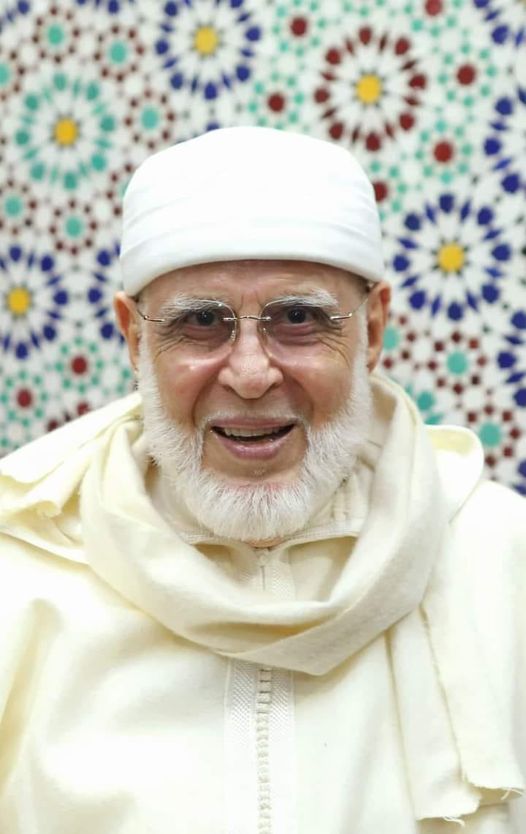
Sidi Jamal al-Qadiri Butshish, may God sanctify his secret (1942-2025), marked the spiritual life of thousands of disciples in Morocco and throughout the world. His recent departure has left a wound still raw in hearts, soothed only by the certainty that he is now in divine peace beside the Prophet, peace and blessings upon him, and his father, Sidi Hamza, may God sanctify his secret. Heir to the Qadiriyya Boutchichiya path, he knew how to combine rootedness in the unshakeable foundations of Sufism with a living pedagogy attentive to the spiritual aspirations of his time. Trained in the initiatic space of the zawiya of Madagh beside his grandfather Sidi Hajj al-’Abbas and his father Sidi Hamza, he took his place within a tradition of transmission in which continuity did not oppose renewal but was its very breath. Conscious of receiving a sacred deposit, the sirr, he assumed its charge not as an appropriation but as a service, reminding us by his attitude that the true master is never the owner of the grace transmitted but the humble mediator of its circulation: ‘The endurance of this blessed path bears witness to the solidity of the foundations laid by our pious forebears, and to the continuity of a sacred heritage handed down through a golden chain reaching back to the Prophet, Sayyiduna Muhammad (peace and blessings be upon him). This precious deposit, borne with faithfulness and dignity, remains a divine light that illuminates souls and purifies hearts.’
An education between Madagh, Fez and Rabat
Sidi Jamal’s education plunges its roots into the spiritual world of the zawiya of Madagh, the founding house where he memorised the Qur’an and received his first initiations into the sciences of inner purification. His intellectual journey, harmoniously combining the two languages of culture, Arabic and French, brought together the learning of the religious sciences and the disciplines of general education, placing his training within two traditions of knowledge at once. At the Moulay Idris lycée in Fez, he benefited from the demanding teaching of the faqih Idris ibn al-Mahi al-Idrisi, whose methodological rigour and juridical ethics left a lasting imprint on his disciples, as well as from the humanist influence of Sidi Mohamed Belkhiat, a man of letters. At the faculty of shari’a in Fez, he was introduced to the subtleties of ’ilm al-fara’id by Sidi al-Ghazi al-Husayni and to the methodology of comparative fiqh by Sidi ’Abd al-Karim al-Da’udi, thereby acquiring an intellectual discipline founded on rigour of argumentation, a sense of justice and openness to the different schools of legal thought.
Finally, at Dar al-Hadith al-Hassaniyya in Rabat, a leading centre of learning devoted to the sciences of hadith, he obtained a higher diploma with a critical edition of the manuscript of Abu Salim al-’Ayashi, before defending in 2001 a state doctorate devoted to ‘The institution of the zawiya in Morocco between tradition and modernity’.
The complete intellectual
Sidi Jamal held the sciences, religious and human alike, in deep esteem, regarding them as an extension of worship: for him, study was a form of dhikr, a remembrance of God through the intelligence. His library, at once rich and varied, gathered the great classics of tafsir, fiqh and Sufism, but also modern works, a sign of his concern to think spirituality within the context of his time. An assiduous reader, he made reading an exercise of inner discipline: he would meditate each page and extract from it intuitions which he noted on small slips of paper, as though tracing the living memory of his spiritual quest. Thanks to a training that combined law, grammar and the religious sciences, and enriched by a sociological eye and a vast general culture, Sidi Jamal embodied the figure of the complete intellectual. His erudition, though solid and deep, showed itself with great simplicity, so that his knowledge illuminated without ever seeming ostentatious.
An integral spirituality
Sidi Jamal’s life stood as the living embodiment of an integral spirituality, in which every gesture of daily life became a mirror of the prophetic sunna: teaching with integrity, providing for his own, serving the community and tirelessly pursuing the inner struggle against the ego. A schoolteacher and later an inspector of Qur’anic schools, he regarded his profession as an implicit act of worship, a way of making education an act of devotion. Beside his father, Sidi Hamza, he worked at the management of the zawiya as one builds a space of brotherhood and service, in the image of Medina, the first city of Islam. His inner vigilance remained constant: daily examination of conscience, scrupulousness (wara’) in deeds and words, care for coherence between being and seeming.
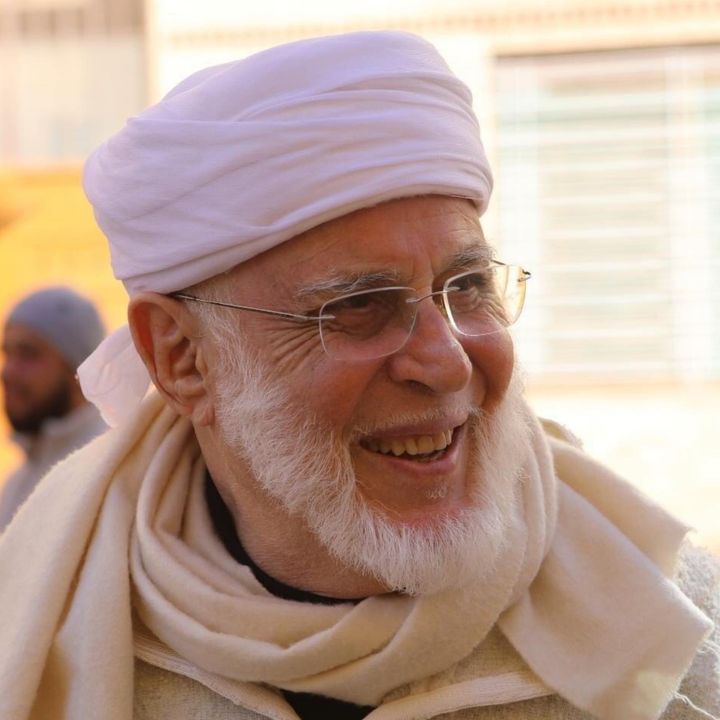
His personality combined humility, gentleness and inner nobility. His speech, of a luminous frankness yet always devoid of hardness, went straight to the essential: purify the heart, invoke God, love one’s neighbour and prepare for the encounter with the hereafter. His discreet, perpetual smile reflected an inner peace and recalled the prophetic teaching according to which a smile is a form of charity. In his bearing he displayed an adab of rare refinement, an inhabited elegance revealing the delicacy of the heart and the harmony of the soul. Even his appearance took part in this silent pedagogy: his clothes, sober and harmonious, expressed a spiritual aesthetic: white, sign of purity and light; black, evoking gravity and recollection; grey, the symbol of balance and sobriety.
The maqam of maskana
The keystone of Sidi Jamal’s spiritual personality lay in the maqam of maskana, which he did not content himself with teaching but of which he was the living embodiment, radiating through the whole of his existence and his speech. Maskana, derived from the Arabic root s-k-n, which evokes rest, tranquillity and appeasement, designates in the Sufi tradition a voluntary poverty before God, an ontological humility that strips the ego of its pretensions and establishes the heart in an absolute dependence on the Real. Junayd defined it as ‘the soul’s resting in submission and poverty towards God’, whilst al-Qushayri, in his Risala, described it as the intimate awareness of the constitutive weakness of the created being. Sidi Jamal’s posture belongs explicitly to this lineage, prolonging that tradition through a contemporary enactment.
In a speech addressed to his disciples in November 2019, he declared:
‘Bear witness, all of you, dhakirin and dhakirat, that I am poor, that I love the poor, and that I have chosen to wear the garment of poverty. A garment that does not pass away, that does not wear out and is not taken off. And this since my youth, for the maqam of poverty (maskana) is among the highest degrees. I advise you to be poor in your conduct and rich through your Lord. Be rich in outward appearance (zahir) and poor within (batin).’
Thus, for Sidi Jamal, maskana was not merely one spiritual station among others, but the ethical horizon that informed his counsel and his conduct, articulating interiority and exteriority, self-effacement and wealth in God. In a world marked by the excess of ego and the obsession with possession, this teaching comes across as a call to recover a humble interiority, a sobriety of the heart and a living relationship with the divine.
Detachment and the gaze of mercy
Sidi Jamal was distinguished by a total detachment, the true central axis of his spiritual life, which pervaded the whole of his conduct. His behaviour never let the slightest touchiness or the faintest inner agitation show through: even when propriety seemed put to the test, he kept an unalterable serenity. This detachment owed nothing to indifference; it expressed a rare inner freedom, in echo to the prophetic saying: ‘He who humbles himself for God, God raises up.’ His heart, entirely oriented towards the Divine, remained impermeable to the fluctuations of human gazes and to the variations of opinion.
This attitude found its balance in a gaze inhabited by love and mercy. Sidi Jamal did not let himself be enclosed by outer forms or apparent defects; he knew how to discern the inner beauty and the potentiality of light deposited by God in every being and every situation. His vision, transfigured by the divine presence, unveiled a horizon of meaning that exceeded mere sensory perception. This twofold movement, detachment from circumstances and contemplation of divine potentialities, constituted a silent pedagogy, yet one of deep spiritual efficacy, inviting each person to go beyond appearances and reach the essential.
Further reading
- Tribute to Sidi Jamal (2): the Qur’an, the sama’ and the mudhakara
- Sidi Jamal al-Qâdirî Bûtshîsh
- The spiritual testament of Sidi Jamal