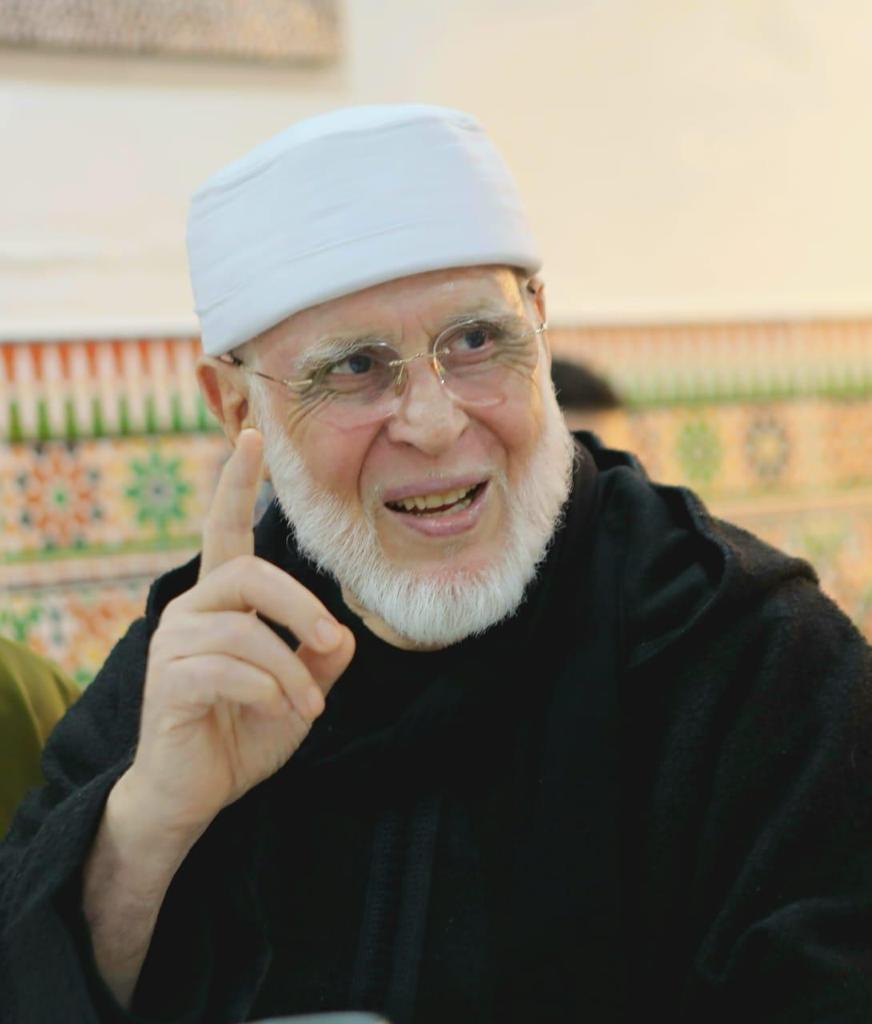
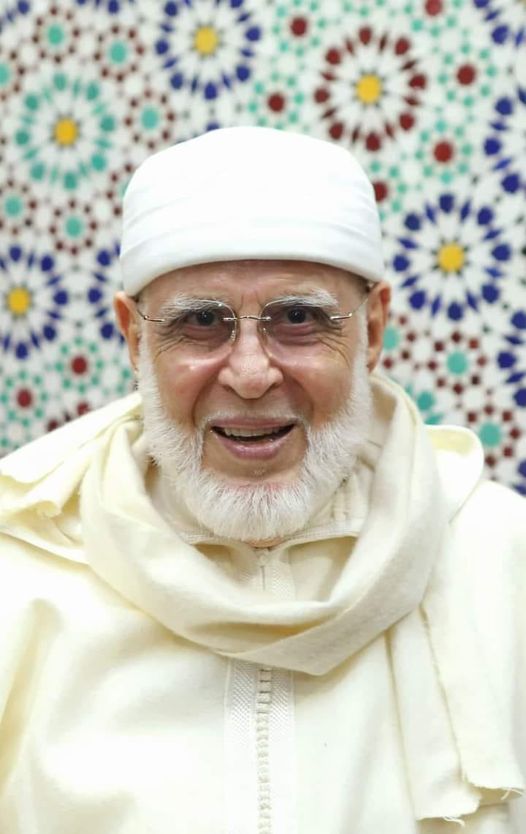
Sidi Jamal, the master of beauty (1942-2025)
Contents
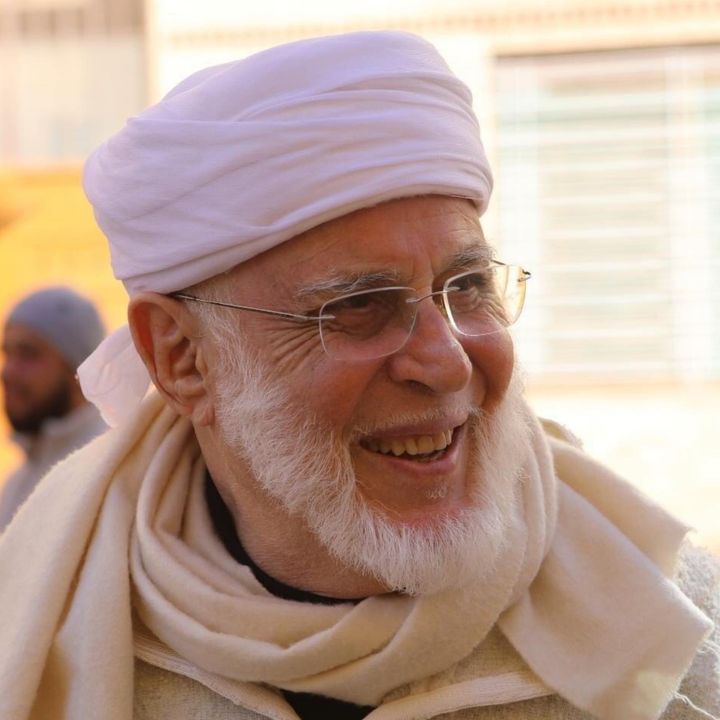
Childhood at Madagh
Sidi Jamal al-Qadiri Butshish (1942-2025) was the eldest son of Sidi Hamza (1918-2017). He was born at Madagh, near Berkane in eastern Morocco, in 1942, the very year in which his father and his grandfather, Sidi Hajj al-’Abbas (1890-1972), began their initiation into the Sufi path under the shaykh Sidi Abu Madyan (1873-1957). Sidi Abu Madyan had himself inherited the spiritual secret from several masters, notably of the Shadhiliyya and Tijaniyya paths; at the invitation of Sidi Hajj al-’Abbas, he settled at Madagh, in the spiritual centre (zawiya) founded in the early twentieth century by the ancestor Sidi Hajj Mokhtar (1853-1914).
Throughout his childhood, Sidi Jamal was nourished by the light of these men, whose ardour in the quest and exceptional spiritual station constituted a peerless model. His grandfather bore him a very great love and granted him the favour of remaining in his intimate entourage until his death. Sidi Jamal thus stayed in his service, attentively watching over his slightest need. At the same time, he learnt the Qur’an and the Islamic sciences at Madagh, then went to the Moulay Idris secondary school in Fez to perfect a complete education in Arabic and French. He then followed the teaching of several scholars in jurisprudence (fiqh). This deepening of traditional knowledge was crowned by a state doctorate, which Sidi Jamal defended in 2001 with a thesis entitled ‘The institution of the zawiya in Morocco between tradition and modernity’. In this work he pleads for a renewal within the institution, so that it may be equal to contemporary challenges and recover its former radiance.
In his professional career, Sidi Jamal was a French teacher, then an inspector of Qur’anic schools in the province of Berkane. He always cultivated a taste for transmission, observing that it reaches excellence when love and respect ground the relation between teacher and pupil.
The designated heir
In October 1990, Sidi Hamza drew up his spiritual testament, in which he clearly states that Sidi Jamal is his spiritual heir:
‘Through the guidance of love and companionship, Allah has gathered into this path those He wished to favour. Among the manifestations of His largesse and generosity is this pure tree that shelters us with its shade: the tree of spiritual gathering dedicated to the invocation and remembrance of Him alone. Among His favours is the planting of this tree in the Qadiriya Boutchichiya soil by our master Sidi Abu Madyan. He then prescribed the authorisation to our father, who tended it until this tree grew vigorous. He died after authorising us to carry on and expand the path, in constant veneration of this permission. We attest before Allah that the authorisation we hold to teach the remembrance of Him on the way of humility will be transmitted after our death to our approved son Sidi Jamal, and then, after him, to his favoured son Sidi Mounir.’
In the early 2000s, Sidi Hamza settled at Naima, 100 km south of Madagh, and entrusted Sidi Jamal with the task of seeing to the smooth running of activities within the brotherhood’s spiritual centre. Thus it was, notably, that Sidi Jamal took part every Saturday at the zawiya in the evenings of sama’ (litanies and spiritual songs). On every occasion he showed himself ever available and benevolent in welcoming and counselling the disciples of the path who came to stay for a while at the zawiya.
Sidi Jamal performed the pilgrimage to Mecca and visited the disciples in the great cities of Morocco, as well as in the various zawiyas existing in Europe (notably in France, Belgium and the United Kingdom). He took constant care to supervise the construction of new buildings at Madagh, in order to meet the ever-growing need for accommodation. He supported and presided over the World Encounters of Sufism (Rencontres mondiales du soufisme), organised by his son Sidi Mounir on the occasion of the celebration of the Prophet Muhammad’s birthday (peace and blessings upon him). This event gathers specialists in Sufism from every continent each year, and constitutes one of the many opportunities for the madih and sama’ ensemble formed by another of his sons, Sidi Mu’adh, to perform. This choir, made up of disciples of the Tariqa Qadiriya Boutchichiya, excels in the a cappella interpretation of sama’, which it offers throughout Morocco and elsewhere at spiritual concerts.
The guide of the brotherhood (2017-2025)
In January 2017, on the death of Sidi Hamza, Sidi Jamal became the spiritual guide of the brotherhood, confirming that he was henceforth the holder of the spiritual secret (sirr) he had inherited from his father. This succession took place smoothly and serenely, the disciples renewing with him the initiatic pact they had taken with Sidi Hamza.
As a tribute to his father, Sidi Jamal had a vast mausoleum built at Madagh in the immediate vicinity of the existing cemetery, whilst completing the major works on the great mosque, able to hold ten thousand worshippers, and on the future university, intended to provide courses in the Islamic sciences through specialists recognised for their competence.
From the outset, Sidi Jamal continued the spirit of Sidi Hamza’s teaching and his principles of spiritual education. He laid particular stress on the need for his disciples to practise invocation (dhikr) assiduously, particularly the repetition of the testimony of faith ‘La ilaha illa Allah’, so as to purify the heart and fight the only enemy worth fighting: our own ego. He helped to unify and gather souls, so that universal love might spread in consciences and in deeds.
Sidi Jamal likewise put forward the values of service to God and to the path, of generosity and excellence of conduct. He exhorted all disciples to behave as ‘good citizens’ and to respect the laws of the country in which they live.
On a more inward plane, he insisted on the function of the educator master (shaykh at-tarbiyya), able to purify and transform hearts, and on the relation of spiritual love uniting the guide with all the disciples.
The transmission to Sidi Mounir
Through his testament drawn up at Madagh on 5 December 2024, then publicly at the dikra of 2025, Sidi Jamal designated his son Sidi Mounir as heir to the spiritual deposit of the path, taking up the very words Sidi Hamza had addressed to him: ‘What I hold, Sidi Mounir also holds.’ Sidi Jamal rejoined his Lord in August 2025; the guidance of the brotherhood now falls to Sidi Mounir, according to the unbroken chain of transmission of the path.
Further reading
- Tribute to Sidi Jamal (1): the master of poverty
- Tribute to Sidi Jamal (2): the Qur’an, the sama’ and the mudhakara
- Excerpts from Sidi Jamal’s speech, mawlid 2024