Sidi Hamza, or the living teaching
Contents
From the twelfth century onwards, Sufism came to express itself through the brotherhoods, known as tariqa, ‘the path’. Founded essentially on the notion of companionship, the tariqa is organised around a spiritual guide whose disciples come to receive his teaching. The very meaning of the tariqa rests on this educational relation. The guide is recognised as such by his high degree of spiritual realisation, which legitimises his position as an educator, while the disciple is recognised by his desire to ‘walk’ in the way of inner knowledge. The guide’s role is to ‘take by the hand’ those who so wish, men and women alike, and lead them towards God. From then on, Sufism is no longer the austere practice of early Islam, lived in solitude and want, for it offers itself as a workable support for meditation in the world.
The radiance of a presence
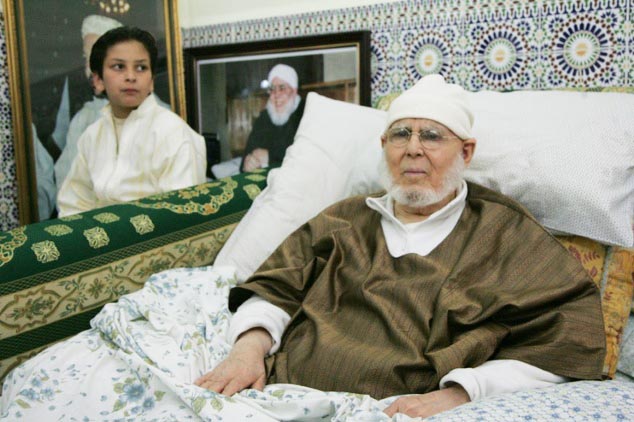
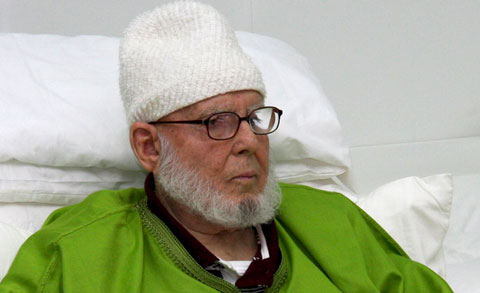
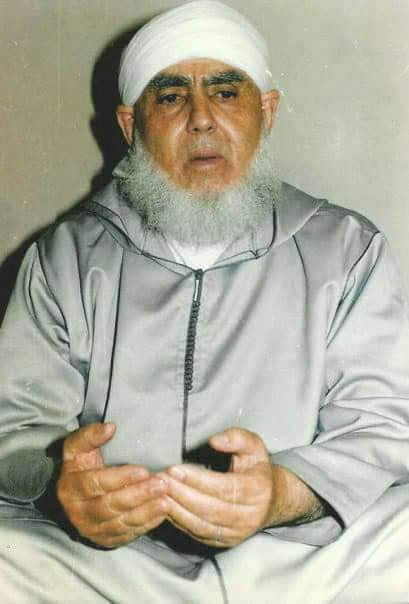
The first brotherhood organisation goes back to ’Abd al-Qadir al-Jilani (1077-1166), around whom the Tariqa Qadiriyya was founded. Sidi Hamza al-Qadiri Butshish, born in Morocco in 1918, is his direct descendant, both by blood and by initiatic affiliation. After theological studies in Oujda, Sidi Hamza was only 19 when he met a great mystic, Sidi Abu Madyan (1873-1957), who became his spiritual guide and that of his father, Hajj ’Abbas (1890-1972). After fourteen years of companionship with their master, Sidi Hamza and his father reached the highest summits of spiritual experience and became themselves able to transmit this education. On the death of Sidi Abu Madyan, the guidance of the brotherhood fell to the father for some ten years, then to the son, Sidi Hamza, in 1972.
Those who met him acknowledge him as a singular being, who impressed them not only by his imposing stature, but above all by the intense light radiating from him and the infinite kindness of his gaze. Two of his disciples could say of him:
‘His face was alight; his gaze had the depth of a well. He stood there, towering over the whole assembly. He was a man unlike any other: the first time I saw him, I knew nothing of his spiritual dimension, and yet, with the naked eye, the difference from the others was plain to see’.
‘When I saw Sidi Hamza, his face shone so brightly that all I could see were his eyebrows, whose dark colour stood out against the rest. Any poetic comparison of that face to the moon falls short of describing the radiance in question’1.
The place of invocation
Sidi Hamza’s teaching is marked by a renewal of spiritual education. ‘The Sufi is the son of his moment’, says a Sufi adage. Sidi Hamza illustrates this by adapting his educational method to the conditions of our age, so as to meet the challenge of re-enchanting hearts in an ever more dehumanised world.
A first step, then, was to lighten spiritual practice. Previously, in the setting of classical Sufism, practice often included the wearing of an austere garment, frugal food and, sometimes, retreats of several months cut off from the world. These were exercises aimed at purifying the heart and mastering the ego. In Sidi Hamza’s path, purification and transformation of the soul remain very much present. The chosen instrument for achieving them, however, is the practice of invocation, individual and collective. The individual practice consists in telling one’s beads at home, morning and evening. This is the daily invocation of the wird2, a word which can be rendered as ‘the drinking’. Like a beneficent water, the morning and evening ‘draughts’ let the disciple taste the flavours of the path. This experience is deepened at the collective gatherings, which include invocations aloud, spiritual teachings and, to close, songs. Songs hold a very important place in this brotherhood: not only is their poetic content a teaching aid for the disciple, but the singing itself touches the infinite spaces of his being.
From time immemorial, the spiritual education offered by the Sufi brotherhoods has been a complementary space to the official educational system. The role of the official institutions, known as the madrasa, has been, down to our own day, to develop the faculties of understanding the sensible world through the tools of reason. The brotherhoods, for their part, have allowed the grasping of the inner world to develop through the purification of the heart.
‘There is an organ, said the Prophet of Islam, which, when it is made sound, allows the whole body to be sound and, when it is corrupted, brings about the corruption of the whole body. That organ is the heart.’ The whole of Sufi ethics takes its meaning accordingly. This ethics does not rest on a theoretical set of values, but on the transformation of the being, made possible by spiritual exercises and guidance. It is rooted in the divine breath borne within the son of Adam. The good, the beautiful, mercy and love then become outpourings of the being transformed by meeting his Beloved.
Beyond the outward identities, there is an identity to be discovered. Behind the appearance of multiple identities lies a spiritual identity to be realised. It is a question of finding that identity within oneself and seeing it in others, so that ‘beautiful conduct’, as the Sufis call it in the manner of the Prophet, may spread.
Purity of the gaze
In the days of classical Sufism, access to a spiritual guide’s teaching was reserved for an elite. The renewal breathed in by Sidi Hamza opened the doors to anyone sincere in their quest for the sacred. The expansion of spiritual awakening that follows from this is a great wealth for humanity. In a context of globalisation and pluralism, indeed, a behaviour of beautiful conduct, as the Sufis teach it, is essential to building harmonious relations. In this light, Sidi Hamza’s brotherhood contributes to the blossoming of living together through spiritual education, inviting each person to respect others and to devote their critical faculties to unmasking the ruses of their own ego. Such is the teaching delivered by this saying of Sidi Hamza: ‘Despise neither Jew, nor Christian, nor atheist! Be vigilant, on the other hand, towards your own ego, for it alone is truly your enemy.’
Here, too, is a handful of sayings from Sidi Hamza, who tirelessly invites us towards that presence of the divine consciousness within us:
‘The saint sees the good in every man, in accordance with his true nature. He sees each being in its essence.’
‘We are all of the same essence. We are all of one light; there is no distinction, there is only union.’
‘Fault and ugliness are not in things and beings, but in the impurity of our gaze upon them.’
The relation to unity takes place in a direct relation of the living to the Living. Yet such a perception can only come about through a synthetic grasp of creation. Thus creation, itself alive, takes part in the spiritual symphony attesting to a single God. But the tragedy of the human being is that the world’s appearance veils from him the unifying presence, in every thing, of the divine Essence. The soul, tyrannised by certain aspects of the world, finds a true healing in the spiritual perspective of Islam, of which Sufism, the ‘heart of Islam’, is the expression. The sacred effluences of spiritual practice purify the gaze and direct it towards that synthetic vision of creation, beyond its diversity. For only such a purified gaze can guarantee an authentic respect for the other, that other who is, in reality, nothing but myself.
Karim Ben Driss

Further reading
- Sayings of Sidi Hamza on the wayfaring and the heart
- The universal dimension of Sidi Hamza
- The spiritual testament of Sidi Hamza
Footnotes
-
This testimony alludes to a Sufi poem that attempts to describe the face of the Beloved: ‘I saw the crescent moon and the face of the Beloved. Two heavenly bodies appeared to me and I do not know which of the two annihilated me: the lunar crescent or the human face.’ See on this subject: K. Ben Driss, Le renouveau du soufisme au Maroc, éd. Al Bouraq/Archè, 2002. ↩
-
A Sufi ritual consisting in repeating divine names under one’s breath, certain Qur’anic formulas and prayers upon the Prophet. It is specific to each brotherhood, which lays down its various modalities of application. ↩