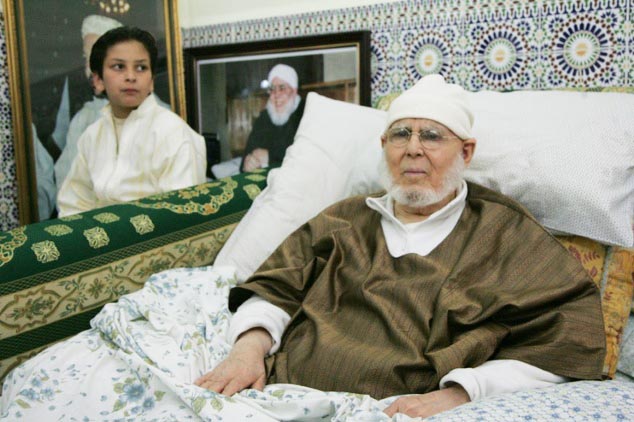
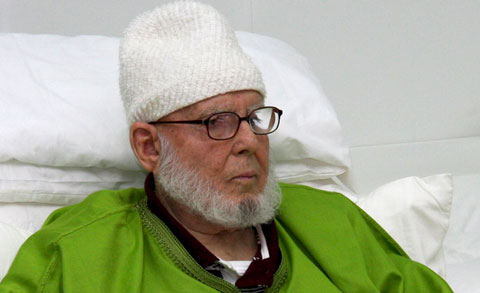
The spiritual testament of Sidi Hamza
Contents
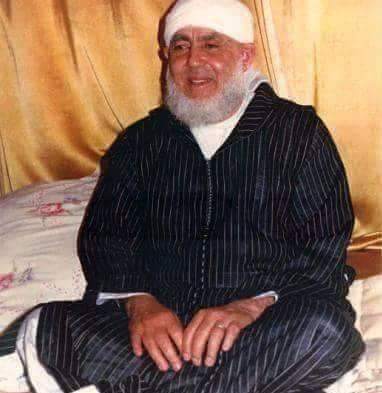
Drawn up at Madagh on 3 October 1990 (12 Rabi’ al-Awwal 1411 of the Hijra), this testament of Sidi Hamza officially designates his son Sidi Jamal to succeed him, and after him his grandson Sidi Mounir. The full text follows.
In the Name of the Clement, the Merciful
A blessed testament.
Praise be to Allah, Lord of the worlds, and prayer and peace upon Sayyidina Muhammad, the faithful Prophet and guardian of the Deposit, the mercy offered to the worlds, the best guide until the day of resurrection and judgement, upon his purified family and progeny; and may Allah be pleased with all the conscientious scholars who invoke Allah abundantly, among the multitude of authorised elect and the group of (Muhammadan) heirs.
The path that guides towards Allah, and the way that leads to Him through the teaching of invocation, is (for the gnostics, through all its stations) the straightest of paths and the clearest of itineraries. For those who have tasted the delights of faith, it is the greatest guidance and the most successful of methods. It is in the path that the veils are lifted from the hearts of those affiliated to it, and it is there that troubles vanish. It is through the path that one attains, within the precinct of Subtlety and Protection, the stations of the pure. It is by way of the path that one reaches the knowledge which enables one to worship Allah truly, with a sincerity cleansed of cares. After all that comes after, unto infinity, there is no existence but for Allah; and before all that came before, until there is no more knowledge (consciousness), there is no existence but for Allah. In the ocean of oneness, individualities are effaced and egotisms buried. In the presence of the Muhammadan Essence, the rights of servanthood towards Allah are confirmed: the Unique, the One, the Supreme and Efficient Refuge. It is incumbent upon the humble servant Hamza Ibn al-’Abbas al-Butshishi al-Qadiri to give thanks, to thank the Thankful, and by means of this gratitude to proclaim publicly a fragment of what the innermost soul holds, so as to praise and thank the Lord of favours, thus submitting to the divine law and making manifest [this blessing of Allah] through the wisdom of clear expression. Praise be to Allah for the ‘inner’ meaning of worship that He has bestowed upon us, and for that of which He has made us inheritors: the function of guidance, in order to set hearts on the right way and raise them until they end by attaching themselves to Him alone. And that is a favour and a grace of God the Most High: ‘the gifts of your Lord are not limited’ (Qur’an XVII, 21).
Happiness be yours, and congratulation on the approval of Allah and His satisfaction with the repentance of fathers and grandfathers, and on the generosity of the people of certainty, the truthful and the people of endeavour. A favour (an excellent reward) coming from Him, may He be sanctified and blessed: by His mercy He has prescribed inheritance, for the living, of material riches. It would not be beyond Him, glory be to Him, to prescribe under the same condition this inheritance where subtle riches are concerned (the spiritual secret deposited in the heart).
The authorisation received from his father
Good tidings already announced by our father (may Allah take him into His mercy) have been confirmed, praise be to Allah. Allah favoured our father in the authorisation he had granted us and singled us out for, and for which he had our brothers the Fuqara bear witness. This, after being evoked by allusion, was done explicitly, and finally in writing, in a testament recorded according to the rules in force. This authorisation was clearly seen, and the believers saw it spring forth in abundance, amid blessings and lights. It was not slow to blossom and spread, enabling diverse groups of men and women, older and younger alike, in countries near and far, to gather its fruits. These same people have revived the path according to its proprieties and have known happiness thanks to it, for Allah granted them the revivification of the rites of belonging to invocation (dhikr) according to its ends. All this in an ease commended by the Sunna, and a coming closer that answers to the conditions of our age and saves the community. The path eases the way of repentance (return to God), and helps to accomplish what He has legislated for us concerning the pillars of religion; it allows one to adorn oneself with the virtues of rectitude and divine approval. Through the guidance of love and spiritual companionship, Allah has gathered into this path those He wished to favour, making them yearn for His Face and attain, through that companionship evoked in the holy Book, the reward of subduing one’s ego and remaining faithful to the pact or oath (’al-‘Ahd’ in Arabic). This reward has manifested itself, sometimes in the tastes of realisation and excellence, sometimes in the sciences of the understanding of the Book and of faith, sometimes in a spiritual state among the states of virtue, piety (reverential fear) and serenity. Among the manifestations of His largesse and generosity, may He be exalted, and among His favours in the beginning, the completion and the perfection, is this purified tree beneath whose shade we shelter: the tree of spiritual gathering for the invocation of Allah. Among these manifestations and among His favours is that the planting of this tree in the Boutchichiya Qadiriyya soil had been renewed by our master and cousin Sidi Boumédienne Ben Lemnaouer, before he prescribed the authorisation to our father, who tended it until the tree grew stronger. Our father died after authorising us to continue tending the path through a comprehensive, complete and unifying authorisation.
The designated succession: Jamal, then Mounir
We have thus spent what was dearest to us in order to continue building up and extending the benefits of this authorisation, in consideration of its noble worth and to pay tribute to its rights and duties, counting on the support and strength of Allah to compensate for our weakness. Part of the veneration of this authorisation, and part of the tribute owed to its rights and duties, is our attesting before Allah (the True Reality), may He be glorified, that the authorisation we hold to teach invocation and to call to God on the way of poverty (humility) will be transmitted after our death to our approved son Moulay Jamal Eddine, and after him to his favoured son Moulay Mounir. Glory be to Him the Most High, glory be to Him, the Living, who watches eternally, His worth is magnified: ‘Every term has its prescribed end (or: to every era its book)’ (Qur’an XIII, 38). Where do we stand in the quest for the Prophet, peace and blessings upon him, of whom Allah revealed: ‘Muhammad is but a messenger before whom messengers have already passed. If he dies or is killed, will you turn back on your heels? Whoever turns back on his heels (or whoever breaks his oath) will never harm God in the least, and God will reward those who give thanks’ (Qur’an III, 144). God, may He be venerated, speaks the truth. We enjoin all those who aspire to the Face of Allah (the Most High), men and women among those who have taken with us the pact and the promise of repentance (of return to Allah), to renew this promise and this pact with our sole heir, authorised and well guided; and our counsel to them is also to consolidate their relation with him, in veneration of his edifice sealed (a reference to the authenticity of the guide’s spiritual authorisation) by the formula ‘La ilaha illa Allah’ (there is no divinity but Allah).
The good news for us is that this is an authentic authorisation, covering general and particular (special) invocations alike, as well as education through the gifts of spiritual aspiration, the strength of the spiritual state and the wisdom of speech. It is an authorisation by which the number of the well-guided will increase through the strength of Allah, and by which the outward aspects of the divine law, together with its ends, will be protected by the will of Allah. The purified Muhammadan tradition (sunna) will be followed, in shunning ostentation and aspiring to His love. For the sincere (those whose request is sincere), the proximity of Allah will be attained by this means and by Allah’s authorisation. We implore Allah to spread His blessings by the expansion of His mercy.
Sidi Jamal is of our clayey progeny; he was raised in purity, as those near and far know. Allah prepared him for the pure and lofty states of invocation in which he was brought up and grew, until he underwent a new birth from the spiritual progeny of this path. His beginnings were, praise be to Allah, luminous; the signs foretell happy tidings concerning him, by a providence prescribed beforehand by Allah. This has been confirmed by the proofs of certainty that Allah grants His truthful servants. And thereafter, by the grace of Allah, he is equal to the task of shouldering the burdens of this path, devoted in his fidelity to the representations (forms) of the path, through what Allah has inspired in him of success, good guidance and drawing near, and to the measure of the support and help Allah procures him. He will take care to exercise sound judgement towards everyone, to pray constantly for the leaders of the Muslims and the community in general, to be lenient with his disciples and to steer them away from slippery paths and fomenters of disorder, to listen attentively to the conscientious scholars, to act as a benefactor towards the poor and those in need, and to take great care of family and relatives. The path and ourselves disavow whoever would not conform to the application of the content of this testament: ‘Whoever betrays his oath only betrays himself, and whoever keeps his engagements towards God, God will give him an immense reward’ (Qur’an XLVIII, 10). Peace upon His elect servants, and praise be to Allah, Lord of the worlds.
Done at Madagh on 12 Rabi’ al-Awwal (the third month of the Muslim calendar) of the year 1411 after the Hijra (the emigration of the Prophet of Islam, peace and blessings upon him), corresponding to 3 October 1990 of the Christian era.
Signature of Sidi Hamza. Seal of the competent authorities.

Further reading
- Sidi Hamza al-Qadiri Boutchich (1918-2017)
- The spiritual testament of Sidi Jamal (2024)
- The spiritual testament of Sidi Hajj Abbas
- The initiatic chain of the tariqa