The humility that makes the other better
Contents
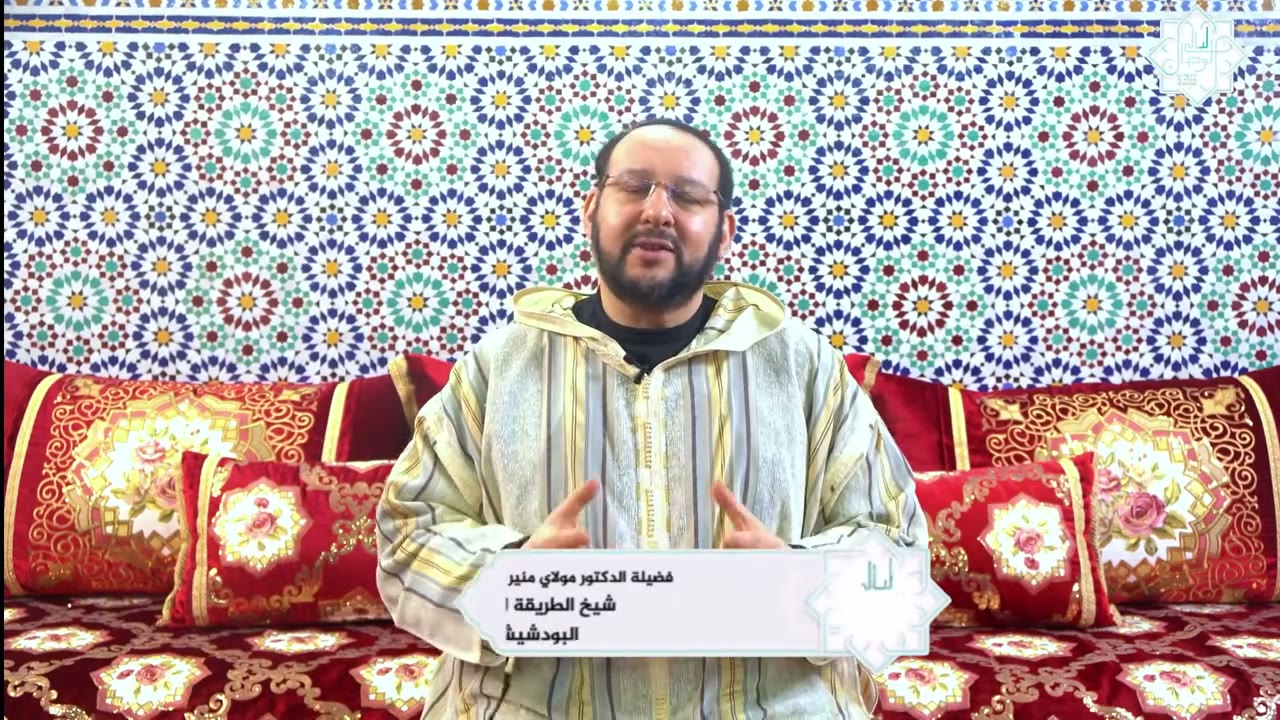
A teaching of Sidi Mounir al-Qadiri Boutchich, shaykh of the path, delivered in French and broadcast in episode 329 of the series Layali al-Wissal (‘The Nights of Union’), on 18 October 2026 on the channel of the Al Moultaqa Foundation. Announced by the host under the title ‘The humility that makes the other better’.
Extract of 8 min 32 s (01:34:18 to 01:42:50). Original full video: Layali al-Wissal, episode 329, Al Moultaqa Foundation channel.
Two faces of humility
The teaching opens on a reversal: when we speak of humility, we think of the humble person, rarely of what surrounds him. ‘And yet, the humility of one often makes the other better.’ Such is the thesis of the whole talk, and it unfolds in two faces: one turned toward truth, the other toward people.
The first face is told through a story that Mu’awiya ibn al-Hakam himself recounted. A young man who had barely entered Islam, he was praying behind the Prophet, peace and blessings be upon him, when at his neighbour’s sneeze he answered aloud ‘may God have mercy on you’, unaware that one must keep silent during prayer. Every gaze turned toward him, the faithful struck their thighs, and he fell silent, covered with shame. After the prayer, the Prophet called him. Mu’awiya later recounted never having seen, before or after him, a master who had instructed him so well: no roughness, no blow, no insult (Sahih al-Bukhari 1200, Sahih Muslim 537).
To this gentle correction, the speaker attaches two prophetic formulas: ‘God is beautiful, and He loves beauty’, and the rejection of pride, that cloak which humiliates the one who wears it. Humility is therefore not a posture: it has two faces, one toward truth, the other toward people.
Lowering oneself before truth to learn
The ‘truth’ side of humility is first illustrated by the Qur’an itself. A man among the sons of Israel once asked Moses, peace be upon him, whether he knew anyone more learned than himself. ‘No,’ Moses answered; God then made known to him that His servant al-Khidr knew more. Moses set out to meet him and said, as the Holy Qur’an relates (surah al-Kahf, 18:66): ‘Would you follow me so that I might be taught of the right conduct you have been taught?’ The Qur’an reminds us, the speaker notes, that above every man there is always one more learned.
The second story comes from the spiritual family of the path. ‘Our master and spiritual grandfather Sidi Hamza liked to tell this story of Sidi Abu al-Hasan al-Shadhili’, founder of the Shadhiliyya, one of the greatest paths of Sufism. Already renowned as a young scholar, al-Shadhili had gone as far as Iraq to seek the one who could guide him toward God; there he had been told that the one he sought was in his own country. He returned to Morocco and made his way into the mountains, to the sanctuary of Moulay Abdessalam ibn Mashish, the great Sufi master. Before him, exhausted, he was about to greet him; the master said: ‘Go perform your ablutions.’ Certain he was in a state of purity, he obeyed, went down to the spring, performed his ablutions, came back up. The master repeated the same sentence. A third time, at the water’s edge, his hands in the spring, al-Shadhili understood what he had to unlearn: everything he believed he already knew. He came back up, and this time Moulay Abdessalam received him, calling him by his first name: ‘O Ali, you have come to us poor in your knowledge and your deeds, and you have received from us the wealth of this world and the next.’
The story, the speaker comments, bears witness to one simple thing: to know that one can be wrong is to leave the door open to truth. Whoever closes it through pride or habit can sink into error and drag those around him down with him.
Lowering oneself before others so that they may grow
The second face of humility looks toward people. The verse cited is that of surah Al ’Imran (3:159): ‘You have been gentle toward them by a mercy of God. Had you been harsh and hard of heart, they would have parted from you.’ The Prophet’s gentleness, peace and blessings be upon him, is a rahma that comes from God; and the speaker draws from it the law of relations: at home as at work, before someone harsh one falls silent and hides one’s mistakes; before someone gentle one dares to say ‘I did not understand’, ‘I was wrong’. Where one fears being humiliated, faults are hidden, and they grow worse.
The example of Mu’awiya returns to seal this side: ‘it was Mu’awiya who ascended,’ says the speaker, when the Prophet descended to him. Then come the two images of water. Sidi Hamza used to say: to drink from the stream you must stoop, for water is always at the lowest point; we must be like water. And Sidi Jamal teaches: to drink from the spring you must dismount your horse and lower yourself to the level of the water.
The conclusion is clear: ‘To lower oneself, then, before truth to learn, before others so that they in turn may learn. Whoever lowers himself leaves room for the one facing him. And it is in that room that the other grows.’
The closing prayer
The teaching ends on an invocation that sums up the two faces: ‘We pray God to grant us humility before His truth and gentleness toward His creatures; may He make us people in whose presence others dare to learn and to better themselves.’ It is followed by a prayer for the kingdom of Morocco and its people, a request for long life, health and guidance for His Majesty King Mohammed VI, Commander of the Faithful, and for the crown prince Moulay El Hassan, then a final blessing that peace, light and spiritual and human values reach everyone.
This teaching on humility extends the Arabic side of the same vigil, where Sidi Mounir treated the sincerity of orientation and the excellence of action: the two faces of humility (before truth, before others) echo the two demands of spiritual education (purifying the heart, serving one’s neighbour). To go deeper into the figure of the master in question here, Sidi Mounir al-Qadiri Boutchich is the shaykh of the Tariqa Qadiriya Boutchichiya; the teaching ‘Honour and Constancy’ explores the believer’s dignity in the face of trial; a dhikr session is its practice.
Frequently asked questions
How did the Prophet correct Mu’awiya ibn al-Hakam?
Without treating him roughly or striking him: after the prayer he called him and taught him silence. Mu’awiya later recounted never having seen, before or after, a master who had instructed him so well (Sahih al-Bukhari 1200, Sahih Muslim 537).
What does the Qur’an say about the Prophet’s gentleness toward his own?
Surah Al ’Imran (3:159): ‘You have been gentle toward them by a mercy of God. Had you been harsh and hard of heart, they would have parted from you.’ The Prophet’s gentleness is a rahma, a mercy that comes from God.
What does ‘stooping to drink from the spring’ mean?
The teaching attributed to Sidi Jamal: to drink from the spring one must dismount one’s horse and lower oneself to the level of the water. Whoever lowers himself leaves room for the one facing him, and it is in that room that the other grows.
What does the story of al-Shadhili and Ibn Mashish teach us?
The young scholar Abu al-Hasan al-Shadhili, who had gone to seek a guide in Iraq, was answered that the one he sought was in his own country. Before Moulay Abdessalam ibn Mashish, he understood at the third ablution that he had to unlearn what he believed he already knew.
Frequently asked questions
How did the Prophet correct Mu'awiya ibn al-Hakam?
Without treating him roughly or striking him: after the prayer he called him and taught him silence. Mu'awiya later recounted never having seen, before or after, a master who had instructed him so well (Sahih al-Bukhari 1200, Sahih Muslim 537).
What does the Qur'an say about the Prophet's gentleness toward his own?
Surah Al 'Imran (3:159): 'You have been gentle toward them by a mercy of God. Had you been harsh and hard of heart, they would have parted from you.' The Prophet's gentleness is a rahma, a mercy that comes from God.
What does 'stooping to drink from the spring' mean?
The teaching attributed to Sidi Jamal: to drink from the spring one must dismount one's horse and lower oneself to the level of the water. Whoever lowers himself leaves room for the one facing him, and it is in that room that the other grows.
What does the story of al-Shadhili and Ibn Mashish teach us?
The young scholar Abu al-Hasan al-Shadhili, who had gone to seek a guide in Iraq, was answered that the one he sought was in his own country. Before Moulay Abdessalam ibn Mashish, he understood at the third ablution that he had to unlearn what he believed he already knew.