Listening in spirit: the sama'
Contents
The Arabic word sama’ (سماع) literally means ‘hearing’, ‘audition’. In the language of the Sufis it has become a technical term: the spiritual audition, the ordered hearing of Qur’anic verses, inspired poetry and the songs of the paths, a listening that aims at the heart rather than the ear. The Qur’an itself commands it of its own recitation: ‘When the Qur’an is recited, give ear to it and keep silent, that you may be shown mercy’ (Qur’an VII, 204). The whole tradition of the sama’ is contained in germ in this verse: an attentive hearing, a silence kept, a mercy hoped for.
The sama’ is not a concert. It is a practice, with its texts, its conditions, its known fruits and its dreaded excesses. Al-Qushayri devotes to it what is perhaps the longest chapter of his Risala (eleventh century), and a thousand years of masters have refined its rules: what is listened to, with what intention, under whose authority, and what listening does to the one who gives himself over to it.
What is listened to
Spiritual audition observes a hierarchy. At the summit stands the recitation of the Qur’an: the believer’s first sama’ is the hearing of the Book, and many masters have never admitted any other object of audition for beginners. Next comes inspired poetry: the didactic qasida, praise of the Prophet (madih, na’t), the mystical verses of the great poets of the path, from Rumi to Ibn al-Farid. The words carry the teaching; the melody brings it down towards the heart.
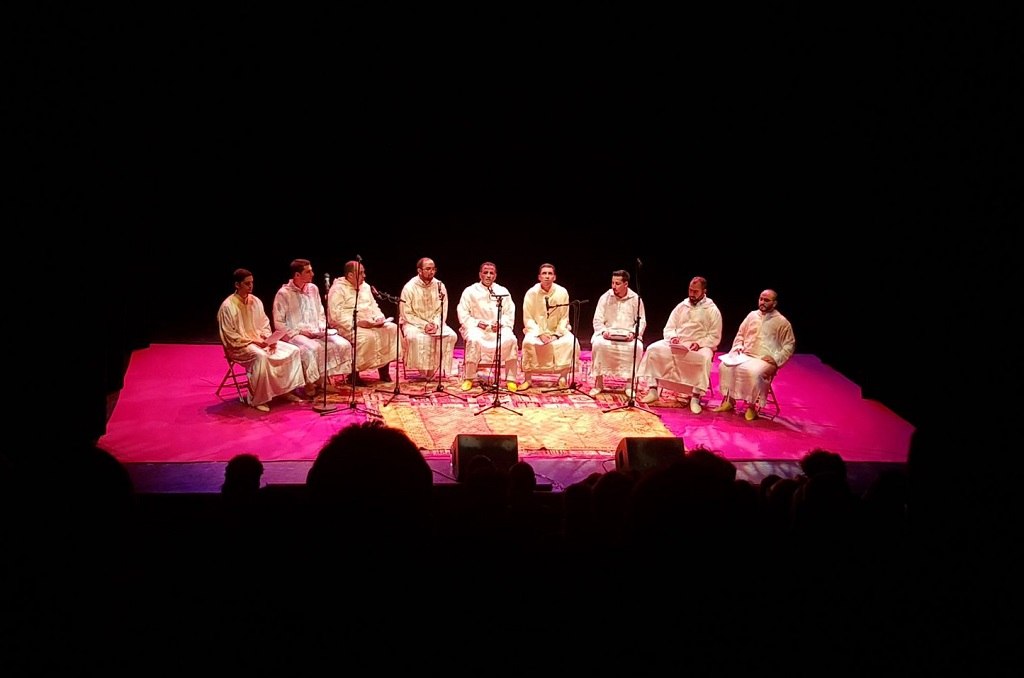
The favoured instrument remains the human voice. The munshid, the one who recites or chants, is not a singer in the sense of a performer: his office is to disappear behind the text. Depending on the path and the period, the voice may be accompanied by the frame drum (duff, bandir), sometimes by the reed flute (nay) or other instruments, a disputed question, as we shall see. The listening assembly gathers in the audition hall, the sama’-khana, often within the precinct of the zawiya.
Abu Talib al-Makki, in the Qut al-qulub (tenth century), already describes those Baghdad gatherings where the reciter was heard until tears came. What distinguishes such a gathering from entertainment comes down to three things: the object heard is sacred or inspired, the listeners’ intention is turned towards God, and the assembly remains under the master’s vigilance.
The rules of audition
Al-Ghazali, who treats the question in book XVIII of the Ihya’ ‘ulum al-din (the Kitab adab al-sama’ wa-l-wajd, ‘the book of the manners of audition and ecstasy’), gave the formula the paths still keep: the sama’ is permissible on three conditions, the time (zaman), the place (makan) and the company (ikhwan). One does not listen just any time, anywhere, with just anyone. To these conditions a fourth is added, a more inward one: the state of the listener himself.
The rules of etiquette converge from one treatise to the next. One listens seated, head bowed, without looking around. One keeps still so long as the state does not command movement: the body follows the heart, it does not precede it. One does not applaud, one does not provoke emotion, one does not imitate a neighbour’s ecstasy: the tradition names that imitation tawajud, and it condemns it, for to feign a state one does not have is the worst play-acting, and it deceives the actor first of all. The tearing of garments and the cries uttered in certain ancient assemblies were judged by the same principle: admissible when the state wrenches them out, reprehensible when they are put on.
One last rule, and not the least: the sama’ is not for everyone at every moment. Several masters kept novices away from it, not out of disdain but because audition amplifies what already dwells in the heart: it quickens remembrance in the one who invokes, and it feeds the passionate soul in the one ruled by it. ‘Audition stirs what speech alone does not move’, runs the traditional saying; it matters therefore to know what, in oneself, will be stirred.
A thousand-year-old debate
The lawfulness of the sama’ was disputed from the golden age of the brotherhoods onwards, and it must be said honestly: the scholars never agreed. Al-Hujwiri’s book, the Kashf al-mahjub (eleventh century), the first Persian manual of Sufism, devotes an entire chapter to drawing the line between the permissible, the doubtful and the forbidden. Against audition, Ibn al-Jawzi devotes severe pages in the Talbis Iblis (twelfth century) to the excesses of the assemblies: trances staged for the onlookers, instruments that ape the entertainments of the courts, states taken as proofs of election. Al-Ghazali, at almost the same time, acknowledges these abuses but refuses to condemn the principle: it is the use that is judged, not the listening itself.
On the side of the defenders, the list is long and learned. ’Izz al-Din ibn ’Abd al-Salam, the ‘sultan of the scholars’ of the thirteenth century, writes a Risalat al-sama’ in favour of audition. Ibn Hazm had already admitted it in his Muhalla. And at the turn of the eighteenth century, the Damascene shaykh ‘Abd al-Ghani al-Nabulusi settles the matter, so to speak, in his treatise Idah al-dalalat fi sama’ al-alat, ‘Clarification of the proofs concerning the hearing of instruments’: no primary text forbids melody as such, he observes, and the hadiths invoked against it always concern gatherings where it was mixed with wine and debauchery.
On instruments, the tradition’s position is subtler than the debate suggests. The duff, the frame drum, has a Prophetic precedent behind it: girls were singing to it in the house of ’A’isha, the mother of the believers, and the Prophet, may God’s peace and blessings be upon him, did not forbid them. The flute and the strings are more disputed; the unaccompanied voice has never posed a problem. That is why many paths have made unaccompanied singing, or singing with the frame drum alone, the canonical form of their audition.
What listening does to the heart: hal, wajd, tawajud
Why listen rather than read? The masters’ answer is always the same: meaning analysed reaches the intellect, meaning heard reaches the heart. Melody carries the verse over the mind’s defences, and what reading kept at a distance becomes, in audition, an intimate matter. This is the taste (dhawq) of which the treatises speak: a knowledge that is savoured before it is understood.
Audition may then produce a state, the hal: a stirring or a peace that comes over one unbidden, tears, a trembling, a long inner silence in which the whole assembly holds its breath. The wajd, literally ‘what is found’, is what the heart discovers in that state. Al-Ghazali orders the three terms into an ascent: tawajud, the effort that solicits the state; wajd, the state found; wujud, the fulfilment in which one no longer seeks because one has found. He advises everyone to keep to a sober welcome: let come what comes, neither forcing it nor working to make it last.
The masters add a necessary warning. The state is a guest, not a dwelling: stations (maqam) are won through work, states (ahwal) are gifts that pass. The one who collects the emotions of the sama’ without the discipline of dhikr, prayer and service risks building a spirituality of sensations, less solid than he thinks. Audition accompanies the journey; it does not replace it.
The sama’ in the paths
Every path has tuned audition to its own genius. Among the Mawlawiyya, the order of Jalal al-Din Rumi, the sama’ became the sema: the whirling dance of the dervishes, which the Konya tradition presents as a heaven in which each turner becomes a planet in orbit around the sun of the heart. The Mevlevi ceremony was proclaimed a Masterpiece of the Oral and Intangible Heritage of Humanity by UNESCO in 2005. Among the Chishtiyya of India, audition holds the centre of the path: Nizam al-Din Awliya’ was so attached to it that his opponents reproached him for it, and tradition attributes to his disciple Amir Khusraw the form of the qawwali, that audition-song which still stirs the shrines of the subcontinent. Many other paths, beginning with the Shadhiliyya, have joined song and movement in the hadra, the assembly of presence where audition overflows into danced praise.
In the Qadiriya Boutchichiya path, audition is done seated. The qasa’id, the path’s poems in classical Arabic, are sung in assembly or listened to; they prepare the dhikr or prolong its collectedness, and the inner silence that follows the singing counts as much as the singing itself. It is this sober audition, with no sought trance and no display of states, that is carried by the recordings gathered on the spiritual song page.
Listening to the sama’ today
A recording is not an assembly, and the masters would insist on the difference: the traditional sama’ is lived in presence, under the master’s authority, in the right time, place and company. Yet the attentive hearing of a song of the path keeps something of the practice, so long as it is not treated as background music. Sit down. Hear the words before the melody: the qasa’id pages give the transliterated and translated texts for that. Let what stirs do its work, without forcing it or commenting on it. The silence that follows is part of the audition.
This listening, kept up steadily, accords naturally with the path’s other practices: dhikr, whose collectedness it prepares or prolongs, the reading of the Qur’an, the prayer upon the Prophet. And for those who wish to pass from solitary listening to the assembly, dhikr sessions are held in several towns in France: the calendar gives the dates, and the page on dhikr sessions explains how they unfold.
The sama’, in sum, restores listening to its rightful place: not a passive sense, but a faculty that can be educated, and through which the heart sometimes hears what the ear alone never hears.