Remembering: dhikr
Contents

At the heart of spiritual practice, dhikr is, in Ansari’s words, “when you forget everything that is not Him and when you forget yourself in the act of remembering, then when you forget the act of remembering in the act of remembering, then when you forget all remembering in the actual remembrance that God has of you”.
It has been said: “When a man applies himself continually to filling his moments with the dhikr of Allah, when he preserves his breaths through his unbroken discernment of the divine presence in Allah, for Allah, by Allah and with Allah, he is counted among those spiritual beings whom no veil any longer separates from what is hidden in the unseen world, for his incantation is a spiritual force clothed in a luminous form. It moves through the invisible world, and its secrets are disclosed to him sooner or later.” This extract from Shaykh Tadili’s book ad-din wa-n-nasiha (“The traditional life is sincerity”) illustrates the fundamental importance of the practice of invocation (dhikr) in the spiritual ascent of the one who aspires to realisation (murid). Dhikr is the weapon par excellence which makes it possible to overcome psychic obstacles and to put the ego, the main obstacle to spiritual accomplishment, back into a position submitted to the Spirit (ruh), the divine aspect present in every being.
Dhikr of the heart and dhikr of the tongue
In Arabic, the word dhikr means “reminder, remembrance”. In practice it designates a spiritual method based on the invocation and repetition of formulas, of phrases generally drawn from the sacred Book. It has various modalities: it can be a dhikr “of the heart” or a dhikr “of the tongue”, and it can be practised individually or collectively. The dhikr of the tongue concerns Muslims as a whole. Believers practise it as a supererogatory work, thereby granting themselves a share of divine grace. Its source lies in the Qur’an, where it is written: “O you who believe! Invoke Allah abundantly and glorify Him at dawn and at the day’s decline” (Qur’an XXXIII, 41-42).
It should be borne in mind that the dhikr of the tongue carries a certain limitation and is only a first stage. Indeed, it is dependent on the dhikr of the heart, for the latter requires an initiation. This initiation, which in Sufism involves the transmission of the sirr (spiritual secret) from master to disciple, gives life to the dhikr. Thus the invocation of the names of Allah sets the sirr to work in the heart of the disciple or aspirant. At a certain level of the spiritual path, this dhikr of the heart proves permanent: even without the use of the tongue, the aspirant manifests the divine Presence in his whole being, he is “in Allah, for Allah, by Allah and with Allah”, and he never forgets the Invoked One. In Islam, the dhikr of the heart is specific to Sufism.
Individual dhikr and collective dhikr
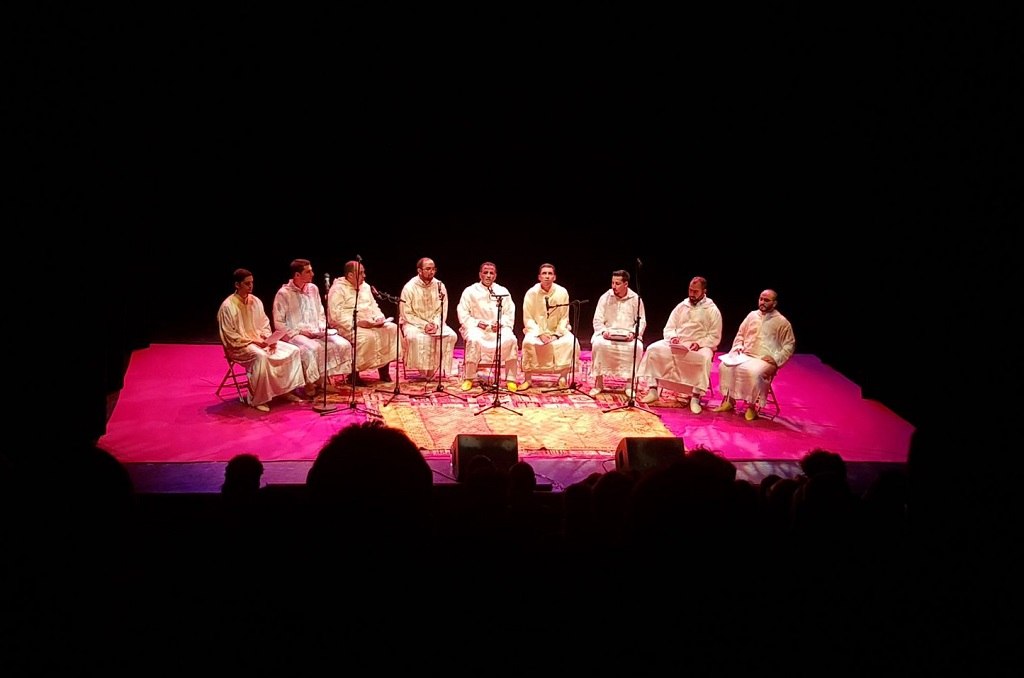
On the Sufi path, this practice has two modalities: individual or collective. The aspirant may recite daily a set of divine names prescribed by the shaykh (spiritual master) of his tariqa (initiatic brotherhood) according to the disciple’s spiritual state. In gatherings, dhikr may include litanies (reading of the Qur’an, recitation of divine names, Qur’anic formulas, prayers of blessing upon the Prophet) recited together at regular meetings.
A number of rules of good practice are to be observed, on the individual or collective level. In his book Les vertus du dhikr, Shaykh Abdelkader Aïssa notably recommends observing a certain purity of the place where one is about to invoke, of the clothes one wears, and of the mouth. The dhakir (the one who engages in dhikr) must, according to him, face the qibla (Mecca) and try to concentrate solely on the divine presence through an orientation of the heart.
Another essential virtue must animate the heart of the one who invokes: perseverance. In his first steps on the spiritual path, the aspirant may be disoriented by the battle being waged, unbeknownst to him, between the dhikr and his carnal soul. The aspirant must then arm himself with perseverance, for, as the great Egyptian saint Ibn ‘Ata’ Allah al-Iskandari said (Hikam, 44): “Do not abandon the remembrance of God (dhikr) because you are not present in it. For heedlessness of remembrance is worse than heedlessness within remembrance. It may be that God raises you from a remembrance done in heedlessness to one done in vigilance. And from that, to a remembrance in which you become present to Him. And from that again, to another in which you become absent to all that is not the object of your remembrance. And that, for God, is not difficult” (Qur’an XIV, 20).
The effects of dhikr
A Sufi master once addressed his disciples in these terms: “Do not seek the truth, seek first to purify yourselves!” Dhikr practised regularly gradually makes desires and impure thoughts disappear. In the same way, “if hunters go into the forest every morning and fire their guns, all the frightened animals flee at the sound of the shots, then come back a little later in the day. But as the hunters return every day, the animals end up moving elsewhere.” Through this metaphor, one of the main consequences of the practice of dhikr is brought to light: the purification of the heart. Partial knowledge disappears to make way for the acquisition of true knowledge, the kind born of intimate experience and not of mere book learning.
Mentioning the Name of Allah polishes the heart and annihilates every manifestation of the ego, the instigator of evil. Invocation empties the heart of everything that is not itself, “polishing it until it is transformed into an immaculate mirror”.
The disciple then rises towards the divine Presence, thereby realising the essential aim of the path: to go beyond his individuality with a view to attaining the state of Universal Man. He can then discern unity in multiplicity and multiplicity in unity.
The effects of dhikr are innumerable and its benefits many, well before realisation has been reached. The first fruits obtained through this discipline and perseverance are a feeling of peace and serenity, together with the conviction of the authenticity of the path.
From then on, the aspirant acquires a vigilance over his acts and thoughts: dhikr preserves him from forgetfulness of God, and his tongue knows no profane word. It is the weapon that keeps him from straying from Him, that keeps him oriented in all circumstances. He thus acts in conformity with the hadith known as that of Jibril (Gabriel): “Worship God as if you saw Him, for if you do not see Him, He sees you.”
Finally, the function of dhikr is also redemptive. The aspirant grants himself a share of divine mercy, for “there is no better salvation from the chastisement of Allah than the dhikr of Allah”. Thus each invocation erases a share of fault and constitutes, for the aspirant, a step towards Paradise.
Raphaël Feur