The Moulidiyat: Moroccan poetry between the Prophet and the Amir al-Mu'minin
Contents
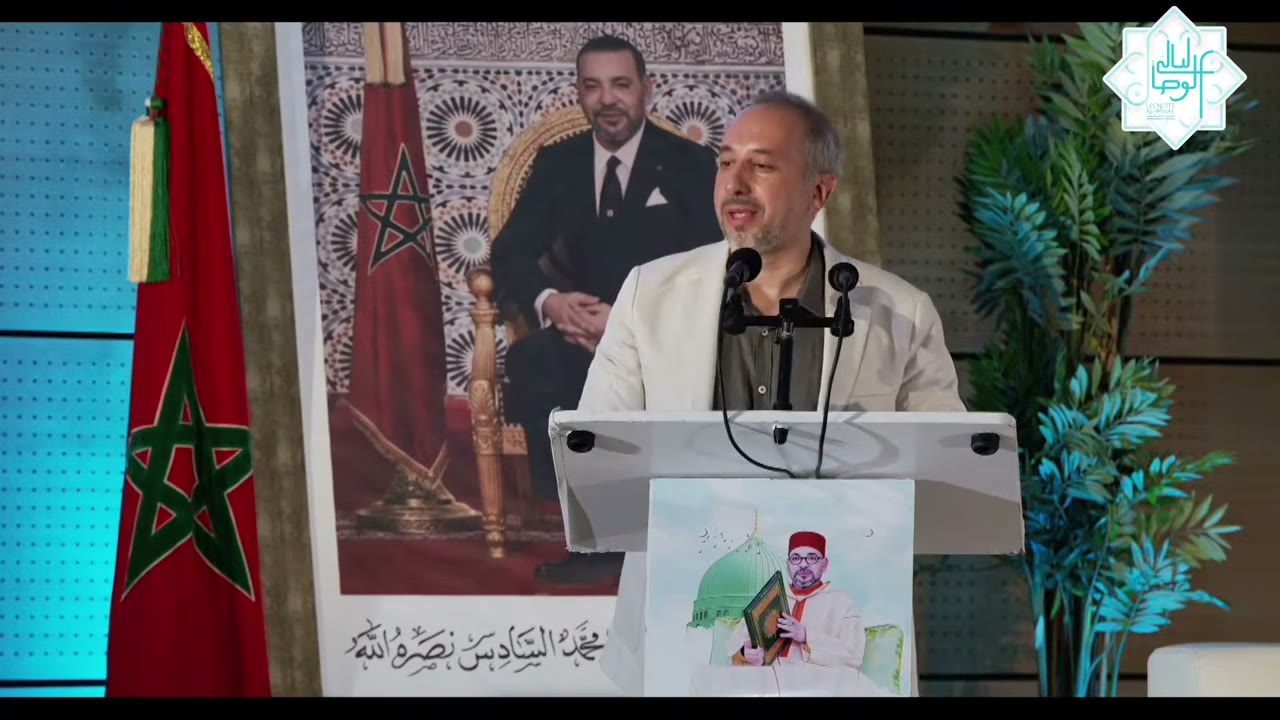
A talk by Dr Abd al-Wahhab al-Filali, professor of universities at Sidi Mohamed Ben Abdellah University in Fez, taken from episode 330 of the series Layali al-Wissal (‘The Nights of Union’), broadcast on 25 October 2026 on the channel of the Al Moultaqa Foundation. Delivered in Arabic, with no title announced by the host; the extract opens on the speaker’s greetings. It is preceded in the live broadcast by a Qur’anic recitation and followed by a sama’.
Extract of 20 min 25 s (00:35:40 to 00:56:05). Original full video: Layali al-Wissal, episode 330, Al Moultaqa Foundation channel.
Literal translation of the talk (from the Arabic)
A literal, word-for-word translation as far as English allows; the article below presents its meaning and structure.
“O my master Mounir, may God protect him; my lords the nobles, my lords the professors and scholars, honoured attendants, may the peace of God be upon you, with His mercy and His blessings.
In the domain that is ours, if we wish to fix its keys, we say: the Imarat al-Mu’minin, the Messenger of God, may prayer and blessings be upon him, purification and the good life: these are the keys that govern our meeting on this night. I propose to speak first of the unity of the Imarat al-Mu’minin, then of the Messenger of God, by way of prophetic praise, in a single one of its colours, namely the Moulidiyat.
But before that, my lord, I ask your pardon for presenting an indication, for a remark of my own led me to it: it is this link which attaches our blessed tariqa to the Book of al-Dakhira. We have with us Madame Asma’ Samudi who defended a doctoral thesis on an edition of the Dakhira, and a group of researchers who worked with me and whom I accompanied in what concerns the Book of al-Dakhira; you and I were among the first to study the Dakhira at the end of the nineteen-eighties, from the copy preserved in the Royal Treasury, then that of the National Library, formerly the Great Library. This is only an indication of that scientific link which unites the paths and the zawiyas of Morocco, and praise be to God.
The Moulidiyat are, as I have said, a colour of prophetic praise. They are the incarnation of a Moroccan thought which sees in the person of the Messenger of God love, sees in his community faith and sees in his traits the model. The poetry of the Moulidiyat is also called the ’Idiyyat, in reference to the celebration of the prophetic Mawlid. In Morocco it is a strong answer, in our Moroccan literature, to the nature of the thought and spirit of Moroccans, that is, to the Moroccan personality in its rootedness in its reality.
And when one speaks of the Moulidiyat, one must distinguish between prose and verse. Prose gave us what are called the Mawalids, and verse gave us the mawlidiyya qasida or the ’idiyya qasida, which were attached on the occasion of the celebration of the prophetic Mawlid. The particularity that occurred in Morocco, fundamentally, is that this celebration, if it was a face of the attentions of the Imarat al-Mu’minin toward the Messenger of God, may peace and blessings be upon him, brought together in its constituent elements poems that were recited in the presence of the Imarat al-Mu’minin; and this from the Almohad era fundamentally until today, through this historical continuity in Morocco. From this one can look with the greatest merit upon this ‘transmission’ of the Messenger of God by the Imarat al-Mu’minin: it is a face of the links which unite one to the other, and which link Morocco to the Messenger of God, and through Him to the One whom God established as successor on His earth, the Imarat al-Mu’minin.
The poetry of the Moulidiyat is thus attached to the prophetic Mawlid and has become in Morocco a cultural, moral and civilisational heritage; its poems always accompanied this memory and participated alongside sessions of listening, song and praise. In the noble Prophetic majlis, which is the fundamental majlis, or again in the nights and in the zawiyas, in the mosques: it is a very strong phenomenon in Morocco, which has crossed the Islamic history of Morocco, as I have said, from the Almohad era to our days.
And this phenomenon, the solemn celebration of the prophetic Mawlid in Morocco, knew at a very important stage of the history of Morocco, the Marinid era precisely, the height of this link between the celebration of the Messenger of God, peace and blessings be upon him, of His birth, and the sultan at the same time. The poets, as the researchers say, recited their poems before the sultan and the sultan rewarded them, out of love for the Messenger of God, out of attachment to the Messenger of God and out of veneration of what was said of the Messenger of God. This poetry continued until it became a tradition in the Saadian era, in the Saadian state; then the matter deepened in the Alaouite era. This poetry, the poetry of the Moulidiyat or of the ’Idiyyat, became one of the most composed in Morocco and one of the most widespread. And as I take part, my lord, in a study relating to prophetic praise in the work of our team, it appeared that when the Mamluk era reigned in Egypt and prophetic praise had declined in value and creativity, the people of Morocco distinguished themselves through this new colour which is the Moulidiyat. That this new colour should appear and that its radiance should deepen through this long history in Morocco is very important proof in the context which is ours: the link of the Imarat al-Mu’minin with the Messenger of God, and the link of Moroccans with the Messenger of God.
Nor is this unrelated to al-Dakhira, the greatest work of prayer upon the Messenger of God in quantity as in quality: it is said that its volumes exceed seventy, I do not know to what number they have reached until now; all this shows a book in prayer upon the Messenger of God, prophetic praise in all its colours, the mawlidiyya qasida or the poetry of the Moulidiyat being a colour of these colours.
Moroccans have distinguished themselves in all this: proof of a strong link, which is a deep historical identity in the soul, in the spirits, in the historical memory of this community; and it is a face of Morocco’s distinction, assuredly.
It comes in the Book of al-Azhar, in the reports of Qadi Iyad, according to Ahmad Muhammad al-Maqqari of the Sanhaja, that the kings of Morocco and al-Andalus of that era, meaning the Marinid period and, before it, the Almohad one, honoured the night of the prophetic Mawlid and celebrated it to the utmost, without any negligence on their part. What precision: there is strong attention, strong guardianship of this celebration; proof again of what we are treating.
And let us return somewhat to the content: we find the Book of al-Shifa’, which is a writing on the Messenger of God, peace and blessings be upon him; it is a book that still circulates today, and not only in the Arabic language: it has been translated into several languages, including French, German and English. Then we have in the Almohad era, model of all Almohads, another model in this field: the Book of Dur al-Mandhum on the Mawlid of the glorified Prophet, of the ’Azafiyyin, that is, of father and son, Abu al-’Abbas and Abu al-Qasim, al-‘Azafi; then we have the Book of al-Tanwir on the Mawlid of Siraj al-Munir, by Ibn Dihya; then we have the Wasila al-Kubra, in whose blessing one hopes for profit in this lower world and the other, in the person of the Messenger of God, by Malik ibn al-Murabba’. Then we have the Maqsura… this only in the Almohad era, then the Almoravids before it, then the Marinids, until we enter the Saadian era, such as the Golden Manuscript and the Laiha for the poets: the Manahil al-Safa’ as a book by Abd al-’Aziz al-Fishtali in this field, and the poems are numerous, very numerous.
I will therefore not dwell in this field: these are only indications, otherwise one could linger on it longer. To deepen our knowledge we must know that the mawlidiyya qasida is composed, as to its construction, of components: the prophetic sira, the occasion of the celebration and the events that occur in it; then, among the components of construction, there is the journey toward the lands of the Hijaz, or the desire and nostalgia for those lands; then prophetic praise, resting on the prophetic sira, on the traits of the Messenger of God, on the miracles and the virtues, and so on; then the theme of the sultan, of the amir al-mu’minin, who establishes the nights of the prophetic Mawlid, calls to attach oneself to religion, to engage in its principles, to defend it, to protect it, and who is linked to the Messenger of God: for he is his descendant, and his sultanate derives from his. This link between the amir al-mu’minin and the Messenger of God subsists until today on the basis of the rule of the caliphate, as a divine trust, and its model is the prophetic model.
From this is therefore clarified the legitimacy of the link between the Messenger of God and the Imarat al-Mu’minin in Moroccan identity and in the making of the Moroccan personality, from the beginning of the Islamic states of Morocco until today. And is also clarified the course of union between him, peace and blessings be upon him, and the amir al-mu’minin in the texts of Moroccan poetry, and foremost the mawlidiyya poetry. Most of this poetry, through it, shows how is woven in it the link between the Messenger of God and the amir al-mu’minin across the time of the Moroccan states: a weaving of faith and belief. There is faith and belief in the person of the Messenger of God, and in this celebration of His birth, on an assuredly prophetic model.
It must be affirmed that the comparison of the meanings of the prophetic dimension in the texts of mawlidiyya poetry and the sultanic dimension, and the link which unites the two dimensions in the person of what is called the transition passage: how one passes from the person of the Messenger of God to the person of the amir al-mu’minin. It is a subject which, when one dwells on it, reveals the strength of this link and its depth: how the sultan is of the Prophet’s descent, of the house of the Messenger of God. And this also serves to unveil the depth of the feelings of the amir al-mu’minin toward the Messenger of God, and the depth of the feelings of the poets toward them both together. For the poets represent the Moroccan people as a whole, and the amir al-mu’minin, guided by prophetic guidance, guided by a commitment and an attachment.
I will not prolong: I will cite a few models of this poetic colour.
’Ali al-Fasi, in one of his mawlidiyyat, addressing the late His Majesty King Hassan II: ‘O king of the people, O son of the Chosen, / God has renewed religion through your splendour, / you are the hope of all the lands of the country; / take up the affair with firmness and wisdom: / you have inherited the glory of the best father, / whose grace has embraced all beings, / guide of the people and protector of their land / against the wrong of the usurper and the thief.’ The context was then that of colonisation, of the exit from the protectorate and others; meanings of this sort were therefore needed which carried the person of the Messenger of God and the person of the amir al-mu’minin, linked one to the other, in the occasion which then presented itself.
The second: a poet of the tenth and eleventh [Hijri] century, al-Hasan ibn Ahmad al-Masfiwi, in a mawlidiyya where he passes to the praise of the sultan Ahmad al-Mansur al-Sa’di after having praised the Messenger of God: ‘O best of him whom the suppliant hopes for, when every mortal is hostage to what he has acquired; / may the God of the Throne pray upon you as long as the turtledove will sing above a tree unto drunkenness; / and may the guarantor of this religion, the grandson of him who rises through you in a night of glory when one attaches.’ Therefore, through attachment to the Messenger of God, the rank of the amir al-mu’minin rises: ‘caliph that he has become between the two horizons, / his name has grown sweet on tongues.’
I conclude with a model of this field that we have lost in modern and contemporary time: Isma’il Ahmad al-Halawi, who in his time was among those who walked in this wake and who were much active on these occasions. He says, reuniting the Messenger of God and King Hassan II: ‘O Messenger of the Right, by your light the darkness that had gathered in space was dispelled; / may the salutation of Him who loved you in perfection, / the tongues of poets fall short of it, / and greetings upon your grandson who walked on the way raising the banner, / bearing in his hands the torch of love; / and greetings, you whose echoes are beloved, O king whose ancestry and origins were excellent, / for in glory you are the summit of heights; / he has ceaselessly raised the dawn and built miracles surpassing all daughters; / God has blessed the course of his high deeds and rewarded his effort with the best requital; / he adorns himself with religion and makes prosper the best of peoples, to whom He has given the best allegiance.’
I end by dwelling on a model that was said in honour of His Majesty the king, the amir al-mu’minin, Mohammed VI, may God protect him; it is by the contemporary poetess Khadija Abu Bakr, ‘Ma’ al-‘Aynayn’, who is of our time, and who has a collection, ’Nafath al-‘Ashiqa’, and she says in one of her poems: ‘O Mawlid of the Chosen, this community is mine, in its blessed feast a union has gathered for those who were separated, / it strives to gather the union of him who inherited the heights and the wisdom of a noble forefather, / a king to whom souls give themselves in tribute of their pure and delightful love; / I have invoked You, O my Creator, and by my attachment to the Chosen, / preserve the country from plague, / and keep for us the grandson of the Prophet, the guided one, protector of holiness against all causes of anguish.’
Peace be upon you.”
The keys of the gathering
The talk opens with a framing: the mawlid vigil, our own terrain this evening, has its keys: the Imarat al-Mu’minin, the Messenger of God, purification and the good life. The speaker announces his purpose: to speak first of the unity of the Imarat al-Mu’minin, then of the Prophet, through prophetic praise, in a single one of its colours: the Moulidiyat.
Before coming to them, he asks pardon for an indication that comes from a personal remark: the link attaching the tariqa to a great book of the Moroccan heritage, the Kitab al-Dakhira, a collection of hadiths in some sixty volumes or more. The doctoral thesis of Mrs Asma’ Samudi on an edition of the Dakhira, the work he conducted with his team on the manuscript of the Royal Treasury and that of the National Library in the 1980s: so many proofs, he says, of the scholarly link uniting the paths and the zawiyas of Morocco.
A colour of prophetic praise
The Moulidiyat are a colour of prophetic praise (al-madh al-nabawi): they embody a Moroccan thought which sees in the person of the Prophet love, in his community faith, in his traits the model. They are also called the ’Idiyyat, after the feast. Prose produced the books of mawlid; verse produced the mawlidiyya qasida, attached to the occasion of the celebration.
The speaker then unrolls the history of the genre: the celebration is an aspect of the attentions of the Imarat al-Mu’minin toward the Prophet, and poems were recited in the presence of the amir al-mu’minin. Attested from the Almohad era, the tradition flourishes in the Marinid era, when poets declaimed before the sultan who rewarded them out of love for the Prophet; it takes root in the Saadian era and deepens under the Alaouites. The genre counts among the most composed and most widespread in Morocco; yet over the same period, he adds, citing his own research on prophetic praise, it declines in value and creativity in Mamluk Egypt.
The link between the Prophet and the sultan
Here comes the doctrinal heart of the talk: the mawlidiyya qasida is articulated in components: the prophetic sira, the occasion of the feast, the journey toward the lands of the Hijaz and the nostalgia for those lands, then praise proper, resting on the sira, the traits and the miracles of the Prophet. But it ends with a theme of its own: the sultan, the amir al-mu’minin, who establishes the nights of the mawlid, calls for attachment to religion and for its defence, and who is linked to the Prophet of whom he is descendant. This link, he says, holds on the basis of the caliphate as a divine trust, whose exemplarity is the prophetic model.
It is here that the poetic ‘transition’ operates: the text passes from the person of the Prophet to that of the amir, from the house of the Messenger to the house of the sultan. The poets, he adds, represent the Moroccan people; the amir, for his part, follows prophetic guidance. The mawlid poem is thus the place where is woven, across the dynasties, a double link: faith and belief in the person of the Prophet, and attachment of the person of the sultan to that same person.
Four models of the tradition
The speaker concludes with four examples, which sketch four centuries of the tradition.
’Ali al-Fasi, addressing King Hassan II in one of his mawlidiyyat, in the setting of the country’s exit from the protectorate: ‘O king of the people, O son of the Chosen, God has renewed religion through your splendour; you are the hope of all the lands of the country; take up the affair with firmness and wisdom: you have inherited the glory of the best father, whose grace has embraced all beings, guide of the people and protector of their land against the wrong of the usurper and the thief.’
Al-Hasan ibn Ahmad al-Masfiwi, in the tenth and eleventh Hijri centuries, passes from the praise of the Prophet to that of the sultan Ahmad al-Mansur al-Sa’di: ‘O best of him whom the suppliant hopes for… may the God of the Throne pray upon you… and may the guarantor of this religion, the grandson of him who rises in a night of glory, caliph that he has become between the two horizons.’
Isma’il Ahmad al-Halawi, whom the speaker says counts among the last to have walked this path, unites in a single poem the Messenger of God and King Hassan II: ‘O Messenger of the Right, by your light the darkness that had gathered in space was dispelled… he has ceaselessly raised the dawn and built miracles surpassing all daughters… he adorns himself with religion and makes prosper the best of peoples.’
Khadija Abu Bakr, contemporary Moroccan poetess signing ‘Ma’ al-‘Aynayn’, addresses the Mawlid itself on behalf of the community: ‘O Mawlid of the Chosen, this community is mine, in its blessed feast a union has gathered for those who were separated… I have invoked You, O my Creator, and by my attachment to the Chosen, preserve the country from plague, and keep for us the grandson of the Prophet, the guided one, protector of holiness against all causes of anguish.’
Four centuries, four voices, a single weave: the Prophet first, then the sultan descended from him, then the community they serve together. The intervention ends on the closing formula, ‘Peace be upon you’, before the return of music and praises.
What this talk says of the path
This historical tableau reveals a trait found in the very teaching of the vigil: in Sidi Mounir al-Qadiri Boutchich, shaykh of the Tariqa Qadiriya Boutchichiya, the feast of the Prophet is the place where holiness is transmitted from heart to heart. Federico Salvaggio’s talk on spiritual and temporal order and the teaching on virtuous companionship extend the same vigil. For context: this communication from Fez belongs to the 21st World Meeting of Sufism, and the poem by Khadija Abu Bakr quoted at the close prays for ‘the grandson of the Prophet’, the Sharifian descent of which Salvaggio’s talk also speaks.
Frequently asked questions
What are the Moulidiyat?
A genre of Moroccan poetry born of the celebration of the mawlid, the Prophet's birth. They are also called 'Idiyyat (festival poems). Prose produced the mawlid books, verse produced the mawlidiyya qasida, recited in the presence of the amir al-mu'minin and in the zawiyas since the Almohad era.
What link do the Moulidiyat weave between the Prophet and the king of Morocco?
The mawlid poem passes through a transition (the 'ishraq or the takhallus) from the person of the Prophet to that of the amir al-mu'minin, descendant of the Prophet: the sultan establishes the nights of the mawlid there, calls for attachment to religion and presents himself as its defender, on the basis of the caliphate as a divine trust.
How long has this genre existed in Morocco?
The celebration of the mawlid is attested there from the Almohad era and develops especially in the Marinid era, when poets recited their qasidas before the sultan who rewarded them out of love for the Prophet. The genre becomes a tradition in the Saadian era and deepens under the Alaouites; it counts among the most widespread poetry of Morocco.
Why does the speaker mention the Kitab al-Dakhira?
As an opening of erudition: the Dakhira, a great collection of hadiths of the Maghreb in some sixty volumes, is cited as the greatest work of prayer upon the Prophet in quantity and quality, and as witness to the scholarly link between the paths and the zawiyas of Morocco, in which the speaker himself took part in the 1980s.