Spiritual and temporal order: the Amir al-Mu'minin between tradition and modernity
Contents
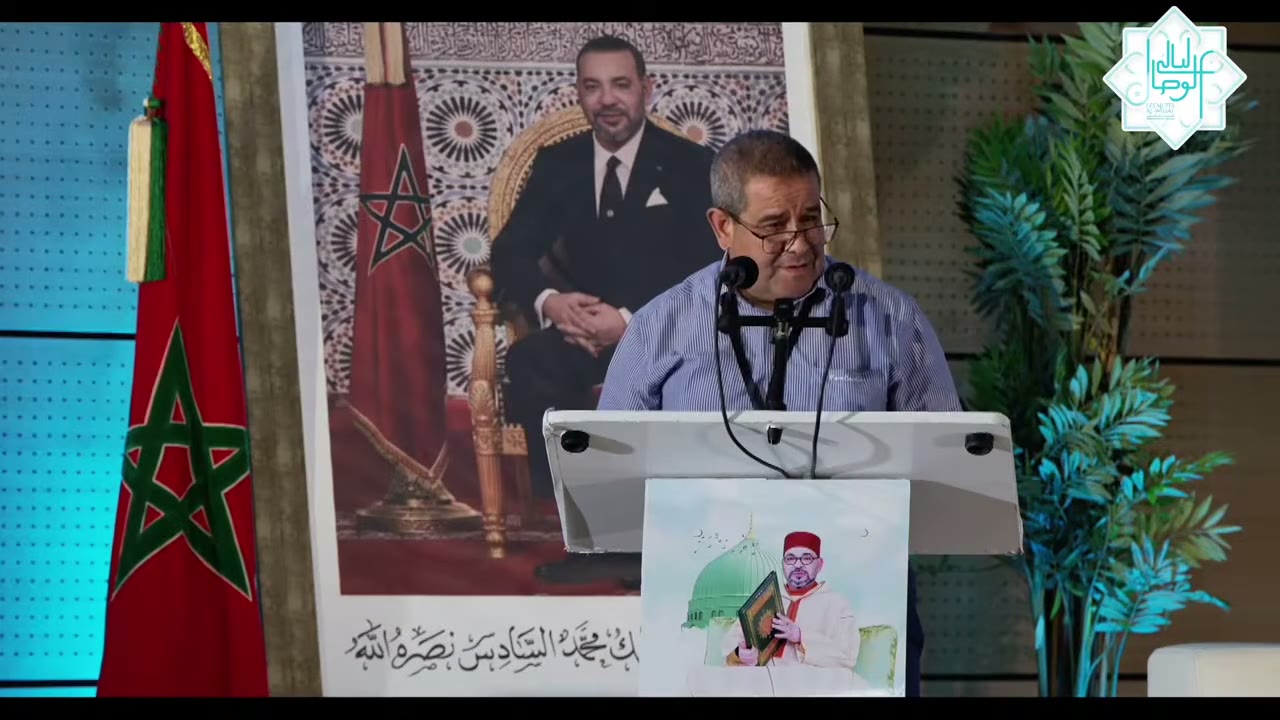
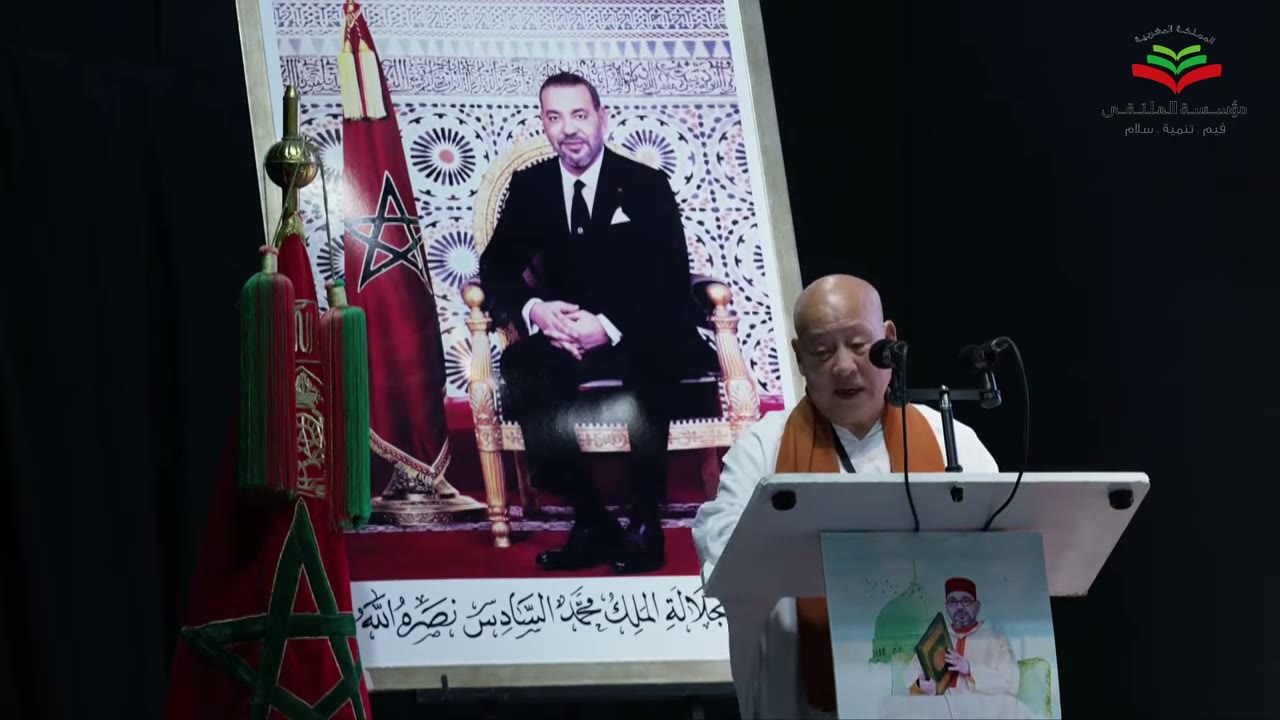
A talk by Dr Federico Salvaggio, researcher in Sufism, speaking at the World Meeting of Sufism (21st edition), taken from episode 330 of the series Layali al-Wissal (‘The Nights of Union’), broadcast on 25 October 2026 on the channel of the Al Moultaqa Foundation. Delivered in French; the extract opens on the first words of the talk, ‘In this talk’. It is preceded in the live broadcast by a brief welcome address in Arabic.
Extract of 11 min 19 s (01:25:56 to 01:37:15). Original full video: Layali al-Wissal, episode 330, Al Moultaqa Foundation channel.
Two orders, one principle
The talk opens with a framing: to understand the Imarat al-Mu’minin, the Command of the Faithful of which the King of Morocco bears the title Amir al-Mu’minin, one must see it as an institution situated at the junction of two orders, the spiritual order and the temporal order, whose vocation is to unite them around a principle that surpasses them and gives them their meaning: the Muhammadan heritage, al-wiratha al-muhammadiyya.
This framing comes into its own at the time of the mawlid. The birth of the Prophet, peace and blessings be upon him, is not only a historical anniversary: it is the occasion to reflect on the transmission and presence of this heritage as a living principle of knowledge and orientation.
The speaker’s first gesture is critical. Modern Western categories have grown accustomed to separating the religious sphere from the civil sphere, two domains that would have to be kept rigorously distinct to preserve each one’s independence. This conception presupposes that the two orders are autonomous and can enter into competition or conflict. The word ‘secular’ itself, he recalls, comes from the Latin saeculum, the century, the temporal condition of manifestation.
A separation foreign to tradition
In the perspective of Muslim metaphysics, this separation cannot be absolute. Nothing that manifests is truly separated from its principle: all that appears belongs to the order of theophany, of tajalli. This is why the temporal order cannot find its own measure in itself: it requires an orientation that surpasses it and orders it beyond contingency.
The speaker then cites René Guénon, known in the land of Islam under the name Abd al-Wahid Yahya, for whom this absolute separation between spiritual and temporal is totally foreign to traditional civilisations. In their perspective, the two are not competing forces but functions whose harmony depends on their attachment to one and the same superior principle. To the spiritual order fall authority and knowledge of the principles, with the capacity to ensure their transmission; to the temporal order, power, action, government and the organisation of collective life.
Action thus receives its right orientation from the knowledge of principles. The speaker borrows from Aristotle the image of the unmoved mover: unmoved in itself, it is nonetheless the principle that sets all things in motion. Likewise, the temporal order finds its full measure only when it remains ordered to a principle that surpasses it. Wisdom and action form two complementary functions: wisdom, stable and unmoved in the knowledge of principles, gives the direction; action is its realisation in the temporal order.
Tradition has long expressed this articulation through the notion of consecration, of royal unction. In traditional civilisations, temporal authority was never conceived as a reality sufficient to itself: it received its legitimacy, its orientation and its measure from a principle that surpassed it. Confucius spoke of the mandate of heaven; he who governs does not find in himself the principles of his authority, he receives a charge, an orientation and, with it, a responsibility.
In the Muslim tradition, the same articulation is inscribed in the very conception of al-din wa-l-dawla, of religion and state: not two foreign realities, but dimensions called to be ordered to a superior principle that precedes and encompasses them. It is here that the Muhammadan heritage takes on its full meaning: it makes it possible to understand how the link with the prophetic origin can perpetuate itself in time as a continuous presence of living knowledge and orientation.
A consecrated authority
Here comes the heart of the talk: the Amir al-Mu’minin exercises a consecrated authority, not in the sense of a merely secular construction, but of a charge attached to a superior order and invested with a particular responsibility. The title itself is revealing: it is not a purely temporal charge, but a responsibility toward a community defined by faith. The temporal function is thus oriented toward an end that surpasses it: justice, peace, the protection of the deserving, the continuity of transmission and the preservation of the conditions allowing spiritual life to flourish.
Its most significant sign is the bay’a, the pledge of allegiance. It possesses a profound spiritual dimension: it represents not only a political link, it creates an attachment that goes back to the prophetic origin and beyond, to God Himself. The speaker cites at this point the verse of surah al-Fath (The Victory, 48:10): ‘Indeed, those who pledge allegiance to you pledge allegiance only to God.’ The bay’a thus appears as an act of attachment and transmission, which inscribes the link between the amir and the believers in a continuity linking the people to sovereigns, sovereigns to the prophetic heritage, and the latter to its living principle.
The Moroccan model
It is in this perspective that one must understand what is particularly remarkable about the Moroccan model: it gives a living and active form to the continuity of the link that the bay’a expresses and transmits. Two complementary dimensions are united there.
On the one hand, the function of the Imarat al-Mu’minin attaches authority to the prophetic origin itself. This link is confirmed by the nasab sharif of His Majesty: the Sharifian lineage reinforces, within the historical and genealogical transmission, the links with the prophetic source and manifests its permanence across time and generations.
On the other hand, traditional institutions, through the ulema and the masters of the paths, ensure for Morocco the living transmission of the traditional teaching of Islam. This rests on the continuity of a knowledge transmitted from generation to generation, from master to disciple, according to chains of transmission authenticated and verifiable which, through the system of isnad and silsila, link the received knowledge to its sources and, in the last instance, to the Prophet and to the Revelation itself.
These two dimensions cannot be dissociated: one anchors and protects, the other vivifies and transmits. The Moroccan model can thus be understood as a civilisational model founded on the articulation of an authority that protects and supports, a knowledge that preserves itself and is transmitted, and a spirituality that flourishes. All this converges toward one and the same end: a unified life under the gaze of the One.
What this talk says of the path
The teaching of Sidi Mounir al-Qadiri Boutchich, shaykh of the Tariqa Qadiriya Boutchichiya, extends this tableau: in the same vigil, he treats in Arabic of sincere love, from hearts’ remembrance to the work of limbs, then in French of virtuous companionship, a path to God. The articulation between a spiritual order that transmits and a temporal order that protects is also that which every Sufi path lives: knowledge passes from heart to heart through the silsila, and it requires institutions to endure.
In the evening’s running order, Sidi Mounir’s talk ‘Sincere love’ and ‘Virtuous companionship’ are broadcast in the same episode; Dr Abd al-Wahhab al-Filali’s talk on the Moulidiyat opens the session of communications.
Frequently asked questions
What are the spiritual order and the temporal order according to this talk?
Two complementary functions, not two sealed spheres: to the spiritual order fall authority and knowledge of the principles, to the temporal order power, action and government. Their harmony depends on their common attachment to a superior principle, the Muhammadan heritage.
Why is the modern separation between religion and politics problematic?
It rests on the idea of two autonomous and competing orders, born of the secular (from the Latin saeculum, the century). In the perspective of Muslim metaphysics, nothing that manifests is separated from its principle: the temporal order does not find its own measure in itself and requires an orientation that surpasses it.
What role does the bay'a play in the legitimacy of the Amir al-Mu'minin?
The bay'a is not a mere political allegiance: it creates a link that goes back to the prophetic origin and beyond, to God Himself. The Qur'an says of the companions who had pledged allegiance: 'Those who pledge allegiance to you pledge allegiance only to God' (surah al-Fath, 48:10).
How does the Moroccan model illustrate this articulation?
Two inseparable dimensions: the Imarat al-Mu'minin attaches authority to the prophetic origin, confirmed by the nasab sharif (Sharifian genealogy); and the traditional institutions, the ulema and the masters of the paths, ensure the living transmission of knowledge through chains of isnad and silsila. One anchors, the other vivifies.