Dhikr questions: meaning, benefits and what a session looks like
Contents
Many visitors to this site ask the same questions about dhikr: what it is, what it is for, what a session is actually like. Here are the answers, followed by links to the pages that develop them further.
What is dhikr?
Dhikr is the invocation of God: the repetition of a sacred formula, most often ‘la ilaha illa Llah’, while maintaining the presence of the heart. It is not a mechanical recitation. The whole Sufi tradition insists that dhikr must be done ‘with awareness’: the tongue speaks, the heart accompanies.
The word comes from the Arabic dhakara, ‘to remember’. Dhikr is therefore a reminder: a reminder of God, of His presence, of the divine oneness that the shahada proclaims. The Qur’an prescribes it explicitly: ‘O you who believe, remember God often, and glorify Him morning and evening’ (surah al-Ahzab, XXXIII, 41).
What happens in a dhikr session?
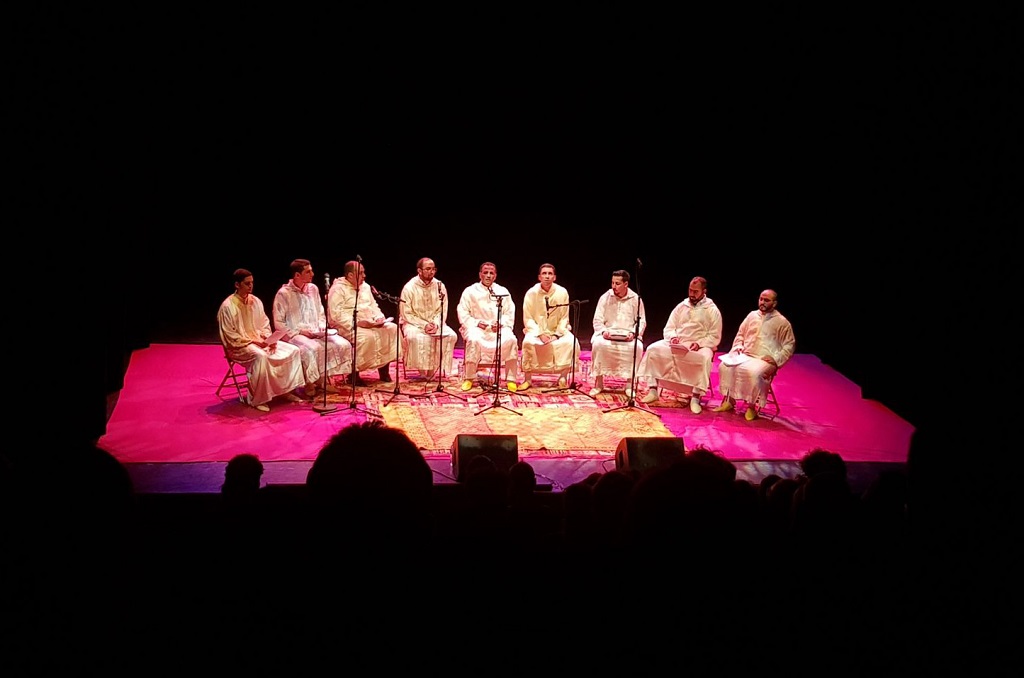
An open session on soufisme.org follows a simple pattern: a period of silent meditation to gather oneself, then the dhikr formula intoned by one participant and taken up by everyone else in a slow, measured rhythm. The guide, or one of those present, may then offer a short teaching. Everyone is free to remain silent or to join in.
The exact format varies from town to town and from evening to evening. The dhikr session page describes the format; the town pages (Paris, Lyon, Marseille) give times and places.
What are the benefits of dhikr?
The tradition reported by al-Bukhari and Muslim relates this word of God: ‘I am with My servant for as long as he invokes Me, whether lying down or standing, or unseen.’ Dhikr is thus, first of all, a way of being present to God, not a technique with an automatic effect.
What the practice brings, those who practise it describe for themselves: a calming of the heart, a greater availability to what is, a regular reminder of what gives life its meaning. Al-Tirmidhi reports this hadith: ‘The best of invocations is the invocation of the testimony of faith.’ Regularity matters more than intensity: a little dhikr done with presence is worth more than a great deal done while thinking of something else.
For further reading, the article The benefits of dhikr and the interview What is dhikr? develop the subject.
What is the difference between dhikr, meditation and prayer?
Three practices often confused, three different functions:
- The ritual prayer (salat) is a codified act of worship: set positions, recited verses, times fixed by the sunna. It is the pillar of Muslim practice.
- Meditation is a time of inner silence: one gathers oneself and lets the mind settle. In the sessions of the path, it prepares the ground for dhikr.
- Dhikr is the invocation itself: the repeated formula, the remembrance of God kept in the heart.
They complement one another: meditation prepares the presence, dhikr sustains it, and the ritual prayer gives it its place within Islam. The article Some symbols of prayer sheds light on the meaning of the salat.
Can you practise dhikr alone or in a group?
You can recite the formula at home, with a sincere intention. But within the path, dhikr is not merely a formula: it is a transmission. The wird (the formula prescribed by the guide) is received from a master, and its regular practice forms part of a spiritual companionship.
The group is not obligatory, but it helps: the shared rhythm, the presence of others, the guide’s teaching. This is why open sessions exist: to let people taste the practice before committing themselves. The page Can you be a Sufi without being Muslim? explains what is open to everyone and what belongs to commitment.
Where can you attend a dhikr session in France?
Open sessions of meditation and dhikr take place in several towns: Paris, Lyon, Marseille, Avignon, Nice, Montpellier, Antibes and Yvelines. Each town’s page gives its own times and arrangements, and the contact form lets you ask a question before coming.
For other frequently asked questions, the Sufism in the West FAQ and the questions about Sufism hub gather the editorial team’s answers.
Frequently asked questions
What is dhikr?
Dhikr is the invocation of God's name: repeating a set formula, most often 'la ilaha illa Llah', while keeping the heart present. The Qur'an prescribes it: 'remember God often' (surah al-Ahzab, XXXIII, 41).
What happens in a dhikr session?
Open sessions on soufisme.org begin with a period of silent meditation, then a participant intones the formula which the gathering takes up in a slow, measured rhythm. You are welcome to come and listen without asking anything in return.
What are the benefits of dhikr?
The tradition reported by al-Bukhari and Muslim holds: 'I am with My servant for as long as he invokes Me.' Dhikr calms the heart and opens it to the presence of God; it is not a technique with an automatic effect, but a practice that asks for regularity and presence.
Can you practise dhikr alone or at home?
You can recite the formula at home with a sincere intention, but the dhikr proper to a path (the wird) is transmitted by a guide. Open sessions let you taste the practice in a group before any commitment.