"Lettre ouverte à ceux qui critiquent le soufisme": a review
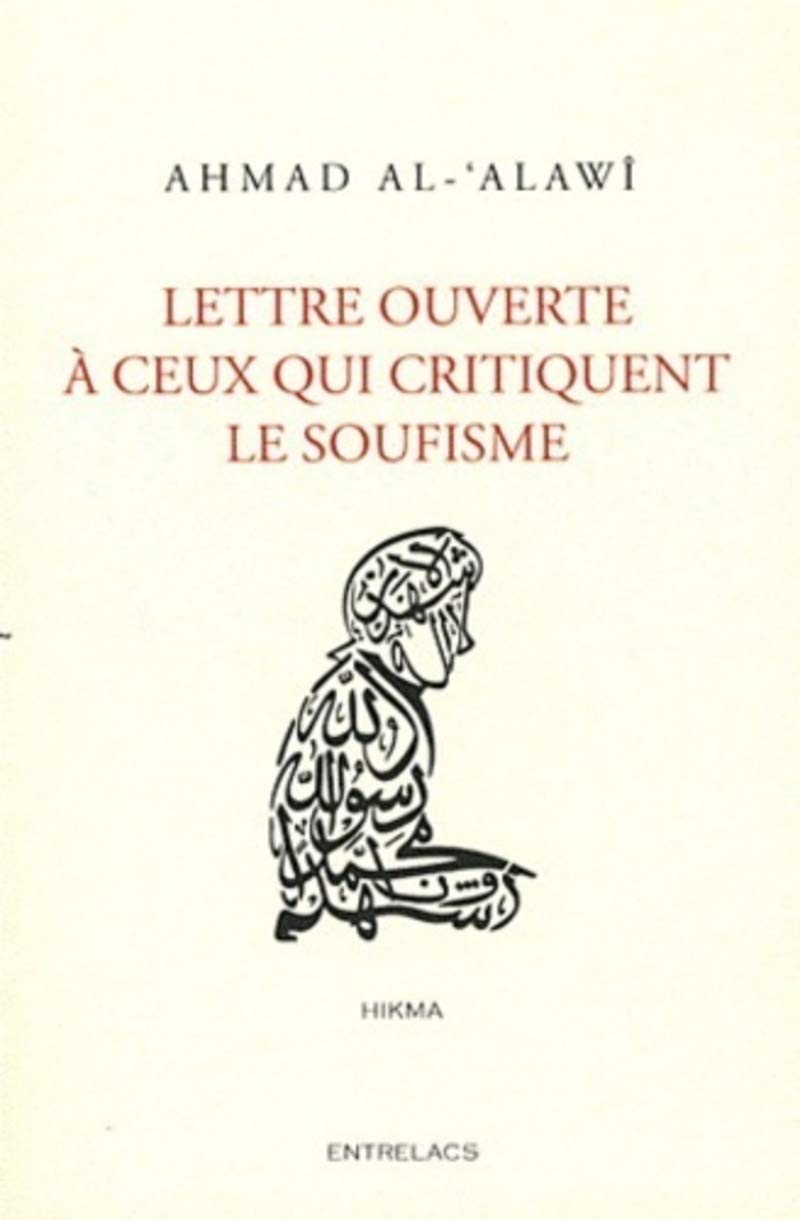
Author: Shaykh Ahmad al-’Alawi. Publisher: Entrelacs, “Hikma” collection, 2011.

A century after it was written in 1920, this treatise in defence of Sufism remains as pertinent and topical as ever. The Entrelacs publishing house had the happy idea of reissuing the work in their “Hikma” collection in 2011, calling once more on M. Chabry for the translation (which he was thus able to bring up to date); this gave a new lease of life to Shaykh Ahmad al-’Alawi’s finely argued text.
Regarded by some as the spiritual pole of his time, Shaykh al-’Alawi (1869-1934) was initiated into the Darqawiyya path1 by his master Sidi Muhammad al-Buzidi, who named him as his successor before he decided to found the ’Alawiyya tariqa2 in 1914.
He wrote several works in various styles, among them an esoteric commentary on a classic work of fiqh3, the Murshid al-Mu’in of Ibn ‘Ashir, in Les Très Saintes Inspirations ou l’Éveil de la conscience, and a collection of spiritual poems (diwan) used for the sama’4.
La Lettre ouverte à ceux qui critiquent le soufisme was published in 1921, in response to a polemic aimed at the Sufis, more precisely at a jurist by the name of Shaykh5 ’Uthman Ibn al-Makki, a teacher at the great mosque of Tunis. Ibn al-Makki had published Le miroir (The Mirror) in 1912, a text which constituted the first public attack on Sufism on the part of Tunisian religious reformists influenced by the ideals of Salafism; a bold move at a time when tasawwuf6 was respected by all in most Muslim countries.
The Lettre ouverte à ceux qui critiquent le soufisme is not, strictly speaking, divided into chapters or parts, since it replies point by point to the attacks of the author of The Mirror, in a rather incisive style, given the gravity of the accusations made. Most of the themes habitually taken up by the detractors of Sufism are discussed and argued out one after another. Ibn al-Makki’s whole line of reasoning consists in branding the Sufis as innovators in relation to the Islamic tradition and accusing them of distorting prophetic sayings or passages of the Qur’an, ending in extremely violent accusations against them: unbelievers, liars, profiteers, opportunists, nothing is spared them.
In his reply, Shaykh al-’Alawi begins by warning Ibn al-Makki about the divine Jealousy, which will surely come to the defence of His friends and worshippers. For in a famous hadith qudsi7, Allah said: “Whoever harms one of My friends, I declare war on him.” In another hadith, the Prophet himself, may God’s peace and blessings be upon him, renewed this warning: “The people of my family and the friends of my community are two poisonous thickets: whoever rubs against them is pricked!”
The author of The Mirror is then sent back to his own attitude, a strange one indeed when set against what is recommended for Muslims. A thoroughly egotistical attitude, in the end, since he regularly confuses his own judgement with the Truth and installs himself as legislator, with no legitimacy at all. Here is the passage in which he is apostrophised on the subject (p. 33): “You have poured out reproaches, combing through things of no interest; you believed yourself the sole and unique representative of Sunni orthodoxy, the rest of the universe being peopled by the ignorant, by innovators, or by errant transgressors. Yes, that is indeed how you judge the sons of your own religion!” It is then recalled, among other things, that calumny is considered a very grave sin in the Qur’an (24, 17): “God adjures you never to do the like again, if you are believers.”
Conversely, several other hadiths and passages of the Qur’an invite Muslims and believers as a whole to behave well towards one another, the Prophet being the supreme model of this attitude, as described in the Qur’an (9, 128): “full of concern for you, kind and merciful towards the believers”. Another hadith quoted invites Muslims to show mercy: “He who is not merciful towards men, God will not be merciful towards him.”
This briefly describes the joust as it appears in the opening of the work. It continues thereafter with very thorough replies on other themes such as dhikr8 and its legitimacy, the definition of innovation in religious matters (bid’a), the spiritual states (ahwal), the view of the four legal schools on Sufism, the cases of dancing and sama’, of loud invocation, of the cantillation of the Qur’an, of the celebration of the mawlid9 and the use of prayer beads. There are also some very fine quotations from great scholars of Islam, such as this definition of Sufism by Imam Junayd (p. 95): “it is that God should make you die to yourself, so as to make you live in Him”, or the view of Imam Malik (p. 114): “whoever practises Sufism without the Law is a heretic, whoever follows the Law without practising Sufism has gone astray; only the one who joins the two together realises the Truth.”
To read this treatise in 2021 is to grasp the ideological upheavals the Muslim countries have undergone over a century, and the inversion of the balance of power that gradually took place in their media. In the continuity of René Guénon’s work10, one observes with hindsight the degeneration of traditional societies in the face of a runaway modernity whose advent coincided with the triumph of reformisms of every kind (Wahhabism, Salafism and the like) and the marginalisation of the Sufi communities.
For followers of Sufism, this treatise is a veritable self-defence manual, for its hard-hitting arguments, drawn from sure sources, admit of no reply. Reading it also allows one to watch the shaykh’s tarbiyya11 at work in the way he conducts himself and treats his detractor. Alternating benevolence and “jealousy”12, it is of great interest to see fine conduct in action in the shaykh’s answer to accusations so grave. For the Sufis, polemic is a last resort when every other solution has been exhausted. Despite his knowledge of the tradition, he warns against the individual interpretations of the traditional sources that led the author of The Mirror astray, and he always cites them with the greatest humility. One also notes Shaykh al-’Alawi’s effort to keep a good opinion of the other (in this case ’U. al-Makki), as the excellence of conduct requires and as the following verse of the Qur’an recalls (25, 63): “the servants of the All-Merciful are those who walk humbly upon the earth, and who, when the ignorant address them, say: Peace (salam)”. Nor does Shaykh al-’Alawi deprive himself of a few strokes of humour that season the text, as in this passage (p. 55): “Until then, nothing enabled these adversaries of the tradition to be identified, but you then specified clearly, ‘such as the Sufis of our time’. On reading this, I said to myself: ’there it is, the baby the shaykh (here ‘U. al-Makki) has just given birth to is starting to cry.’ The evil you were alluding to, the subject of this whole epistle, is now clearly identified: Sufism, a calamity of the gravest kind in your view!”
We believe that reading this book carries several benefits and, as has already been said, its anchoring in the tradition means it has not aged a day. It also allows a better understanding of the relations between exotericism and esotericism in traditional Islam13, and of the written sources on which the Sufis rely (Qur’an, hadiths, sayings of saints and recognised scholars). We should salute in this regard the translator’s extraordinary work of referencing the hadiths cited, made possible by the new resources of the digital age, and the very interesting notes which illuminate and broaden the author’s remarks. For those who wish to hear another point of view and to be better informed about what tasawwuf is and is not, exclusively on the basis of authentic sources of the Muslim tradition, this is a work that has lost none of its bite.
Footnotes
-
Itself an extension of the Shadhiliyya path founded by Abu-l-Hasan al-Shadhili. ↩
-
Named, beyond the shaykh’s own name, in reference to the Most High (A’la in Arabic) and to Sayyiduna ’Ali, often considered the father of the Sufis. ↩
-
Islamic jurisprudence. ↩
-
A Sufi practice consisting in singing spiritual poems in a group, often written by great Muslim saints. ↩
-
Shaykh, sometimes rendered “elder”, is a general term designating both a scholar and a master educator. ↩
-
The Arabic name for Sufism. ↩
-
In a most sacred tradition (hadith qudsi), it is God who speaks in the first person through the mouth of the Prophet, peace be upon him. ↩
-
Dhikr, the remembrance of God, is at the centre of Sufi practice. ↩
-
The Prophet’s birth, peace be upon him, commemorated each year on the twelfth day of the lunar month Rabi’ al-awwal. ↩
-
The author notably of La crise du monde moderne and Orient et Occident, in which these themes are addressed, some years after the publication of the treatise under review here. ↩
-
Spiritual education. ↩
-
See the hadith qudsi quoted above: “whoever attacks one of My friends, I declare war on him”. ↩
-
At the symbolic level, exotericism is often associated with the image of a covering or a container. In parallel, esotericism corresponds to the heart or the content (wine, milk or water). ↩