"Au seuil de l'aube, un cheminement soufi": a review
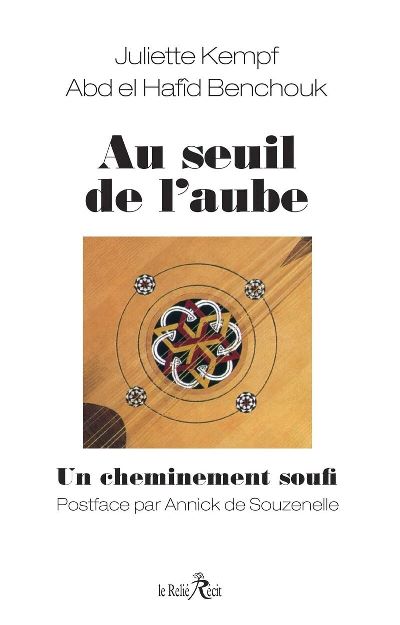
Juliette Kempf is an actress, dancer, theatre director and practitioner in psychiatric settings. Abdelhafid Benchouk is moqadem (representative) of the Naqshbandiyya path in France and director of the Maison soufie in Paris.
The authors show that the initiatic journey remains a matter of individual discernment and inner travelling. Written in the first person, this account of an experience shows how the peace developed within can find expression in presence, in deeds and in words, amid the vicissitudes of daily life and the urgencies of our present situation.
Abdelhafid Benchouk describes how, during a solitary retreat, he experienced peace and inner serenity, the connection with the One: the whole challenge lies in abiding in that state of serenity and detachment whilst living in the world of action, of work, of family.
He explains how his spiritual practice of Sufism constitutes a food for the heart and makes it possible “to be in the world without being of the world”.
The style, at times poetic, is marked by emotion and sensitivity, yet never lapses into sentimentality: one senses the nostalgia for Being breaking through, the desire for the return to the One, and it is in this that the experience concerns us all.
The authors describe the progressive opening of the Sufi paths to the outside world, through the history of the Naqshbandiyya path and of Shaykh Nazim. They also analyse the renewal of spiritual Islam in the West, on the basis of René Guénon’s monumental work: this revivification proves more than necessary if the horror of Islamic terrorism is to be fought.
The inner journey reveals that there are no things sacred or profane in themselves, only a sacred or profane point of view: any act can be sacralised for the one who knows how to see with the eye of the heart.
The authors describe the links between the outer rituals and the spiritual journey, and the necessary complementarity between the exoteric and the esoteric (prayer, obligatory alms, the fast of the month of Ramadan, pilgrimage). They invite us to read the divine signs, to see beyond the visible, to come out of a narrow and death-dealing literalism, and to learn to reconcile the outward forms with the inner senses, thanks to the breath of the spirit.
The essential thing is to taste, to experience the spiritual flavours, to know them with one’s whole being and not merely from a mental standpoint: what is required is a work of inner transformation, the Sufis’ “greater striving”.
This experience also makes it possible to reconcile, subtly, our free will and our responsibility with submission to the divine will.
Throughout this quest, all the arts can serve as a support for travelling towards the origin (music, poetry, architecture): “Is the true artist not a bridge, casting the cord woven of his poetic intuition between this world and other worlds, bearing witness before all our eyes of flesh to what the eyes of the heart have seen?”
The authors also address the painful yet liberating function of trial, which allows the heart to open, to be fruitful, like the woman who undergoes the pains of childbirth.
How are we to sacralise the acts of our existence? How are we to see the divine signs that manifest themselves, how are we to see, beyond the visible, the symbols everywhere present? “To see these symbols in things is to set out on the traces of His presence in the world.” Our dealings with those around us, spouse, children, relations, offer so many occasions to rise spiritually.
The authors finally evoke the deep imbalances of our modern society, oriented solely towards having and quantity, disconnected from the Real, which has relegated the notions of Being and quality to the background. They observe “the traces of the materialist thinking that dominates our contemporary cultures, and the lack of spirituality by which they are suffocated”.
To conclude with a message of universality and openness, Islam and Sufism are presented as a path that leads back to the Source, on the same footing as the “religions of the Book” (Judaism and Christianity), but also as all the revelations issuing from the primordial Tradition.