'The Conference of the Birds' by Attar: a review
Contents
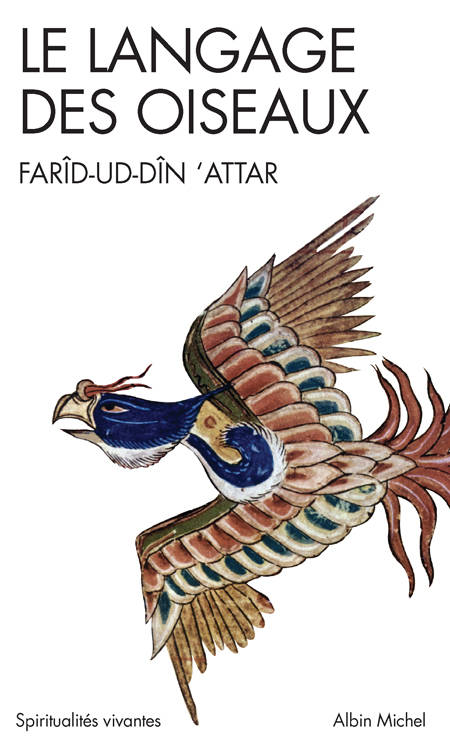
Author: Muhammad Farid ud-Din ’Attar.

The quest for the Secret
Muhammad Farid ud-Din ’Attar lived in Nishapur, in present-day Iran, from around 1150 to 1220, in a Sunni milieu like the great majority of Iranians of that period. ’Attar (a name meaning “perfumer”) owes his sobriquet to his trade as an apothecary and perfumer. He was also a spiritual master. He wrote a great deal, but his poetic work The Conference of the Birds (Mantiq ut-Tayr, “The Language of the Birds”) remains his masterpiece, known throughout the world.
It is a pedagogical work of the first order: ’Attar presents himself as a physician of the soul; he who has advanced on the Path wants to transmit his knowledge to those whom the search for the True attracts. His text is a long poem of 9000 verses which he offers to his disciples and to all who will come after them.
This story of the birds is in fact that of souls in quest of the divine Light. Each journeying in its own fashion, overcoming the obstacles, or not, to reach the ultimate goal, or not.
The text is in close connection with the Qur’anic message; numerous verses are quoted or evoked, as are the prophetic sayings.
The birds assemble
The text opens with a very long praise of God, comparable to a prayer. Then come praises of the Prophet himself and of the first four caliphs. This long introduction ends with a remarkable passage against the fanaticisms that divide the Muslim world. The master’s intention to teach is already very perceptible at this stage.
Then the birds appear. The author greets each of them, each associated with a prophet, in particular the hoopoe associated with King Solomon, she who served as messenger to the Queen of Sheba to show her the way of divine Oneness.
As with Solomon in verse 16 of the surah of the Ants: “And Solomon inherited from David and said: ‘O people! We have been taught the language of the birds; and we have been given a share of all things. Truly this is the manifest grace’”, ’Attar endeavours to initiate us into the language of the birds, that is, of souls.
And so we enter the heart of the matter: the birds want a king, for everyone has a king. The hoopoe knows who the king is: a sovereign majesty, the Simorgh, so near and so far away…
The Simorgh is a mythical creature of the Zoroastrian tradition, the Persian monotheistic religion, serving as a metaphor for the divine in that tradition’s sacred book. The hoopoe gives them so beautiful a description of the Simorgh that all the birds decide to follow her and set out in search of her. The hoopoe nevertheless warns them that the journey will be long and beset with pitfalls; but when Beauty is described to you, who can resist?
Very soon they are seized by anguish, by scruples, by mistrust, and find good reasons not to go. All the tendencies of the human being are thus described, and each time the hoopoe replies with an edifying story upon which each can meditate. One prefers to stick to his ablutions, another seeks only paradise, yet another thinks he has already arrived…
While each of these stories is short, it is the longest, the most laden with meaning, the story of San’an, which convinces them to attempt the adventure. For this shaykh, esteemed by all, leaves Mecca one day, leaves his disciples, his faith, to follow the Lady of Beauty. It is the prayers of his disciples that will cause God to bring him back to the Path, and the Beautiful Lady will follow him. This magnificent lesson on transcendence and immanence wins the birds’ assent, and they finally decide to commit themselves under the hoopoe’s leadership, to whom they swear allegiance.
The seven valleys
But already new scruples appear, to which the hoopoe replies with other tales: it is the Divine’s gaze upon one of His creatures that causes it to accede to Reality. On the Path:
Many are those who from afar have come hither
some were burnt and others illumined
with fire and with light. Then after a whole life
having reached a goal, they became greedy
and the goal then vanished from their sight1
Yet divine Goodness and Mercy are infinite: it is better to set out and be constant; sincere repentance is taken into account whatever the belief or the fault:
“Before Him all crimes are a raindrop”
Through all these behaviours that hold the soul back in its quest, ’Attar explains to us what true humility is and how to put away everything that is an idol. He insists, though, that divine Beauty goes hand in hand with Majesty, so that the wayfarer finds himself ceaselessly between fear and hope.
’Attar enchants us with his verses and his counsels of wisdom and Knowledge:
Renounce this heap of mud and illusions!
To the greatness of the soul, open your eye, see the Way!
Set foot on the Way and behold the celestial Threshold!
Once your soul has reached that Threshold
haloed in glory, you will become so great
that you will no longer fit within the universe.
This part of the poem is central in the work and the longest too; it constitutes the heart of the author’s pedagogical message. To convince us, he summons the most prestigious masters: Rabi’a, al-Hallaj, al-Basri, al-Junayd, to name but a few. And the prophets too, above all Abraham, Solomon, Muhammad.
Many birds still hesitate despite their pact and their guide; the hoopoe, through many examples, explains to them what right conduct is: loyalty, faithfulness whose source is love, true humility.
The birds finally set off, but at each of the seven valleys crossed, from Desire to Annihilation, some are stopped by their own inner demon. For it is indeed a matter of polishing one’s heart so that the divine Beauty may be reflected in it, and not all are ready for that difficult work.
The Simorgh unveiled
We follow the journey of the birds, of souls that is, through these various valleys, and the hoopoe guides them in each. Few of them reach the end of the journey, which lasts a whole lifetime, ’Attar tells us. Only thirty will have their reward. It is divine Grace that lifts the last veils, and the Simorgh is finally revealed: the Simorgh is the thirty birds2:
And when they looked at both the Simorgh and themselves
they saw themselves as One, in the Simorgh, or nearly so
They have attained His image within themselves, for their heart is polished enough to reflect it.
From that point on, words cannot reach to explain the ultimate secret, which no allegory can render any longer.
In his epilogue, the perfumer-master hopes that his readers have heard and understood him; but before the Secret, silence alone is golden. He chastises himself for having undertaken this work, since all is nothingness if not the Being, and he has doubtless shown vanity despite his good intentions.
And so, once again, as so often throughout the poem, he leaves us in perplexity before apparent contradictions.
The French translations
This work has been translated into French, first in 1819 by Garcin de Tassy, in prose.
More recently, Leili Anvar produced a verse translation accompanied by 207 paintings from the fourteenth to the seventeenth centuries which have accompanied this text in the Muslim East, from Turkey to the confines of India. Each one is provided with an enlightened commentary giving the symbolic keys in direct connection with the wise poet’s text. (In English, the poem is best known through Dick Davis’s verse translation, The Conference of the Birds.)
Myriam Bérot
References
- Le Langage des oiseaux (trans. Garcin de Tassy, 1819), Paris, Albin Michel, 1996, 354 p. (ISBN 978-2-226-08513-9); and Albin Michel, “Spiritualités vivantes” collection, 2020 (ISBN 978-2-226-45239-9).
- Le Langage des oiseaux. Manteq ut-Tayr (complete verse translation, introduction and notes by Manijeh Nouri, foreword by Mohammad Reza Shafi’i Kadkani), Paris, Cerf, 2012, 505 p. (ISBN 978-2-204-09636-2).
- Le Cantique des oiseaux d’Attâr illustré par la peinture en Islam d’Orient (complete verse translation from the Persian by Leili Anvar; scientific direction of the iconography by Michael Barry), Paris, Diane de Selliers, 2016, 470 p. (ISBN 978-2-36437-066-1).