The flavour of spiritual experience
Contents
’To him who is given to be illuminated from within, the universe appears with a brilliant and irresistible certainty as being, at that very instant, in its totality as in all its parts, perfectly just.
That is, without it being necessary to seek the least explanation or justification beyond what it is, quite simply, itself. Existence then not only ceases to be a problem, but one remains in wonder before the evidence and the efficacy of things in their rightness.
There are therefore no words strong enough to express the perfection and beauty of this experience. Its clarity sometimes gives the sensation that the world has become transparent or luminous and that, in its simplicity, it is at once penetrated and ordered by a supreme intelligence. At the same time, the one who undergoes this experience often comes to perceive the whole universe turning into his own body. What he is, like everything around him, does not seem to him the result of a becoming, but an immutable presence. This is not a loss of identity to the point of being able to look through another’s eyes, but rather a state in which individual consciousness and existence are brought back to a point of view adopted, at that instant, by something immeasurably vaster than himself’1.
Sufism, or ‘complete’ Islam
Do the words ‘mystical’, ‘initiatic’, ‘gnostic’ succeed in characterising the kind of experience at issue? To which domain of reality does spiritual experience correspond? What is its relation to the techniques employed to reach it, and to the gratuitousness and generosity of Life? Religious and philosophical doctrines strive to answer these questions by thinking through the methodology and the stages of this experience. The heirs of Abraham, for their part, attach their spiritual experience to the Law and to the presence of the one God, living and life-giving. From this perspective, man has access to the divine manifestations, which are tasted through energies revealed to him. The divine Essence, however, is beyond all expression and can be apprehended only through an apophatic approach that repels every form of limitation: He is not this, He is not that. Yet God nevertheless breathed His Spirit into Adam, as related in the Qur’an (XXXVIII, 71-72). In Islam, therefore, the accent always falls on man’s being, by the depths of his nature, ‘capable’ of God.
Islam, which is usually qualified as ‘mystical’ and which the West now calls ‘Sufism’, is in fact only ‘complete’ Islam, that is, Islam bearing an outer dimension and an inner dimension. There can thus be no dichotomy between these two dimensions: the haqiqa, the very essence of inner experience, and the shari’a, the religious Law, are indeed considered as the two wings of a bird. And no one can fly with a single wing, each wing being necessary.
The Sufis have meditated at length on the verse of the Qur’an in which God, questioning the germs of future humanity in the still uncreated Adam, asks them: ‘Am I not your Lord?’ (alastu bi rabbikum) (VII, 172). They all answered: ‘Yes!’ And it is to this pre-eternal covenant between the Adamic line and God that this innate faculty of knowing God is attached, a faculty that has set its imprint in the deepest reaches of the human soul. The anthropological sciences are incapable of giving a complete definition of man, and the criteria borrowed from language or reason always prove insufficient. If man is capable of God, then spiritual experience becomes the human act par excellence. We are made persons by God, through the encounter with God: God gives us our true being, and we remain an incomplete being as long as we have not lived this experience.
The tradition of Islam brings safeguards against the illusion lying in wait for whoever is engaged on the path of self-knowledge. For our imaginative faculties can take over and plunge us into a universe at the antipodes of a true consciousness of the Real. Fidelity to the revealed Law, together with the transmission and the counsels coming from those who have already accomplished such an inner journey, makes it possible to keep as far as possible from the powers of illusion. It is fundamental to remain rooted within a community; and it is, indeed, by going to the very end of one’s own tradition that one can rediscover the convergence with the other traditions.
Sufism is in no way a sort of supra-religion or para-religion, and it is not by effecting a more or less arbitrary syncretism that one truly reaches the end of the path. Where certain orientalists went wrong was in wanting, at all costs, to attach Sufism to other traditions and to have systematically sought influences external to Islam. They made of it now the reflection of Vedanta, now an adaptation of Christian mysticism, whereas in fact the first Sufi is the Prophet of Islam himself. The first Muslim community was thus a Sufi community: what could Sufism mean, if not the lived interiorisation of Islam in the most total respect for religious observance? Throughout history, the great Sufis have never been wayward individuals contenting themselves with a vague poetic or aesthetic sentiment, but on the contrary men and women deeply attached to the most respectful and most meticulous observance of the laws.
The ‘dance’, a support of teaching
All the aspects evoked sketch out Sufism as an individual spiritual experience, but Sufism is embodied above all, on a collective plane, in what are called the turuq, the brotherhoods. The word ‘tariqa’ means in a general sense ‘the way’ and designates more particularly a manner of living the spiritual path. At first approach, these brotherhoods present analogies with the Christian third orders as they existed in the Middle Ages, since there is no question here of monastery, nor of a vow of celibacy and withdrawal from the world. There is, on the other hand, the constitution of a centre, a spiritual hearth called ‘zawiya’ or ‘tekke’, forming around a master who embodies the function of bringing a living teaching, recognised by a chain of transmitters going back to the Prophet of Islam. This spiritual centre gathers, at given periods of time, the disciples, in search of spiritual realisation and having freely chosen to be guided by the master, who come together for the accomplishment of practices proper to the path.
One has sometimes spoken of Iranian, Turkish or Maghrebi Sufism, but such concepts are contrary to the nature of the teaching in question. There are, of course, Iranian, Turkish or Maghrebi Sufis, but there can be no national Sufisms as such. The spiritual method proper to a Sufi path is a matter of subtle dosage between the different practices, which ultimately falls to the spiritual master, who may have disciples living in different lands.
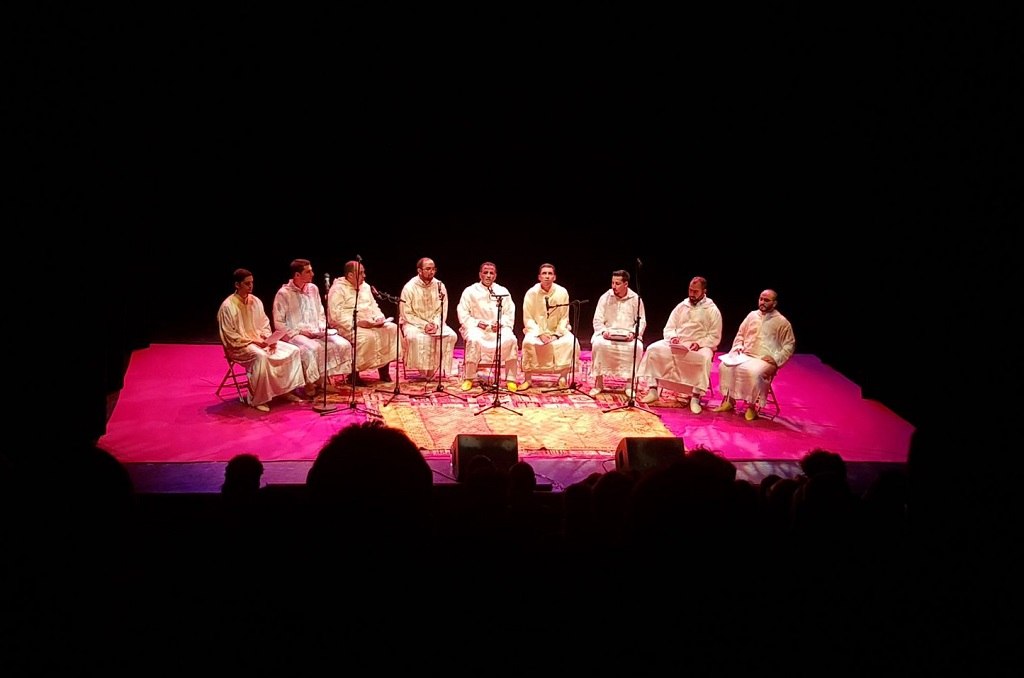
The Sufi brotherhoods offer teachings based on invocations performed aloud or in a low voice, individually or collectively. They are recited with a particular rhythm that harks back to a form of ‘dance’, sometimes spontaneous and sometimes induced. Breathing, gestures and postures imprint upon the body a vibration lived individually, but one that has a universal scope, since it corresponds to man’s inherent capacity to enter into contact with a potential energy that had lain dormant in the depths of his being.
The Naqshbandi path, for example, places a more particular accent on the aspects relating to the control of breathing and the breath. The Chishti path has a particular relation to the effects procured by music. The Qadiri and Shadhili paths lead to ecstatic states occurring during gatherings of chant, most often interpreted a capella. There is always an element of ‘dance’ in the teaching, at a more or less elaborate level. The whirling dervishes have carried this elaboration to the highest degree, notably in the rituals of sama’, or spiritual oratorio. The symbolism of the sama’ can be appreciated at a double level, just as man is a microcosm in the image of the macrocosm. There is thus a symbolism of a cosmic nature and a symbolism of a psychological nature, the latter term including the properly spiritual dimension. The ritual is punctuated by a rhythm that partakes at once of the cosmos and of man, and it constitutes a privileged support making it possible to leave the world governed by time and to touch eternity. Thus, at a certain moment of the ritual, time is supposed to be surpassed, the dance then being performed in silence and no longer to music. It is a particularly evocative expression of the path aiming at spiritual union.
Every technique, however, proves powerless without the aid of divine grace, which allows man to surpass duality to accede to primordial unity. The love of God is present in the human soul; and if it manages to express itself, on a horizontal plane, towards one’s neighbour, it is then through one’s neighbour that man acquires the strength necessary to rediscover, vertically, his Creator.
God is everywhere, but where is He to be found? In the heart of the one who lets Him enter entirely; and such an attribute is precisely the prerogative of the spiritual guide himself, who is the privileged gate of access to the Divine.
Eva de Vitray-Meyerovitch
Words taken from the France Culture programme ‘L’autre scène ou les vivants et des dieux’, produced and presented by Robert Amadou, broadcast on 16 July 1979 on the theme ‘Spiritual experience’.

Further reading
Footnotes
-
Jacques Masui (1909-1975), ‘De la vie intérieure’, Cahiers du Sud. ↩