Invocation: dhikr and wird on the Sufi path
Contents
Text written by a group of disciples of the Qadiriya Boutchichiya path.
Invocation, dhikr, is the privileged means of polishing and purifying the heart. This article explains what the term covers, what the wird is (the daily litany transmitted by the guide), the role of the formula la ilaha illa Llah and the effects the practice can bring about.

Remembering God: the meaning of the word dhikr
The term dhikr, most often used to designate the invocation of God, is a verbal noun drawn from the Arabic root dhakara: to remember something, to recall, to recollect, to call to mind often. The opposite of dhikr is therefore forgetfulness: our ego, in its tendency to assert itself as an autonomous entity, is inclined to forget, even to deny, the existence of its Creator. An antidote to that negligence, dhikr is mention of God, remembrance of God, an ever deeper awareness of His Presence: one remembers a thing after having forgotten it, and one recalls it with tongue and heart.
In the face of the negligence and distraction that are our daily lot, and which today’s society broadly encourages, invocation is a means of concentration and renewal, a return to the centre of our being. It is also a source of contemplation which nourishes our actions. Invocation is meant to settle into the Sufi aspirant’s life and become permanent, beyond the outward changes inherent in our human condition; indeed, it restores to those changes their deeper meaning, and forms the thread connecting the different moments of the day, charging them with a particular intensity. A Sufi adage recommends being constantly “outwardly with men, and inwardly with God”.
Dhikr can be practised at any time, and it nourishes the heart: it is regarded as the disciple’s “fuel” on his spiritual journey, his thirst for God being his “engine”.
Dhikr, the link between guide and disciple
By reviving the heart, dhikr frees us from our egoistic passions. As Sidi Hamza used to say: “Every man is a slave to something, except the men who are inwardly free. Invoke God so that you may become free.” Dhikr is the privileged moment of the spiritual guide’s teaching: the point of contact, the link that enables him to guide us. It is like a rubber that rubs out the illnesses of the heart. It should be practised as often as possible, and above all regularly. Little by little it becomes omnipresent in the disciple’s life, like the One whose remembrance it is.
The wird: the disciple’s daily litany
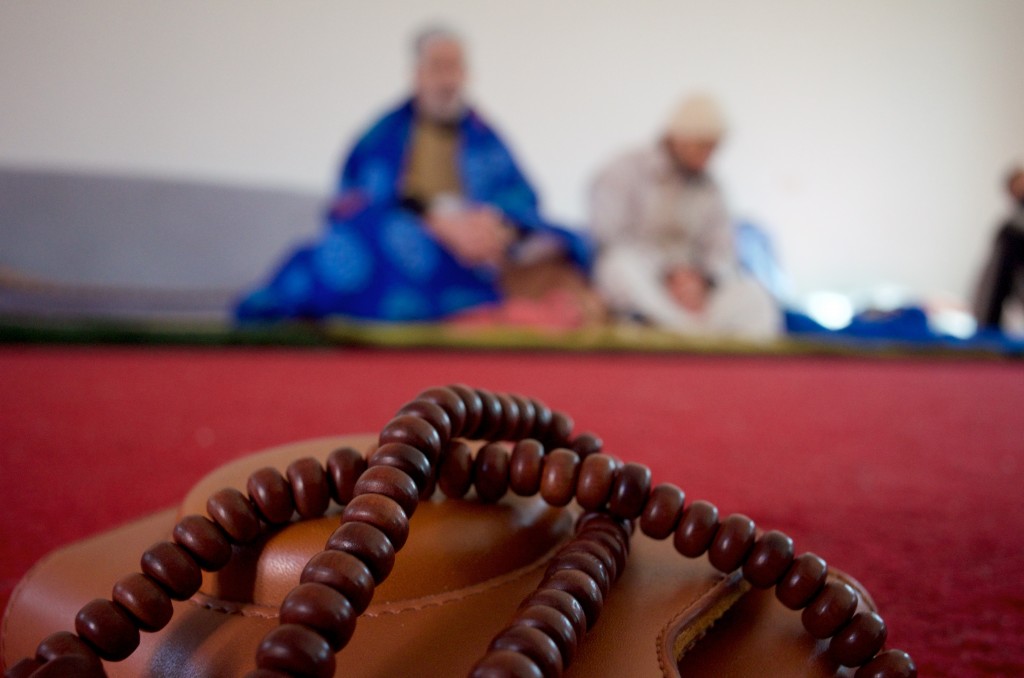
The wird is the set of litanies the disciple receives from his spiritual master when he commits himself to the Sufi path. The invocations that compose it are generally Qur’anic verses, pleas for forgiveness (istighfar), divine names and certain prayers upon the Prophet, in a given number and order. There is a particular secret in the number: a rosary is used to count the recitations exactly. It is the Guide, and he alone, who decides the composition of the wird.
The disciple is called to practise his wird regularly, most often morning and evening, according to the advice he has been given. It is one of the means of spiritual education. The first fruits of this discipline are most often a feeling of peace and serenity, and a conviction as to the authenticity of the Path. The Shaykh insists on not interrupting the wird: it is truly the spiritual tie that binds him to his disciple.
La ilaha illa Llah: the central invocation
Among the invocations of the wird, individual dhikr also consists in reciting the formula la ilaha illa Llah, the first part of the Muslim profession of faith. It affirms divine oneness and literally means “there is no god but God”: all the things to which we lend being and existence exist only through God; the sole Reality is God. It is the very essence of monotheism.
In the same way that the Prophet, peace and blessings be upon him, destroyed the idols of the sanctuary of Mecca to re-establish the worship of the one God, the disciple destroys the inner idols which occupy him and make him act (money, glory, power…) in order to affirm the absolute divine Presence. He strives to silence his ego, so as to act no longer according to his passions or the gaze of others, but according to the gaze of God fixed upon him. Instead of running from one desire to another, from one creature to another, he sets himself to recognise the Creator’s presence and to direct all his energy towards Him alone.
Persevering despite the soul’s resistance
Experience shows that at the beginning of the journey, the soul can shy away from dhikr, and particularly from the recitation of la ilaha illa Llah. As the adage goes, “he who wants the honey must be prepared for the sting of the bees”. The ego revolts against whatever runs counter to its passions and its authority. Sidi Hamza put it this way:
“Dhikr gradually makes desires and impure thoughts disappear, in the same way as hunters who go into the forest every morning and fire their guns: at first, all the animals, frightened, flee at the sound of the shots, then come back a little later in the day. But when they notice that the hunters return every day, they end up moving elsewhere.”
Regularity and perseverance are therefore needed. As one of the Hikam (wisdom sayings) of Ibn ‘Ata’ Allah puts it:
“Do not abandon dhikr because you are not present to God in it, for negligence of dhikr is worse than negligence within dhikr. It may be that God raises you from a dhikr done in negligence to one done in vigilance, and from that to one in which you become present to Him, and from that again to one in which you become absent to all that is not the object of your dhikr: ‘and that is not difficult for God’.”
The spiritual states dhikr can bring about
The practice can provoke certain spiritual states (ahwal) in the disciple, for our heart has lost the habit of the divine light. It is like a dark room, surrounded by a layer of rust which insulates it from that light. It is enough for the rust to come away at one point, thanks to the patient polishing of dhikr, for the divine light to invade the heart and submerge everything in its path. The chamber of the heart then suddenly lights up and the disciple feels an intense taste, which can provoke bodily reactions: cries, tears, laughter, abrupt movements of the limbs.
The origin of these phenomena is truly divine, and therefore luminous: it is advisable to welcome them with gratitude. These states often let the disciple experience concretely how living and operative the Path is; they are said to be a little like the sweets given to children. But if their source is essential, the outward phenomena remain secondary: one is advised neither to become attached to them nor to seek them out.
Further reading
Dhikr is the privileged means of purifying the heart and recovering the perception of God’s permanent activity in all things. Some speak of it as a delicious honey: “The happy man in this world is the one who is oriented towards God and who invokes God. The dhakir [the invoker] is happy, for everything that happens to him is dictated by God. Everything he does, he does in the name of God. And God does only good” (Sidi Hamza).
- What is dhikr?: the interview answering the most frequent questions
- The spiritual guide: the one who transmits the wird
- Dhikr sessions in France: practising as a group, open to all