In the company of Shaykh Abd al-Wahid Yahia: three testimonies on René Guénon
Contents
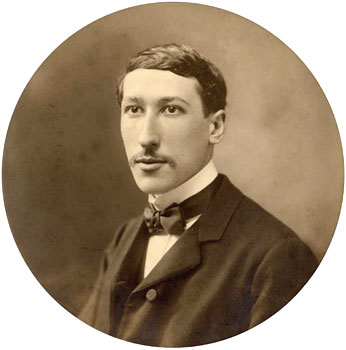
Testimonies of Jean-Louis Michon, Shaykh Abd al-Halim Mahmud and Martin Lings.
The Milanese publishers Archè have just brought out L’Ermite de Duqqi : René Guénon en marge des milieux francophones égyptiens. This work gathers notably a host of articles on René Guénon that appeared in the Egyptian press in the 1950s, together with several testimonies of those close to him. We have extracted from it certain passages that are particularly illuminating on Guénon’s intimacy in his Cairo villa.
The testimony of Jean-Louis Michon
I felt a great desire to meet the one who, by his work and his discreet guidance, had contributed so much to clearing a way for us towards the Truth. Providence facilitated this design by procuring me a post as teacher of English at the French-Arab lycée in Damascus. And it was from there that, on the occasion of my first school holidays, at Easter of the year 1947, I went to Cairo, where Guénon had agreed to receive me. It was my friend Martin Lings, then a lecturer in English literature at Fuad University, who took me to René Guénon’s house, with whom he was in almost daily contact. Guénon lived, in the district of Duqqi, in a modest villa he had christened “Fatima”, after his wife, a sharifa (a descendant of the Prophet Muhammad), who had already borne him two daughters: Khadija and Layla, then aged about 3 and 1. […]
The memory of that first visit to the villa Fatima merges today with that of all those I had the privilege of paying him afterwards, during the same Easter week, then through the summer of that same year 1947, and later in March-April 1948 and July 1949. To render its atmosphere, I can do no better than quote what I wrote from Damascus to my parents on 5 April 1947 on my return from Cairo: “This stay allowed me to visit René Guénon often, whose health is now restored and who is certainly one of the most simply benevolent men one could meet.”
I spent many an hour, over those three years, in the room where Shaykh Abd al-Wahid worked, sitting in an armchair to the right of the desk at which he worked and which he never left, except to go and pray in the neighbouring sitting room at the prescribed hours. He wrote in his regular hand, leaning slightly forwards, firm and without crossings-out, only interrupting himself to light a thin cigarette drawn from the box on his table, or to utter, in his muffled, slightly trembling voice, a few reflections on the subject of his letter or on the article he was writing for the next issue of Études traditionnelles. Sometimes his wife or the young servant attached to the house would come and ask him for one of the small objects he kept shut up in a drawer of his desk: matches, a pair of scissors, a ball of string… His wife addressed him gently, calling him by the title of ustadh, “professor”. She might be accompanied by the elder of the little girls and carry the youngest in her arms. The Shaykh greeted them tenderly, his face lit by a great smile, and he never failed to pull from the drawer of surprises some sweet that the little girls seized with delight… Thus I felt as though I were part of the family, sharing in the concerns of René Guénon the writer and those of the head of the family. […]
In the time when I knew him, Shaykh Abd al-Wahid only left his house twice a year: once in the company of a “brother in the way”, Sayyid Ramadan, to go and pray at the tomb of his master, Shaykh Abd al-Rahman Illaysh al-Kabir, to whom The Symbolism of the Cross is dedicated. Of this Sufi master, of Maghrebi origin, he one day showed me a photograph: a fine, very weathered old man’s face, draped in a hayk. As for the second outing from the villa Fatima, it was a country excursion where the family was complete: they all went by taxi to Martin Lings’s garden and house near the pyramids of Giza. I had the happiness, during the summer of 1947, of taking part in one of those days when Shaykh Abd al-Wahid, far from his habitual concerns, showed himself relaxed and attentive to all that went on around him. […]
In July 1949, at the beginning of the month of Ramadan, I was invited to come and break the fast. I found him stretched out on the sitting-room divan, and he explained to me that the fast tired him to the point that he could only work at night, the day being given over to prayer and rest. As soon as the cannon shot announcing sunset rang out, Hajja Fatima brought us a cup of Turkish coffee, which was drunk as we lit a cigarette. After that, Shaykh Abd al-Wahid performed the maghrib prayer, whose movements I followed behind him. After an excellent Egyptian meal and a peaceful evening, I took my leave of the Shaykh and his family. […] A year later, in November 1950, he fell seriously ill, at the same time as his three children. All were nursed with admirable devotion by Hajja Fatima, though she was pregnant for the fourth time. But his body, already weakened by earlier episodes of illness and by lack of movement, did not withstand this final assault…
The testimony of Shaykh Abd al-Halim Mahmud
My doctoral thesis defended, I left Paris to return to Egypt. As soon as I arrived in Cairo, my most pressing concern was to go to the Dokki suburb in search of Shaykh Abd al-Wahid Yahia. In Nawal Street I knocked at the door of the villa Fatima […] and asked the maid to beg the Shaykh to receive me. A few moments later the maid appeared again, carrying a wooden bench of a very modest look, and asked me to sit on it and wait a while. I waited at the door, almost in the street. The minutes went by and I began to find the wait long. The maid made appearances in the entrance, and as soon as I saw her I rose from my seat, believing she had come to take me in to her master. Some time later, she came to ask me to return the next day at eleven in the morning. I left the house, not without a feeling of surprise and shame, but with the settled intention of seeing this Shaykh who made his visitors wait in the street and dismissed them by asking them to come back the next day.
The following day I was exactly on time for the appointment, but no luckier than the time before. The Shaykh had his maid ask me to write down what I had to ask him; he would answer the questions I put to him. I withdrew after the failure of this second attempt. I did not write to him. The answers he might have given to the questions I would have put interested me less than meeting him. […]
One day, Mr Madero, the Argentine minister in Cairo, and I took the resolution of forcing the barrier that Shaykh Abd al-Wahid had raised between himself and the world. I shall always remember that day when we went to knock at the door of the villa Fatima. An old man, tall of stature, his face illuminated, of imposing bearing, his eyes shining, opened to us. After the traditional exchange of greetings, he asked us the object of our visit. The minister conveyed to him the greetings of a friend. Hardly had the old man heard that man’s name than he invited us into his house. He kept silent during our visit, and but for the minister’s diplomacy we should have found ourselves in a very embarrassing situation. Mr Madero indeed broke the silence by paying a warm tribute to the opinions of Shaykh Abd al-Wahid. But the latter did not on that account depart from his muteness. Before withdrawing, we asked him whether he would allow us to pay him another visit, which he most graciously accepted. […]
Our visits to the Shaykh followed one another from then on. He spoke to us at length and took care above all to point out to us that only importunate people with time to waste on personal and futile talk believe that he confines himself to solitude. We were flattered to hear him say that, having perceived in us the sincere desire to understand, we could come and see him at any moment.
Later on, we succeeded in drawing him from his dwelling and accompanying him to the mosque of Sultan Abu’l-’Ala, where we organised ceremonies for the recitation of the name of Allah. He could be seen, during these gatherings, first murmuring unintelligible words, taken by light tremors. Then the words he uttered became clearer and the tremors stronger, giving way afterwards to a deep recollection. When I happened to remind him that the hour of departure had come, he would wake with a start as though he were coming back from far-off regions.
Time passed. The minister left Egypt and the Shaykh died, leaving me the most beautiful of memories.
The death of René Guénon, by Martin Lings
I think you will already have received the news of the death of Shaykh Abd al-Wahid who, I am certain, rests in the grace of the divine blessing. All this has been unexpected for us. After Abd al-Sabur’s visit, I persuaded him to see a doctor. He refused outright to have his blood analysed, but nevertheless submitted himself entirely to a medical treatment. His leg, which had caused him great pain, seemed to be recovering once more, and four days before his death the doctor appeared to think him out of danger. He seems to have gone into a coma twenty-four hours before his death, which is due, the doctor thinks, less to any particular ailment than to a general deficiency of different organs, a sort of premature bodily senility, the consequence of a complete sedentariness combined with an unsuitable diet.
His last illness lasted a month. During that time he was quite unable to write and he read practically nothing, appearing to take no interest in his mail. During the last days he obviously knew that he was lost, and on the last evening (he died around two in the morning of the night of 7-8 January 1951) he performed throughout a violent dhikr, supported by the arms of his wife and his relatives, which exhausted him all the more as he was exhausted already. It is said that his sweat had the perfume of flowers during that day. Towards the end, he asked their permission to die, as though he could choose the moment of his death; but as they begged him to remain a little longer, at last he said to his wife: “I must die now; I have suffered enough”, and he said “with the protection of Allah” and he died immediately after two invocations.
His cat, apparently in perfect health, began to moan and, a few hours later, it died too.
I forgot to say that Shaykh Abd al-Wahid, on the day of his death, disconcerted his wife by telling her that after his death she must leave everything in his room exactly as it was. No one was to touch his books and his papers. He said that otherwise he would no longer be able to see her, or his children, but that if his room was not disturbed he would always be able to see them, though they would not see him.
Martin Lings (Abu Bakr Siraj al-Din), letter to Frithjof Schuon.

René Guénon (Abd al-Wahid Yahia)

Martin Lings

Abdel Halim Mahmoud

Jean-Louis Michon