Hagia Sophia: light, memory and the preservation of the sacred
Contents
Tafakkur, the reflected contemplation of God’s signs, often consists in discovering links where the ordinary gaze sees only separate realities. Certain verses, read in isolation, seem to speak of different subjects. But when they are brought together, they sometimes reveal an unexpected coherence and open a deeper understanding of history.
Such is the case with three passages of the Qur’an which evoke successively the preservation of the places where God is invoked, the divine light, then the dwellings raised for His remembrance.
Places where the Name of God is invoked
“If God did not repel some people by means of others, monasteries, churches, synagogues and mosques, where the Name of God is abundantly invoked, would be destroyed. God assuredly supports those who support Him. God is indeed Strong and Powerful.” (Qur’an XXII, 40)
This verse is remarkable for its universality. The Qur’an does not evoke only the preservation of mosques here, but that of all places where God is invoked. Monasteries, churches, synagogues and mosques are thus placed within a single perspective: that of spaces where the memory of the divine remains alive within human history.
But the verse also says something else. It suggests that conflicts, changes of power and the upheavals of history are not only forces of destruction. They can become, paradoxically, instruments of preservation. God “repels some by means of others”, and it is through this complex movement that certain places continue to exist.
Light upon light
“God is the Light of the heavens and the earth. His light is like a niche in which there is a lamp.” (Qur’an XXIV, 35)
Then the verse continues its description of this light:
“Kindled from a blessed tree, an olive tree neither of the East nor of the West, whose oil seems to shine even without fire touching it. Light upon light.”
Immediately afterwards, the Qur’an adds:
“In houses that God has permitted to be raised and where His Name is invoked.” (Qur’an XXIV, 36)
Taken together, these verses sketch a striking vision of the sacred in history. Certain places are raised for invocation, become receptacles of light and cross the centuries because they partake of a memory that exceeds civilisations themselves.
It is then difficult not to think of Hagia Sophia.
A city between two worlds
Built in the sixth century by the emperor Justinian, it is no ordinary edifice. It was conceived as the visible symbol of a universal imperial vocation, destined to affirm the spiritual and political centrality of Constantinople in the face of Rome. From its very origin, it is inscribed in a history that far exceeds the local framework.
Tafakkur sometimes begins with wonder. How can one fail to be struck by the echo these verses seem to find in Istanbul? The Qur’an speaks of a light issuing from a tree “neither of the East nor of the West”, then of dwellings raised for the divine invocation. Now here is a city situated precisely between Europe and Asia, between several worlds, several heritages and several memories.
This correspondence is not a demonstration; it is a sign inviting one to look differently.
Standing on both banks of the Bosphorus, heir to the Greek, Roman, Byzantine and Ottoman worlds, Istanbul has appeared for nearly two millennia as a place of passage between several universes. It is Eastern and Western all at once, without being reducible to either of these categories.
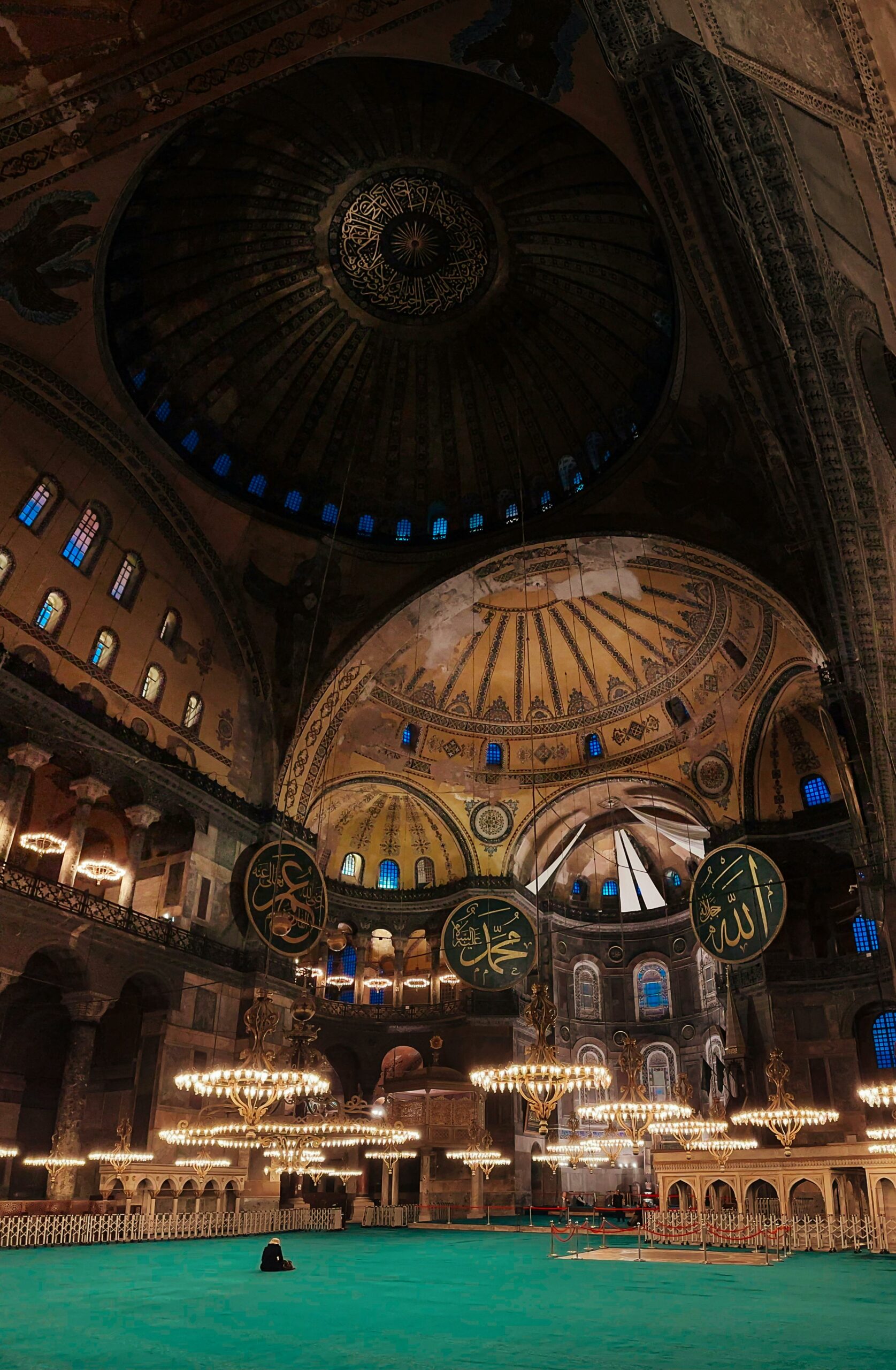
At the heart of this city stands Hagia Sophia. Its light, its dome and its history seem to echo the verses that associate the divine light with the houses raised for the remembrance of God. As though architecture itself became a meditation in stone upon the meeting between light, memory and invocation.
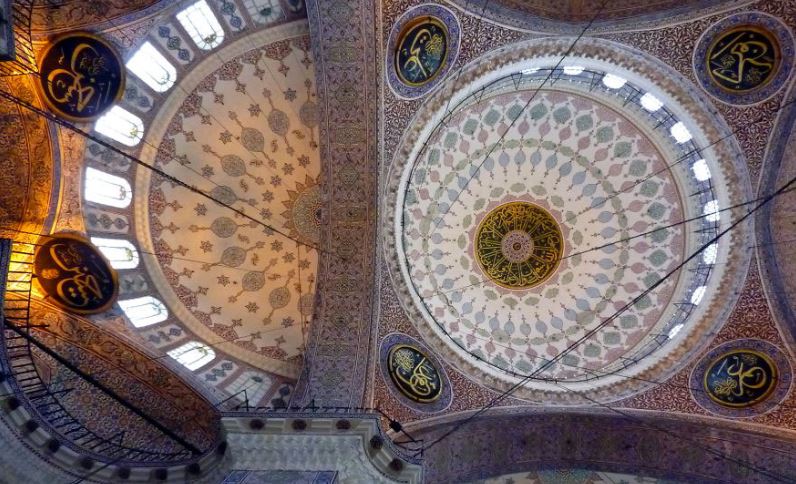
This symbolism is reinforced by the very experience of the place. From its origin, the edifice was designed to bring light into the heart of the sacred space. The dome seems to float above the void while the openings create an impression of almost unreal clarity. Long before the religious or political debates, this light touches something universal in the visitor.
A paradoxical preservation
The most astonishing thing is perhaps that Hagia Sophia does not merely illustrate one of these verses. It seems to gather them all. It is a house raised for invocation. It was designed around light. And its history appears as a striking illustration of that paradoxical preservation evoked by verse XXII, 40.
After having been the greatest church of Eastern Christendom for nearly a thousand years, it became a mosque at the taking of Constantinople in 1453. That event far exceeds the history of the city itself. In classical historiography, the fall of Constantinople marks one of the great shifts of world history: the end of the Middle Ages and the entry into the modern era. Then the monument became a museum in the twentieth century, before becoming a mosque again in the twenty-first.
One could see in this history a succession of ruptures. Yet another way of looking is possible. Despite all these changes, Hagia Sophia never ceased to be regarded as an exceptional place. It has been maintained, protected and handed down from generation to generation.
From this angle, Hagia Sophia appears as one of the most striking historical illustrations of the Qur’anic verse. Where one might expect disappearance or effacement, history paradoxically becomes an instrument of preservation. The very ruptures contribute to keeping alive a place where the Name of God continues to be invoked.
Why preserve heritage?
This reflection, moreover, joins a very topical question: why do we preserve heritage?
Today, the institutions responsible for the conservation of historic monuments speak of memory, of history or of common heritage. Yet they often share the same intuition: certain places bear something precious that deserves to be transmitted.
To preserve a monument is not only to conserve stones. It is to keep alive a bond between past, present and future.
The Qur’an ceaselessly invites the human being to contemplate the signs of God in creation; and in the light of this contemplation, the history of Hagia Sophia takes on a particular depth. Built to affirm the universal vocation of Constantinople, transformed during the event that symbolically marks the passage from the Middle Ages to the modern era, preserved through empires, wars, changes of civilisation and religion, it seems to follow a trajectory that exceeds the intentions of those who successively built it, conquered it or governed it.
The believer can then discern in it something of the action of the One who remains the sole true actor of history. Men take decisions, pursue their interests and defend their causes; yet through their acts a vaster coherence sometimes unfolds than they themselves perceive. What seemed to belong to rupture becomes an instrument of continuity. What seemed to herald a disappearance becomes a means of preservation.
This intuition recalls the reflections of Ibn ’Arabi, for whom divine truth manifests itself in multiple forms without being reducible to any of them.
Hagia Sophia then becomes far more than a monument. It becomes a sign. A sign of that wisdom by which God preserves what He wills to preserve, sometimes by paths no one could have foreseen. What seemed to announce a disappearance becomes an instrument of continuity; what seemed to belong to rupture becomes a means of transmission; and what at first appeared only as a succession of historical events gradually reveals a hidden depth.
Hagia Sophia thus appears as one of the most striking illustrations of the Qur’anic verses on light, on the houses where God is invoked and on the preservation of the sacred. Through its successive metamorphoses, it bears witness to a deeper reality: history does not always preserve the sacred despite transformations; it sometimes preserves it through them.
That is precisely where tafakkur begins: when history ceases to be merely human and becomes the place where the traces of divine action let themselves be glimpsed.