Sufism in daily life: living the universal in the ordinary world
Contents
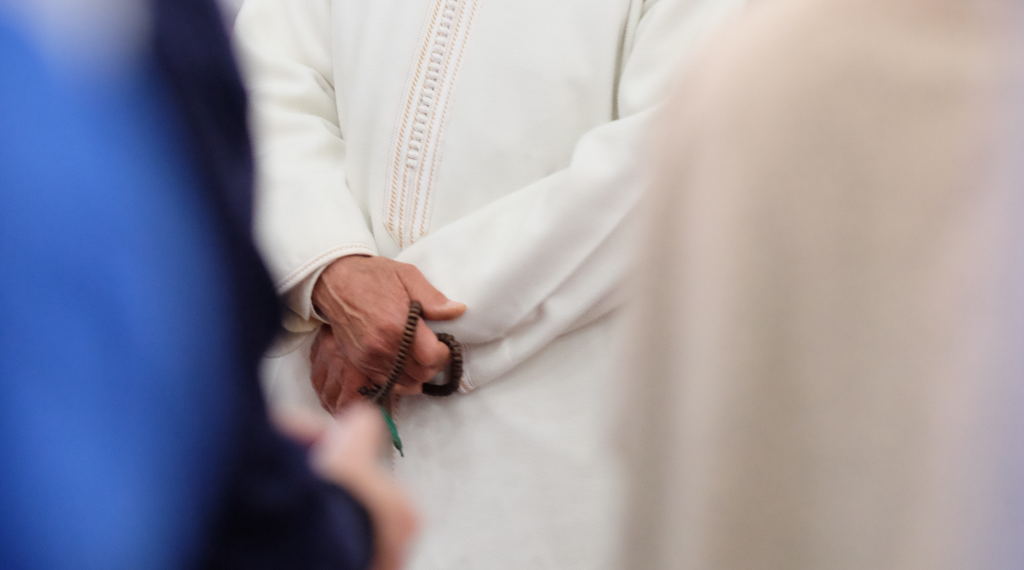
Unlike the devout ascetic (zahid) who refuses the world because he does not recognise God in it, he who follows the Sufi way espouses the world here below (dunya) the better to transcend it. ‘The devout and the ascetics take fright at everything, because everything renders them absent from God. If they saw Him in everything, they would take fright at nothing’. In accomplishing this cosmic marriage (dunya is feminine in Arabic), the Sufi breaks the dualism that ordinarily exists between the world and us. He thus tends towards union, that is, towards realising inwardly the unification (tawhid). Through contemplation, he grasps and traverses the multiplicity of phenomena in order to ascend back to the source, what Ibn ’Arabi calls ‘the unicity underlying multiplicity’ (ahadiyyat al-kathra). Whence the persistent incitation, in the Qur’an, to perceive and decipher the ‘signs’ (ayat): ‘We shall show them Our signs in the universe and in themselves until they realise that this is the Real’ (Qur’an XLI, 53). This lower world is in fact a veritable alchemical laboratory where every outward sign can be transmuted into an interiorising allusion (ishara). We must therefore remain constantly in a state of vigilance (muraqaba), for ‘Each day He is at some work’ (Qur’an LV, 29), and He manifests Himself under ever-renewed guises.
The major difficulty, indeed, is to recognise God in all His theophanies (tajalliyat). It is certainly easier to sense Him when one is in one’s shaykh’s company, during a session of dhikr, before a beautiful landscape, and so on, than when one finds oneself in a sordid environment, in the stress of daily activity, in the dreariness that modern life so often distils, or quite simply in lukewarmness and torpor (ghafla). Yet whatever these situations, positive or negative, it is always He who is the Agent. ‘Do not insult the age, for God is the age!’, as a hadith qudsi puts it. This is the sound, instinctive reaction that every believer has when he says: ’Al-hamdu li-Llah ‘ala kulli hal’ (praise be to God in every situation), and that is what constitutes the strength of the simplest Muslim faith. God cultivates paradox and always surprises. He is there where one does not expect Him a priori. Faced with this sometimes disconcerting ambivalence, the Prophet sought resolution in unity by saying: ‘I take refuge in Thee against Thee’.
Servants of the Living
Our everyday experience is thus forged by following the meanders of the small reality, of the apparent reality, until one becomes conscious that all these clues are none other than the Reality, the haqiqa of Sufism. It is the ruse (hila), or the pedagogy if you will, employed by God to bring us from the trap of appearances to the one and only Reality. These meanders must be observed without being lost in them; one must not take the sign for the Signified, and must live the tribulations the wayfaring in this life entails with attentiveness and humility, for it is thereby that the experience of the way grows. Is spiritual wayfaring (suluk) a ‘long quiet river’? Fundamentally yes; yet the condition of creatures obliges us to reckon with the waves’ motion on its very surface. ‘The advent of tribulations is a festivity for the novices’. ‘Sometimes you will acquire through tribulations a surplus of grace that you will find neither in fasting nor in prayer’. Sufism, the living and warm heart of Islam, makes it possible to live the universal in the everyday and to adapt permanently to the world’s evolution.
If we are truly the servants of the Living (al-Hayy), who ceaselessly renews creation, we must vivify our spiritual practice by adapting it to the context and, more generally, to the cyclical conditions. It is not in vain that Sufism is the spirituality of Islam, the last expression of the divine will on earth. Since, according to a hadith, ‘the whole earth is a pure mosque’, man is his own temple: wherever he goes, he always bears within him his inner axis, the universal axis of tawhid, whether at home or in nature, but also in the underground, at work or in any seemingly profane place. We know that, historically, Sufism has played a great role in the spread of Islam in the West, precisely because it knows how to go beyond ethnic, nationalist, cultural and civilisational cleavages to reach the essential. Through its universalism, it can act upon different consciousnesses. Why restrict divine mercy (rahma), which ‘encompasses all things’ (Qur’an VII, 156)? That is one of the manifold applications of Junayd’s saying: ‘The colour of the water comes from the colour of its vessel’.
Going to the essential
It is accepted that we are living at the end of a cosmic cycle, with all the disorders and the decadence that supposes. But we must view this situation positively, first out of courtesy (adab) towards God: the pollution of the earth and of human consciousness is but the effect of the divine will. It is in this period, which some qualify as messianic, that our ‘trusting abandonment to God’ (tawakkul) is most put to the test. God, for the rest, compensates: it is at the height of darkness that light springs forth. Is there still a horizontal solution to our planet’s problems? If we hold to the metaphysical perspective of the descent and the re-ascent along the arc of Manifestation, then it is clear that humanity must touch bottom before being able to rise again, according to a modality we can sense but which still escapes us. Here paradox is king. In this environment of globalisation, of standardisation, of the instantaneity of information, God has perhaps never been so immanent. We have the good fortune to live in the ultimate phase of the ‘last third of the night’, during which, according to a famous hadith, God comes down to this lower world. The night of course symbolises the lifespan of the cosmos and of humanity. For Ibn ’Arabi as for the emir ’Abd al-Qadir, God is therefore closer to us during this period and, as a consequence, the spiritual science of the Muhammadan community would be more accomplished than it has ever been (Kitab al-Mawaqif, II, 919).
For whoever has a certain spiritual consciousness, indeed, the state of the world is such that it can only refer back to Him: ‘He wishes to make you dissatisfied with everything so that nothing may distract you from Him’. The gap between the Real (al-Haqq) and the parody of today’s world means that God is increasingly evident: social structures are crumbling and outward landmarks are collapsing; our inner landmarks must therefore be strengthened. Our ‘poverty’ (faqr) is no longer outward, for we are materially ever richer, and we no longer wear patched frocks: our poverty must therefore interiorise itself ever more. Where spiritual practice is concerned, we are now bound to go to the essential, to implement an active, as it were instantaneous, contemplation. On account of the compression of time, of which the Prophet spoke, and the feeling of acceleration that ensues, the duration of rites such as individual invocation (wird) is sometimes curtailed and the spiritual retreat (khalwa) is not always easy to observe. More than in the past, no doubt, it falls to us to apply the old Naqshbandi principle: ‘My place of retreat is in the midst of the crowd’.
By Eric Geoffroy.
Further reading
Further reading
- L'autorisation divine (idhn)The divine authorisation (idhn): transmission and degrees (1/2)
- L'autorisation divine (idhn)The divine authorisation (idhn): transmission and Qur'anic sources (2/2)
- The allusive science (ishara), by Kalabadhi
- The heart of the path: the spiritual guide and the transmission of the secret