The Muhammadi Light and the educator shaykh
Contents
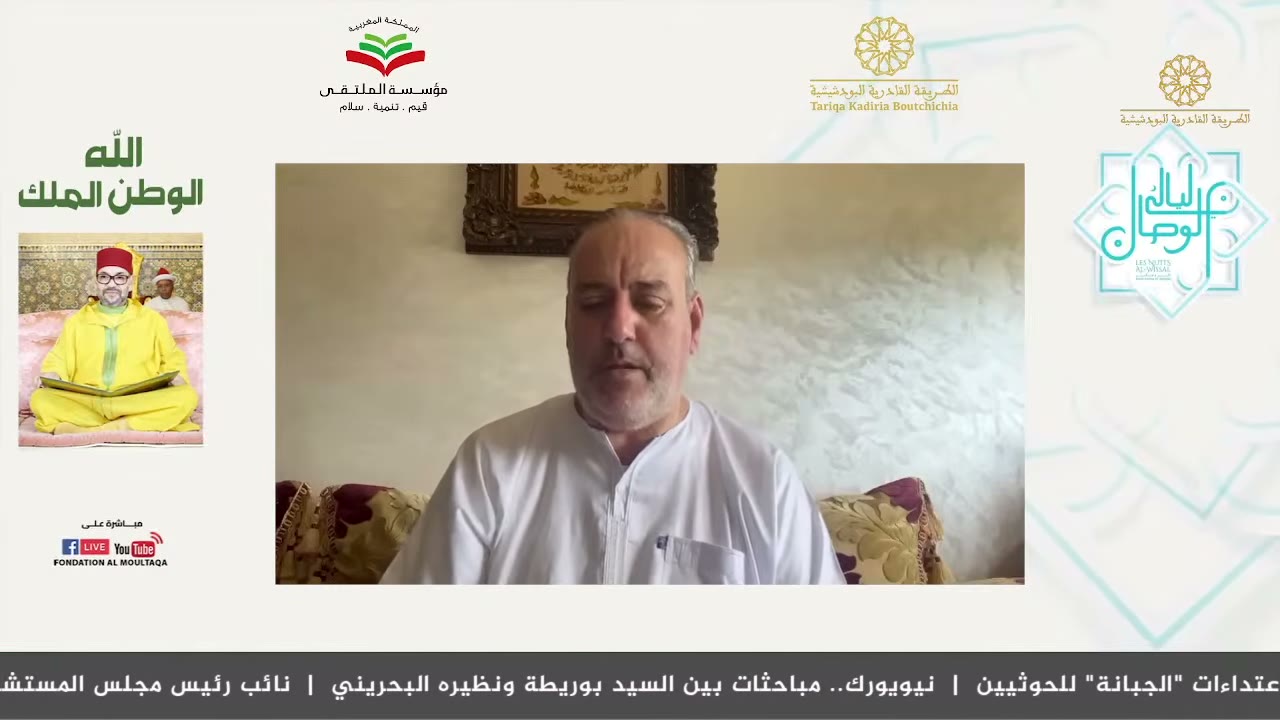
A talk by Said Shakir, teacher of English, taken from episode 325 of the series Layali al-Wissal (‘The Nights of Union’), broadcast on 20 September 2026 on the channel of the Al Moultaqa Foundation. Delivered in English; accompanying text written by the editorial team.
Extract of 13 min 15 s (00:51:30 to 01:04:45). Original full video: Layali al-Wissal, episode 325, Al Moultaqa Foundation channel.
For the 325th vigil of Layali al-Wissal, the Al Moultaqa Foundation opened an English-language segment, as it regularly does for its international audience. The title, announced in both languages, states the programme: The Muhammadi Light and the Authorized Educator Shaykh, the case of the Qadiri Boutchichi Order: النور المحمدي والشيخ المربي المأذون، الطريقة القادرية البودشيشية نموذجاً, “the Muhammadi light and the educator shaykh who holds authorization: the Qadiriya Boutchichiya path as the model”.
The timing matters: the Mawlid of 2026 coincided with the commemoration of Sidi Jamal, the previous shaykh of the path. The talk unfolds in two movements, much as a language teacher would: first defining the two concepts of the title, then showing how they meet.
A light that came from God
First concept: the nur muhammadi, the Muhammadi Light. Said Shakir grounds it in the text. Sura al-Ma’ida (5:16): ‘There has come to you from Allah a Light and a clear Book.’ The light is the Prophet Muhammad, peace and blessings be upon him; the light is the guidance.
He adds an argument drawn from daily practice. At the heart of every prayer, the believer recites al-Fatiha: ‘Guide us to the straight path, the path of those You have blessed’ (1:6-7). Without this verse, he reminds us, the prayer is not valid: asking for guidance is the very breath of the ritual, five times a day.
The guide, named without being named
Sura ash-Shura (42:52): ‘And indeed, you guide to a straight path, the path of Allah.’ The speaker points out a subtlety of language: Muhammad’s name does not appear in the verse. In Arabic rhetoric, that ellipsis is not a silence: it serves veneration and keeps the listener expectant, as though the text declined to name what exceeds the name.
The same mechanism in sura Yusuf (12:108): ‘Say: this is my way, I call unto Allah with sure insight, I and those who follow me.’ The insight, basira, does not stop at the Prophet: those who follow him call with insight too. That is the second concept of the title: the educator shaykh, authorized to guide.
Seeing with the eyes, perceiving with the heart
Said Shakir then distinguishes two verbs of seeing. Basar perceives with the naked eye; basira perceives truth through heart, intellect and knowledge together. This is not the guidance of blind imitation, he makes clear, but a guidance founded on the knowledge of God, on certainty and on proof.
The direct consequence: the claim that the Prophet’s role as guide ended at his death collapses against the verse of Yusuf. Those who follow him still guide. It remains to know who they are.
Those whom God loves
The answer comes through the qudsi hadith of the supererogatory deeds, reported in the Sahih of al-Bukhari (no. 6502): ‘My servant does not cease to draw near to Me through supererogatory deeds until I love him. When I love him, I am his hearing by which he hears, his sight by which he sees, his hand by which he grasps, his foot by which he walks. If he asks Me, I will surely give him; if he seeks My protection, I will surely protect him.’
That beloved servant now sees with another sight. Said Shakir brings in alongside it the hadith of firasa, reported by at-Tirmidhi in his Sunan after Abu Sa’id al-Khudri: ‘Fear the insight of the believer, for he sees by the light of Allah.’ And the link that closes the loop, sura Al ’Imran (3:31): ‘If you love Allah, then follow me, Allah will love you.’ Following is done out of love, and love is repaid in received insight.
A light that passes on
It is on this basis, he says, that the disciples of Sidi Mounir al-Qadiri Boutchich flock to him, from all over the country and beyond. The speaker goes back up the line of transmission: Sidi Mounir was designated by his father Sidi Jamal, himself designated by his father Sidi Hamza, son of Sidi al-Haj ’Abbas, a transmission attested, he says, by three testaments deposited with the authorities, and more recently by a legal declaration of Lalla Fatiha, Sidi Jamal’s wife and Sidi Mounir’s mother, certifying that her husband wrote his testament before his death: the light, the sirr, settled in his heart would become firmly rooted in the heart of his eldest son.
He backs this acknowledgement with the verse of the trusts, sura an-Nisa’ (4:58): ‘Allah commands you to render the trusts to those entitled to them’, and salutes, in the name of the disciples, a stand he calls courageous, meant to dispel misunderstandings about the future of the path.
The synthesis holds in a single image. The Muhammadi Light that came from God, the light that brings ‘those who believe and do righteous deeds’ out of darkness into light, is the same light, the same sirr, firmly rooted in the heart of Sidi Mounir. And the shaykh often tells his disciples: this light is also settled in their hearts, when they visit him and when they invoke, alone or in a group. The disciple then experiences the nearness of God and an impetus for more dhikr, with a heart present to God rather than a heart distracted from Him.
The dream of Madagh
The talk closes on a testimony Said Shakir says he heard from the lips of Sidi Jamal himself, who used to recount it in gatherings. In the early seventies, Sidi Jamal saw in a dream the Prophet coming to the zawiya of Madagh; then he saw him fall ill and die, then the disciples bury him in the mausoleum of the zawiya. On waking, he recounted the vision to his grandfather Sidi al-Haj ’Abbas, who rejoiced at it as good news: the light of the Prophet would remain in that zawiya forever, and would grow with knowledge and righteousness.
‘We remain true to our covenant, Said Shakir concludes, and the covenant of a loving heart never expires or fades away.’
Teaching of Said Shakir in Layali al-Wissal no. 325 (Al Moultaqa Foundation), intervention in English covering 51:30 to 1:04:45. Article written from the transcript; quotations reported faithfully in meaning, references verified in the working file.
Frequently asked questions
What is the nur muhammadi, the Muhammadi Light?
It is the light which, according to the Koran, came from God together with the Book (sura al-Ma'ida, 5:16): the Prophet Muhammad, peace and blessings be upon him, as guidance sent to mankind. In the Qadiriya Boutchichiya path, this light passes from heart to heart, from shaykh to disciple.
What is the difference between basar and basira?
Basar is the sight of the naked eye; basira is the insight of the heart, which perceives truth through heart, intellect and knowledge together. Said Shakir stresses that prophetic guidance, through basira, continues in those who follow the Prophet.
Which hadith links God's love to the guidance of His servants?
The qudsi hadith of the supererogatory deeds, reported by al-Bukhari (no. 6502): 'My servant does not cease to draw near to Me through supererogatory deeds until I love him; when I love him, I am his hearing by which he hears, his sight by which he sees...'
Why is this intervention in English?
The Layali al-Wissal vigils of the Al Moultaqa Foundation regularly open an English-language segment for their international audience. Said Shakir, a teacher of English, spoke there for the Mawlid 2026.