The love of the Hijra: emigrating to God with the heart
Contents
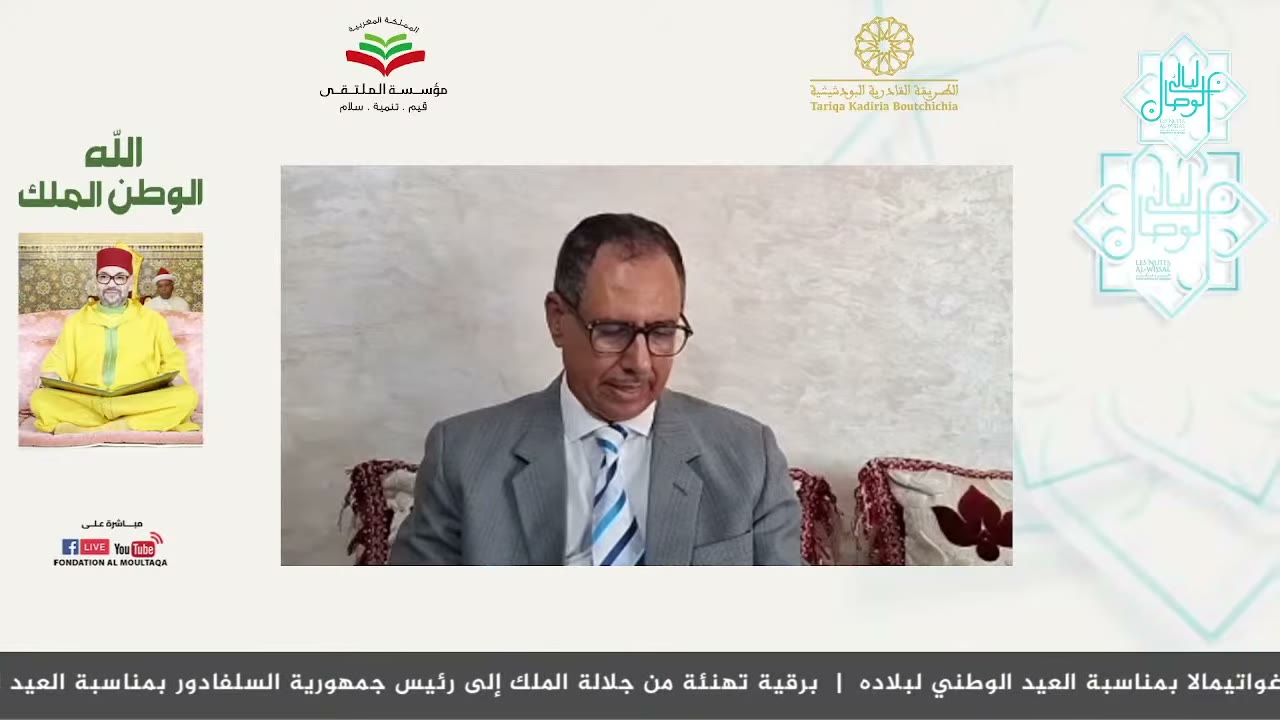
An intervention by Dr Uthman Sibai, professor of Arabic language in Tetouan, taken from episode 325 of the series Layali al-Wissal (‘The Nights of Union’), broadcast on 20 September 2026 on the channel of the Al Moultaqa Foundation. Delivered in Arabic; accompanying text written by the editorial team.
Extract of 9 min 30 s (00:09:35 to 00:19:05). Original full video: Layali al-Wissal, episode 325, Al Moultaqa Foundation channel.
In the 325th vigil of Layali al-Wissal, the first of the evening’s ‘scholarly sections’: Dr Uthman Sibai speaks remotely under the title ‘the love of the Hijra’. On this night ‘of union, of love and of aspiration’, addressing the ‘masters of invocation’, he restores the founding episode to its true scale: an event of the heart before it is an event of history.
A hijra that has not finished speaking
The hijra of the Beloved, peace and blessings be upon him, from Mecca to Medina is not a tale to be commemorated: it is ‘an address to Muslims until the Day of Judgement, until the Hour is raised’. Its meaning is not a departure from one country to another, he states at the outset, but an emigration away from the clay, the desires, the temptations of this deceiving dunya, towards the bounties of God.
And the question turns personal: have we realised anything of that emigration? Are we ready to emigrate towards God and His Messenger? The hadith that opens the Sahih of al-Bukhari fixes the measure: ‘He whose emigration is towards God and His Messenger, his emigration is towards God and His Messenger; he whose emigration is for some worldly gain he hopes to reach or a woman he wishes to marry, his emigration is towards that for which he emigrated.’
Who will decide, this night, to emigrate as the Companions emigrated? They left everything behind: houses, possessions, lands. They were walking towards God alone. But Dr Sibai insists on the order of things: that departure was only possible after they had answered God and His Messenger. The journey of the bodies followed the journey of the hearts.
Thirteen years to build a soul
How were such souls built? By the Qur’an sent down in Mecca, ‘to plant in those breasts the seed of love and aspiration towards God’. For thirteen years the Text fashioned those souls until it granted them an ’umran upon the earth, in the spiritual sense of the word: hearts peopled with faith, then able to leave everything and turn towards the bounties of God.
The first station the Qur’an planted in hearts is the turning towards God. The first verse revealed bears witness to it: ‘Read, in the name of thy Lord who created’ (96:1). A surah that makes God known, revealed in portions at the beginning of the Meccan period. For man cannot abandon desires and whims, and everything attached to his soul, without knowing God.
Dr Sibai then plays on two words that English hardly distinguishes: one must be of the muta’arrifin, those who are learning to know, not necessarily of the ’arifin, the knowers who have arrived. The ’arif has already made the journey: he has travelled it, tested it, and he has answered God with his heart, his spirit and his whole being. In his company, that knowledge is transmitted. To seek it alone, he warns, is to choose a great difficulty: the quest for ma’rifa is only undertaken in the company of a knower of God. One must renew one’s intention there; if God grants it, the states change, the whole of life changes, and one abides in the station of serenity at His side.
Bilal, or what knowledge changes
One face tells it better than an argument: Bilal’s. He came to know God, and the lower world shrank before his eyes; existence itself collapsed around him, until nothing remained in his heart but ‘Ahad, Ahad’, that ‘One, One’ he repeated under torture. The great men of the idolaters could do nothing more to him: his states had changed through his knowledge of God.
Everything that happens, the teaching continues, is a manifestation of God’s greatness. Prayer is the first degree God prescribed on this journey of knowledge. Once a man grasps the worth, the greatness and the majesty of God, he understands that prayer is a pillar among His pillars, a command among His commands. ‘Prostrate thyself and draw near’ (96:19): the station of proximity dwells in the very place of prostration, and there one emigrates by the heart towards the bounties of God.
The sacred hadith reported by al-Bukhari (no. 6502) pursues the movement one degree further: ‘My servant does not draw near to Me by anything more beloved than what I have prescribed for him; and he never ceases to draw near to Me by supererogatory works until I love him.’ When God loves him, He becomes his hearing, his sight, his hand: the stations of love between the servant and his Lord.
Vigils that kindle hearts
The hijra, he recalls, came about after a phase of purification of hearts, among men who lived in the company of the Prophet. Those Companions drew near to God through prayer, and the Beloved would say to Bilal: ‘Give us rest by it’ (Abu Dawud). Prayer: love, aspiration, proximity. They kept their litanies, their awrad, which poured light onto the path and into hearts.
Then comes the night vigil. ‘O thou enwrapped one! Stand up in the night, save a little’ (73:1-2): the qiyam increases the purity of hearts, their clarity, their limpidity; ‘the honour of the believer’, as a saying transmitted from the Prophet puts it. And the verse that follows completes the portrait: ‘Mention the name of thy Lord and devote thyself to Him with utter devotion’ (73:8). Tabattul: complete detachment. Nothing left for thee but God; nothing left with thee but God.
‘Such is the hijra,’ the teaching concludes: ‘the hijra of hearts.’
A teaching of Dr Uthman Sibai in Layali al-Wissal no. 325 (Al Moultaqa Foundation), an intervention in Arabic covering 9:35 to 19:05. Article written from the transcript; quotations rendered faithfully in meaning, references verified in the working file.
Frequently asked questions
What is the hijra of the heart?
For Dr Uthman Sibai, the hijra spoken of by the Prophet is not first of all a departure from one country to another: it is an emigration away from the clay, the desires and the temptations of this lower world, towards the bounties of God. A teaching that remains valid for Muslims until the end of time.
Which hadith determines the value of a hijra?
The hadith that opens the Sahih of al-Bukhari (no. 1): 'He whose emigration is towards God and His Messenger, his emigration is towards God and His Messenger; he whose emigration is for some worldly gain or a woman to marry, his emigration is towards that for which he emigrated.'
Why is prayer the first degree of this journey?
Because recognising the greatness of God leads one to recognise prayer as a pillar. The verse 'Prostrate thyself and draw near' (96:19) makes it the very place of approach: one emigrates there with the heart towards God, as the sacred hadith of the supererogatory works confirms.
In which language was this intervention delivered?
In Arabic. The presenter of the vigil gave a summary in French just after the intervention of Dr Sibai, professor of Arabic language in Tetouan.