Reviving faith: the letter and the spirit
Contents

Sufism is intrinsically a spirituality: it takes on a name, a form, only for pedagogical needs. In the early days of Islam, the grammatical rules of the Arabic language, which had served as the support of the Revelation, had not been formalised.
They proved necessary once Islam reached non-Arabic-speaking lands such as Persia. Codification then appeared for pedagogical purposes. The implicit had to make itself explicit. Yet the implicit is what gives life, as the spirit does for religion; spelling things out, by contrast, can end up freezing what it claims to demonstrate and produce a form without spirit.
It even happens at times that Sufi brotherhoods lose this deeper meaning. Keeping it alive calls for constant, living, inspired renewal. Sufism is then the making explicit of the spirit implicit in the original message of Islam.
So Sufism is not a branch of Islam but its heart. It is a state of mind, the spiritual interiority of Islam. Every religious tradition, Islam included, has an outer side and an inner side. There is ‘the letter’ and there is ‘the spirit’. From the history of religions we know that the conjunction of these two aspects matters. When one strays from the spirit, the letter kills, as Jesus evokes in the Gospels when he reproaches the Pharisees for having forgotten the spirit of the Law. This double aspect must therefore be taken into account in the spiritual approach.
Sufism consists in fostering the opening of the heart, the vision of the spirit, in understanding things within a spiritual perspective. A vision that is necessary within a tradition, without which that tradition loses its meaning. The Sufis have simply recalled this essential truth under different forms according to the times: that spiritual perspective without which religions would be no more than kinds of cultural, social or political identities.
The example of Ghazali
Personalities like Ghazali illustrated this reality through their very lives. In the twelfth century of our era, at thirty-three, Ghazali had reached the summit of the learning of his time. He was a great theologian, a great scholar of the Nizamiyya university, a personal friend of the caliph. He could discourse on whatever one wished, as he himself said. People asked him any question at all on metaphysics or speculative theology, and he answered with great ease. Then came a moment when he asked himself: ‘In the end, of what am I really certain?’ He was seized by a kind of rational doubt, which grew into a total crisis: he could convince others on many questions, but he was no longer capable of answering himself. This crisis drove him to flee far from society, where he now felt a stranger. For eleven years he travelled, meeting people who very often had less knowledge than he, but from whom he learnt wisdom. They taught him what belongs to an order other than knowledge: pure knowing is that of the heart, that inner experience which makes spirituality. He then returned to writing and published fundamental books such as the Revival of the Religious Sciences. In it he called for vigilance, for not mistaking the reality of things, for not confusing religious technique with wisdom and spirituality. For him, the religious sciences were necessary to resolve certain ‘technical’ aspects, but in no way replaced spiritual knowledge. Ghazali observed that in his time people had inverted these realities, and he regretted that those who knew the most, from an outward point of view, were held to be the most important. He therefore wished to help restore the spiritual perspective, and showed how Sufism was the gateway to that perspective.
The spirit of the rites
Spirituality is a state of mind. Praying or fasting with an awareness of the meaning of one’s acts is very different from performing a ritual mechanically. A tradition of the Prophet says: ‘Some fast and reap from their fast only thirst and hunger; some pray and reap only gestures.’ The formal, institutional, purely outward side then prevails, to the point of sometimes making the spiritual dimension perfectly inaccessible.
If we pray to God while thinking of our daily activities, our appointments, our projects, which happens very easily, we are in a practice that conforms to the letter but is devoid of the very spirit that must give life to the act. We are pulled in so many directions, our attention so tends to scatter from day to day, that habit sets in at the expense of intention, of spirit. Today, never do so many people quarrel during the day as during the month of fasting, whereas people should in principle be in recollection, solidarity, brotherhood. Where then is the spirit of the fast? In a great many cases, deprived of the spirit that animates it, it becomes a mere social practice. Fortunately, many people take advantage of this period to withdraw from the outward senses in order to move towards the inner essence: which is the deepest meaning of the fast, a withdrawal from the outside allowing a far deeper connection with the divine Presence.
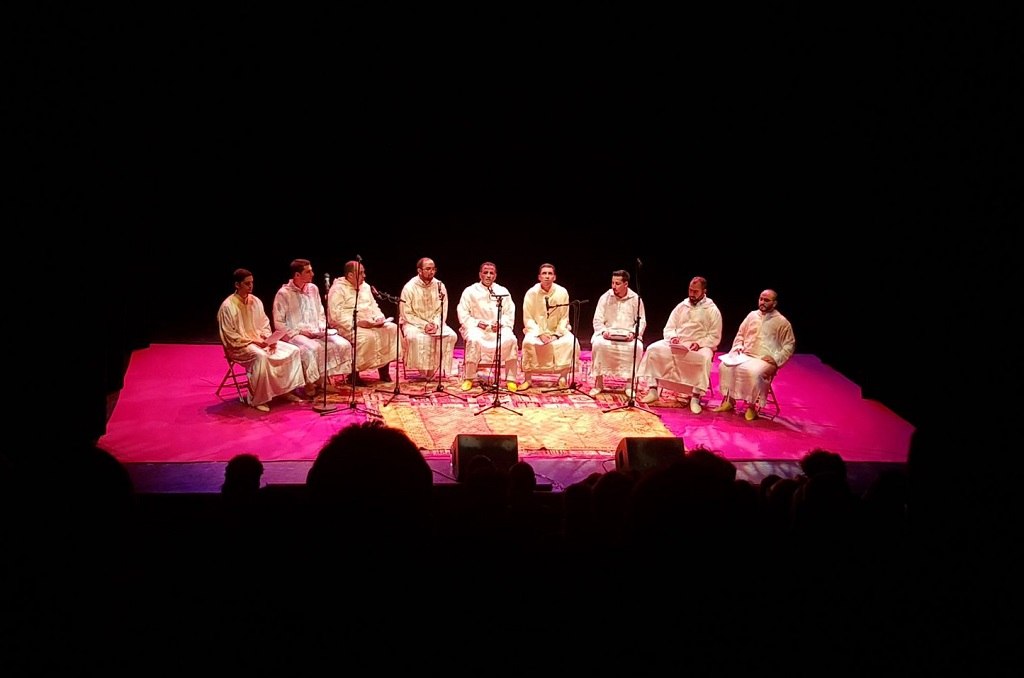
A practice deprived of spirit is not without consequence. The meaning of that practice is completely changed; it then has nothing to do with what it was instituted for. That is why certain people had the function of creating spaces within which a more intense spiritual acuity could be developed. A spiritual teaching can be dispensed there; practices such as dhikr or listening to mystical poetry nourish the soul and foster its drawing near to the divine Presence. Mystical love and spiritual intoxication awaken hearts and allow one to recover the spirit that presides over prayer, over fasting, the original spirit. One then realises more clearly that a religion lived in its purely outward and formal aspect has nothing in common with a religion enlivened by the spirit, nourished by its original meaning.
A letter in which the spirit breathes
This dialectic between spirit and letter runs through the history of all religions. Sometimes, beings embody the conjunction of the two. Al-Shadhili, like Ghazali, was for instance both a great theologian and a great mystic. This conjunction founded traditional Muslim society. In Fez, for example, it manifested itself in the craft guilds, which could also be places of spiritual initiation, as was likewise the case in the Middle East and Central Asia. Often, the master craftsman was also a spiritual master. In other cases, the most frequent today, craftsmen go to replenish themselves within spiritual brotherhoods outside their professional activity. Affiliations are often made according to the trade, craftsmen of a given guild affiliating more with a given brotherhood. This traditional configuration, this cohesion, was nourished by the conjunction between spirit and letter.
There were periods of rupture, denounced incidentally by Ghazali, characterised by a formalist intolerance that favoured a spirit of inquisition and considered everything non-normative as heterodox and heretical. The case of al-Hallaj illustrates this type of period. Louis Massignon, a French orientalist familiar with the realities of Islam and Sufism, wrote a celebrated thesis on this great Sufi, crucified in the tenth century of our era by inquisitorial theologians who convicted him of heresy, even though he enjoyed extraordinary popularity by reason of his profound spirituality. The initiatic path of al-Hallaj would in fact spread as far as China.
Placing things within a spiritual perspective makes it possible to avoid what causes problems in our time: the instrumentalisation of religions. Sufism places things within their spiritual finality. If that finality is lost, religion becomes an instrument of power, whereas it is a means of transforming oneself towards a spiritual finality. The letter, without the spirit, kills.
Faouzi Skali, extract from the dialogue ‘Quelle sagesse pour le XXIe siècle’, between Faouzi Skali and Ghaleb Bencheikh.


Further reading
- Sufism at the heart of Islam
- The experience of Sufism today in the West
- Path of rigour, path of beauty, by Faouzi Skali