A spiritual master named Jesus
Contents
In every authentic tradition, the function of the spiritual master is to transmit true knowledge, also called the science of the heart. The spiritual master is authorised to guide other people in the discovery of themselves. He actualises the meaning of the holy scriptures for each generation, and this is why he is sometimes said, in Christianity, to be the fifth Gospel.
The master-disciple relationship is founded on convictions and on sincerity. Like a jeweller, the master knows from the outset whether a rough diamond has sufficient qualities to become a cut diamond, and he knows how to cut each diamond according to its nature.
The master knows the way for having travelled it himself, but cannot explain everything in words: the mind is powerless, and the disciple very often does not understand from the outset the meaning of the work to be accomplished. In this, he must place absolute trust.
‘He (the master) is the flower of the tradition, but his beauty is equalled only by his rarity. You do not find orchids growing in just any meadow; you do not find a lion moving in a herd,’ says Jacques Vigne1.
The encounter with an authentic spiritual guide is decisive in the itinerary of a resolute aspirant. One who comes into contact with a community of disciples may sometimes feel relief or discomfort. He will find a familial warmth that so many Westerners lack nowadays, but which is a burden for some.
Pleasant or not, it is a starting stage: that of emotional transparency, which is not without therapeutic qualities. It is a preparation for spiritual transparency, subtler, more limpid. The latter is possible only in the relationship with the guide who, devoid of ego, can be the witness of our inner reality without seeking to exploit it.
Jesus, disciple and spiritual master
Every master has first been a disciple. Jesus himself does not seem to have been an exception to this rule: he received baptism from John before becoming his master. As was the case with the disciples of Jalal al-Din Rumi after his encounter with Shams of Tabriz, this was bound to cause some stir.
John’s disciples said to him: ‘Rabbi, he who was with you beyond the Jordan, to whom you bore witness, behold, he too is baptising and all are going to him’ (Jn 3:26). Jesus’ having asked John for baptism was bound to trouble Jesus’ disciples. It was an initiation. John the Baptist’s declaration, ‘I am not worthy to untie the strap of his sandals’ (Mk 1:7), bears witness to the knowledge the Baptist had of the spiritual reality of the one he had been awaiting for years, the one for whom he was born.
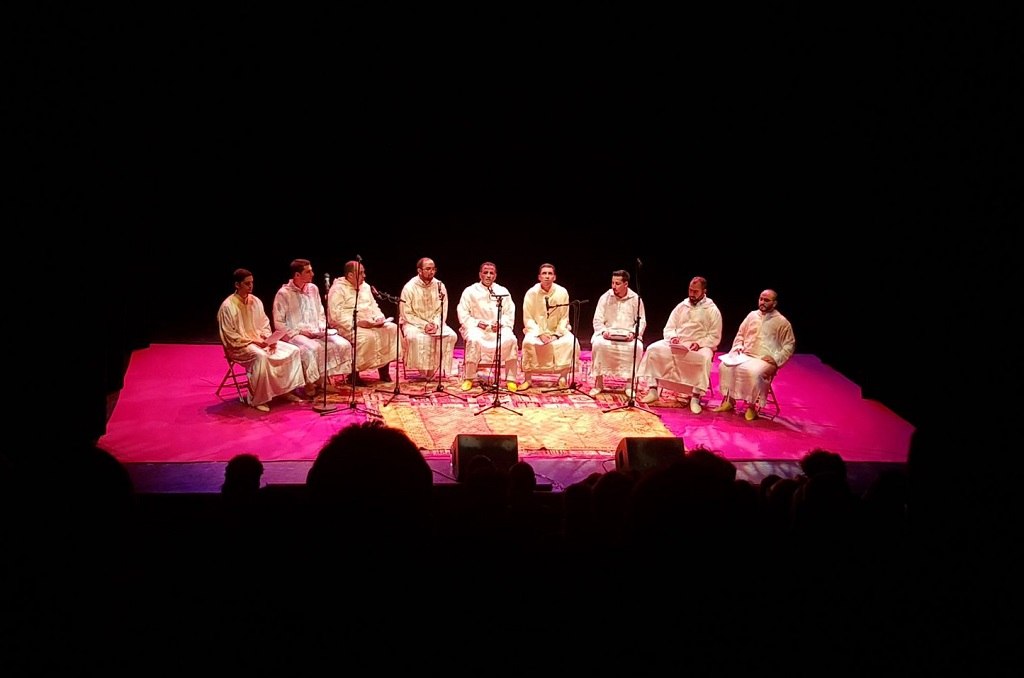
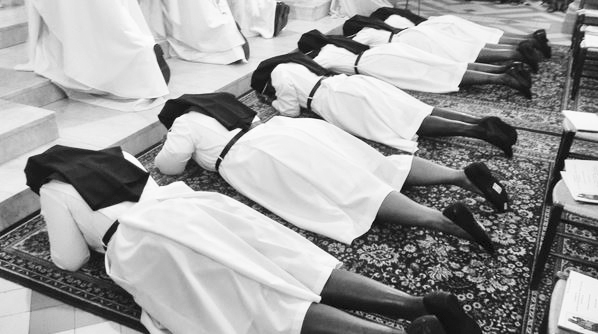
In certain Sufi gatherings, the master can be seen greeting the disciples by prostrating himself before them: such is the case of the sama’ of the Mevlevi dervishes. This aspect of the ritual expresses the reality of the union of hearts at a higher level. Likewise, the Gospels often present Jesus and John side by side, in particular the infancy gospel in Luke. John’s disciples believed that he was the Messiah. They formed the group of the Baptists, from whom the first disciples of Jesus probably came2.
This is doubtless why the Prologue of John specifies that John the Baptist was not the light, but was a voice in the wilderness, whereas Jesus was the true light and the sole Word.
The birth of Christianity illustrates the subtlety of the master-disciple relationship, which is not so simple in practice. The examples are numerous, not only concerning the apostles’ mission of preaching, but also throughout the mission of Christ, whose end is marked by Peter’s denial and Judas’ betrayal.
For the disciples who lived alongside Jesus, he is above all ‘rabbouni’, ‘our master’. For the others, such as Paul or Luke, he becomes ‘kurios’, ‘Lord’: he is divinised.
Jesus, the spiritual master, transmits to his disciples his teaching and finally his function. He invites them to esteem at their true worth those he has sent, who have the function of spiritual masters: ‘Whoever receives you receives me, and receives Him who sent me. Whoever receives a prophet as a prophet will receive a prophet’s reward, and whoever receives a righteous man as a righteous man will receive a righteous man’s reward’ (Mt 10:40-41). In other words, the more esteem one has for one’s spiritual master, the more one will receive from him.
Knowing this, one can better understand this other saying: ‘Do not have yourselves called rabbi, for one alone is your master, and you are all brothers’ (Mt 23:8). Jesus thus protects his disciples against a temptation of the soul, which brings everything back to itself and tries to appropriate the divine deposit. For the master must not pride himself on his function, as the Pharisees do: he must in some sense forget it, behaving as a servant towards what passes ‘through his hands’. From the disciple’s point of view, this same virtue of humility leads him to venerate the master, even if the latter in no way lends himself to it. As long as Jesus was in this world, it also fell to him to advise his disciples not to scatter and to remain concentrated on him, for this outward orientation counts as much as the heart’s inward orientation towards the one through whom the spiritual secret passes.
For the generations that followed, he becomes the spirit of God in the heart (corresponding to the ishta-devata of the Hindu tradition).
The transmission of the secret
A few sayings (logia) of the Gospel of Thomas will help us grasp better the role of Jesus and, after him, of those who represent him in his function of spiritual master.
Jesus places himself from the outset in the domain of the spiritual when he says: ‘I shall give you what has not risen to the heart of man’ (logion 5).
When the disciple stands before an authentic master, he should not yield to the temptation of using the Scriptures, or his knowledge concerning the teaching of the masters of the past, as a screen between himself and the master: ‘His disciples said to him: “Twenty-four prophets spoke in Israel before you, and they all spoke of you.” He said to them: “You have forsaken the Living One who is in your presence and you have spoken of the dead”’ (logion 52).
One must stand before one’s master like a very young child, like a blank page on which the actualisation of the immutable teaching will be able to be written. For this actualisation is indeed the function of the living master: he guides human beings in the era in which they live, in the state in which they find themselves.
To attain real spiritual power, unity with the master is the most direct way: ‘When you make the two one, you will become sons of man, and you will say: “Mountain, move”, and it will move’ (logion 106).
The disciple endowed with this intelligence of the heart does not need to wait for the last day to rise again: he dies to himself, and physical death only comes afterwards. Whether in the East or in the West, the relationship between master and disciple culminates in unity; this unity is celebrated by Jesus during the Last Supper: ‘That they may all be one, even as Thou, Father, art in me and I in Thee, that they may also be one in us… so that they may be one, even as we are one’ (Jn 17:21-22).
The spiritual master’s personality is destined to fade into the Divine, as the Magi’s star disappeared into the dawn above the crib of Bethlehem once its mission was accomplished. That is the supreme humility, and the supreme glory all at once.
There is certainly a difference in the conception of the master between Christianity and Sufism. In the Church, the master is a help in grasping the community’s doctrine directly; in Sufism, it is the community that is a help in becoming imbued with the deep, inner understanding of the master’s reality: ‘the master awakens and the disciples educate’, says a contemporary spiritual master3.
But whatever these differences, it is the true disciples who are wanting, with that capacity for surrender and trust, for love and humility. The encounter with the spiritual master is the encounter with our double: the one who is different and yet ourselves, the one who resembles us like a brother, the one who is our deepest, most intimate reality. The friendship that is formed with him is beyond words, beyond even thoughts, in the philosopher Alain’s beautiful expression: ‘sweet friendship, all in thought, and almost without thought.’ It is in that state, almost without thought, that one can approach the ground of being by stopping the whirlpool of the mind, and return towards the centre of all movement, where it is born: at the heart of intention.
In this, we shall show that we have heeded this warning of Jesus, a master for Christians as for Muslims, who said: ‘Many stand around the well, but there is no one to go down into it.’
Marie-Hélène Dassa
Further reading
Footnotes
-
Jacques Vigne, Le Maître et le Thérapeute (1991) and Éléments de psychologie spirituelle (1993), Albin Michel, ‘Spiritualités vivantes’ series. ↩
-
Annie Jaubert, Approches de l’Évangile de Jean, Seuil, p. 39, note 59. ↩
-
Sidi Hamza al-Qadiri al-Boutchichi, Qadiriyya Boutchichiyya path. The Gospel of Thomas is also available in the translation by J.-Y. Leloup (Albin Michel), or by Pierre Crépon in Les Évangiles apocryphes (Retz). ↩