The structure of the Qur'an
Contents
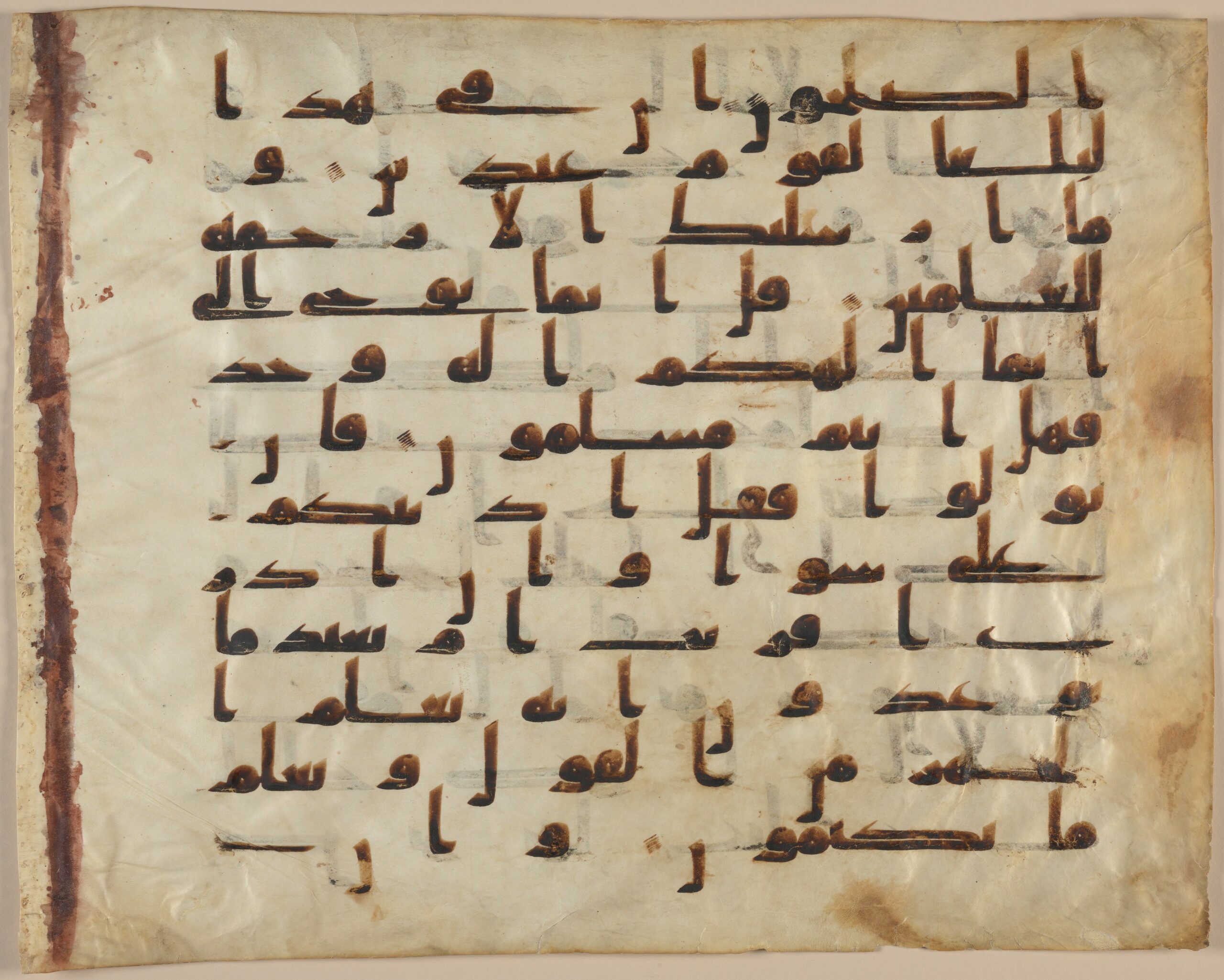
In its formal aspect, the Qur’an is the transcription in Arabic characters of the whole body of revelations that the Prophet, may God’s peace and blessings be upon him, received from the angel Gabriel and transmitted orally to his companions and his relatives. Very soon after the Prophet’s death, a written transcription of the revealed text proved indispensable, to prevent errors from corrupting the original text.
The Qur’anic text, as we find it in today’s bound collections (masahif, sing. mushaf, literally a set of leaves), contains 114 chapters or surahs, in Arabic, which were arranged roughly in order of decreasing length shortly after the Prophet’s passing, during the caliphate of the third caliph ’Uthman ibn ’Affan. They are not in the chronological order of the revelations the Prophet received during the 23 years of his mission. The text remains the same; only the order of its content is different.
After each fragment of the Revelation was dictated, the Prophet recited it, spread it, and had his companions recite it. Those companions who were literate, few in number, recorded the verses (ayat, sing. aya) on various supports: palm leaves, flat pieces of clay, leather, shoulder blades of camels or sheep, parchments.
We know, for example, the circumstance that prompted the conversion of ’Umar ibn al-Khattab, the second caliph (586-644), who had been hostile to the Prophet’s preaching, may God’s peace and blessings be upon him. Going to visit his sister, he found her reciting a written fragment of the Qur’an. Faced with the beauty of the text, he accepted the new religion and became one of the most faithful companions of the Messenger of God.
The elements revealed as time went on, thus retained in the memories of the faithful and consigned to writing, were for the most part structured by the Prophet, who indicated to his scribe-companions the order of the surahs in which they were to be gathered.
The principal scribes who played a major role in preparing a definitive recension of the text, at the successive request of the first three caliphs, were Zayd ibn Thabit, who established a first corpus with the help of the various existing fragments and relying on companions who knew all or part of the orally transmitted Qur’an, Mu’adh ibn Jabal and Ubayy ibn Ka’b. All of them were companions of the Messenger of God.
Surahs, verses, juz’ and hizb
The Qur’anic text is made up of 114 surahs, beginning with al-Fatiha (“the one that opens”), composed of 7 verses. The longest surah is the second, al-Baqara (“the cow”), with 285 verses, and the shortest, al-Kawthar (“the abundance”), is composed of 3 verses.
Another subdivision is superimposed on that of the surahs: the subdivision into 30 equal juz’ (sections), corresponding to the 30 days of the month, or sixty ahzab (parts). Each hizb is divided into 2 halves, 4 quarters and 8 eighths.
Abu Bakr, the first caliph who succeeded the Prophet, may God’s peace and blessings be upon him, from 632 to 634, on the advice of ’Umar who was the second caliph from 634 to 644, asked Zayd ibn Thabit to lead a team composed of scribes and of companions who knew the revealed text by heart, in whole or in part, to constitute a first recension of it.
’Uthman, the third caliph, who exercised power over the community from 644 to 656 and had memorised the whole text, had a complete and definitive recension made of it in the form of an “official” copy called al-Mushaf, the book, composed of leaves, which served as the original for conforming copies sent to the main provinces that had rallied to Islam. It is this standard book, the unique copy of reference, that lies behind all the copies that have existed from that time to the present day and circulate in the Islamic world, Sunni or otherwise.
Note that there are 10 officially recognised readings, of which the two most practised in the Muslim world are the reading of Hafs from ‘Asim and that of Warsh from Nafi’. The latter corresponds to the madhhab or Maliki legal school followed in the Maghreb and in certain countries of the East.
An ancient division
The juz’ and the hizb are not recent words: they were already in use in the Prophet’s time, may God’s peace and blessings be upon him. According to Abu Dawud, the Prophet used to say “qara’tu juz’an min al-qur’an” (“I have read a juz’ of the Qur’an”), a part, or 1/30. ’Abdallah ibn ’Amr ibn al-‘As used to say: “it is my juz’ that I am reading this evening”; ‘A’isha, may God be pleased with her, used to say: “I am reading my juz’”. According to the imam al-Sakhawi, the Prophet sometimes said: “it is time for my hizb”.
This way of dividing up the Qur’an is what the scholars call “tahzib al-qur’an”: the division of the sacred text into parts called ahzab (sing. hizb). Literally, the word hizb means part; in this case, a part of the Book, that is, 1/60.
Finally, let us cite a very edifying story about ’Abdallah ibn ’Amr, reported by several scholars: Bukhari, Muslim, Tirmidhi, Nasa’i, Abu Dawud and Ibn Maja. ’Abdallah ibn ’Amr used to say: “I fast every day and I read the whole Qur’an every night.” The Prophet, may God’s peace and blessings be upon him, summoned him and asked him whether this was true. ‘Abdallah answered that it was, and that in doing so he wanted only good. The Prophet told him: “It is enough for you to fast 3 days a month and to read the Qur’an once a month” (which means 2 hizb or one juz’ a day). ’Abdallah replied: “O Prophet of God, I can bear more than that.” The Prophet told him: “Read it in a week, and do not add more, for you have duties towards your wife, towards people, towards your body.” ’Abdallah insisted that the Prophet change his mind, but the Prophet held firm and told him: “Perhaps you will live a long time.” ’Abdallah did indeed live to a great age, and he later used to say: “I greatly loved having obeyed the order the Prophet, may God’s peace and blessings be upon him, gave me.”
Historically, certain scholars attribute the official division of the Qur’an into juz’ and hizb to al-Hajjaj ibn Yusuf al-Thaqafi, governor of Iraq, who died in 110 AH (eighth century).
The number of verses
The number of verses of each surah in the Hafs version:
7 + 285 + 200 + 175 + 122 + 167 + 206 + 76 + 130 + 109 + 121 + 111 + 44 + 54 + 99 + 128 + 110 + 105 + 99 + 134 + 111 + 76 + 119 + 62 + 77 + 226 + 95 + 88 + 69 + 59 + 33 + 30 + 73 + 54 + 46 + 82 + 182 + 86 + 72 + 84 + 53 + 50 + 89 + 56 + 36 + 34 + 39 + 29 + 18 + 45 + 60 + 47 + 61 + 55 + 77 + 99 + 28 + 21 + 24 + 13 + 14 + 11 + 11 + 18 + 12 + 12 + 30 + 52 + 52 + 44 + 30 + 28 + 18 + 55 + 39 + 31 + 50 + 40 + 45 + 42 + 29 + 19 + 36 + 25 + 22 + 17 + 19 + 26 + 32 + 20 + 15 + 21 + 11 + 8 + 8 + 20 + 5 + 8 + 9 + 11 + 10 + 8 + 3 + 9 + 5 + 5 + 6 + 3 + 6 + 3 + 5 + 4 + 5 + 6 = 6213
Further reading
- Introduction to the study of the Qur’an (1)
- Introduction to the study of the Qur’an (2)
- Surah al-Fatiha