The symbolism of the Arabic letters: the name of Allah as creation
Contents
Nadjm oud Dine Bammate came from a long line of Central Asian Sufis. A doctor of Roman law, he devoted himself very young to Islamic studies in Lausanne, Cambridge, al-Azhar in Cairo, then at the École des hautes études in Paris under Louis Massignon. A delegate of Afghanistan to the UN in 1948, he then began a thirty-year career at UNESCO. There he was coordinator of the Orient-Occident project, director of the division of philosophy and the human sciences, then of the cultural department, and finally special adviser to the director-general for culture and communication. A subtle pedagogue full of humour, he also worked through his teaching at the Sorbonne and at the University of Paris VII as a professor of Islamic studies. A tireless witness to the spiritual and pluricultural reality of Islam, he was ambassador of the Organisation of the Islamic Conference and president of the Educational and Cultural Association of the Muslims of France. Speaking twelve languages, Nadjm oud Dine Bammate embodied ‘the sparkling adventure of the dialogue of cultures’. He died suddenly on 15 January 1985. He had published numerous articles, but many others, as well as books, were still at the project stage. A man of the spoken word first of all, but also of literature, of writing in the noble sense, he left behind texts of great beauty and unfailing rigour.
Soufisme d’Orient et d’Occident would like to give you a taste, through one of these texts, of the joy of reading him.
The alphabetical order
The Muslim tradition knows the science of letters (’ilm al-huruf), which is connected to that of numbers (‘ilm al-arkam) as well as to the knowledge of the divine names (asma’ al-husna). This science goes back to the Qur’an. The sacred book is not merely a guide for the faithful: every verse, every letter is a divine revelation. More than that, the Qur’an is the very speech of God. Against all heterodox temptations, Muslim theology has maintained with strict rigour that the book is, like the Word, eternal and uncreated. The affirmations of the doctors of the law are taken up and amplified in mystical symbolism. Thus the pages the believers chant are none other than the signs inscribed from all eternity in ‘the Guarded Tablet’ beside the divine throne.
The first word revealed to Muhammad was iqra’, ‘read’. There follows the sentence: ‘Read in the name of your Lord who created man and taught him the use of the pen.’ Thus the pact between God and man that is writing was concluded at the very moment of the creation of Adam. The entire universe may indeed be regarded as a writing of God. The creation of the world obeys the same rhythm, retraces the same arabesque of the divine spirit as the Qur’an. Likewise, in return, the symbolism of writing applies to the praise that creatures render to their Lord. It is said that if the ocean were a prodigious inkwell and all the trees of the world so many pens, this cosmic calligraphy would not exhaust the praise of His magnificence.
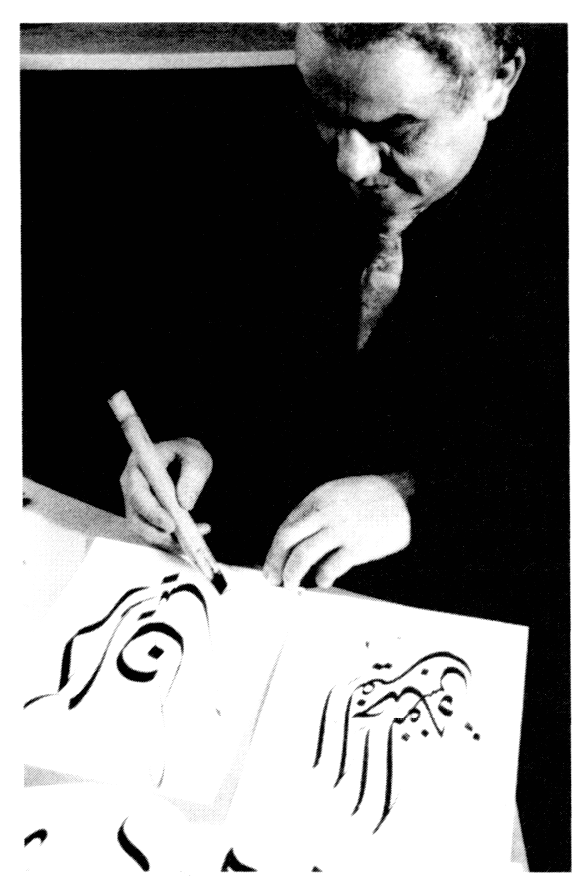
The root of the word iqra’, which is the verb qara’a, to read, is found again in the noun al-qur’an. Qur’an therefore means reading. The Bible, the Scriptures, the Qur’an: by these very words, the three religions place themselves under the sign of the book. And Muslim tradition groups all three under the expression ahl al-kitab, the peoples of the Book. Yet Christianity is above all the religion of the Incarnation. Islam, like Judaism, asserts by contrast an unconditional transcendence; hence the livelier prestige of writing: it stands in for incarnation. It is therefore the Qur’an, a book, and not Muhammad as is often believed, that occupies the place of Christ in Islam. The believer of the desert shudders with metaphysical scandal at the mere idea that a fleshly form could be attributed to God. Only writing is sufficiently abstract to manifest the Word. Calligraphy is the art of iconoclasts. It has been said of cathedrals that they were gospels in stone. For Islam, the terms must be reversed and it must be said that its true monument, its temple, its icons, its Pietàs, are the letters of the sacred book. Writing and drawing at once, the arabesque is the Muslim art par excellence. Drawing like writing is reduced to the essential, to its most stripped-down, most intellectual form: a pure play of linear rhythms, closer to mathematics than to the plastic arts. ‘The arabesque drawing is the most ideal of all’, Baudelaire said in one of his fusées. The arabesque is a text that would be its own illustration, an image that would be its own commentary. Impossible to go further in the economy of means. ‘Let no one touch it who is not purified’: this sentence is inscribed on the cover of certain copies of the Qur’an. As for prayer, ablution must be performed before approaching the sacred Book. To copy it out by hand constitutes one of the most meritorious acts. Even today, in the age of printing, it is preferable to produce it from a manuscript over which the pen has trembled, rather than to manufacture it directly with lead type, that is, with inert objects.
The dignity of the written
A man of deep faith would not sell a copy of the Qur’an. The speech of God literally has no price. A Qur’an is not sold, it is given, for only the thing given is priceless.
Many Muslims wear around the neck, in place of a holy image or a crucifix, a few verses sewn into a little bag. Some always carry a miniature edition on their person. The prestige of the Qur’an extends to all writing. A piece of paper, any paper, provided it is marked with alphabetic signs, must be respected, for it may offer the divine word. In fact, every book published in a Muslim country, and even any letter between friends, begins with the formula ‘In the name of God, the Clement, the Merciful’. They obligatorily bear the Lord’s name as a dedication. In a sense, every written text presents itself as a germ of the Qur’an. Hence the popular gesture, still familiar, of picking up the scrap of paper lying on the ground and putting it out of harm’s way, on one’s person, between the stones of a wall, anywhere so long as the writing is saved. The signs of the alphabet, as such, thus share the dignity of bread. Just as one has no right to throw away a piece of bread, so one cannot abandon a written page. Either gesture would be a profanation.
The tracing of the name of Allah
The symbolism of the Arabic letters reaches its culminating point in the theory of the divine names. The whole of creation can be summed up in the single tracing of the name of Allah. The first letter, the alif, which sounds like ‘a’, presents itself as a vertical line. But this line is surmounted by a small sign, a point that represents the guttural attack, the intake of breath before speech. Likewise silence precedes the word, and the secret, beyond all manifestation, precedes the unity of being. Yet the two signs are but a single reality. The vertical stroke is interpreted as a projection of the point; the point is only the line seen ‘edge on’. The two together symbolise that God is at once ‘beyond the stars’ and ‘closer to us than our jugular vein’.
Next comes the ‘l’ sign of the name of Allah. This letter is called barzakh, the letter of linkage, the mediating one. Through this letter, God manifests Himself in the world, unfolds creation, takes possession of things. The symbol is at once visual, sonorous and numerical.
The letter lam stretches like a hook. And it is doubled: The voice makes the letter of manifestation vibrate by giving it all its possible resonance. The number of lam, which is 30, likewise signifies infinite expansion.
Finally the letter ‘h’, the ‘ha’’, the final expired breath, leads back to the alif in the form of a loop returning upon itself. The circle is accomplished.
The correspondences are limited neither to the name of Allah, since God has 99 names, the hundredth being secret, nor to the series: idea, form, sound, number. Countless analogies are added to it. For example, the gestures of Muslim prayer can be interpreted as a transcription, into the body’s movements, of the letters that form the name of Allah.
The mystics of Islam have known how to draw the most astonishing variations from the letters. Mansur al-Hallaj compares the state of spiritual union with God to the placement of a sign that punctuates a letter.
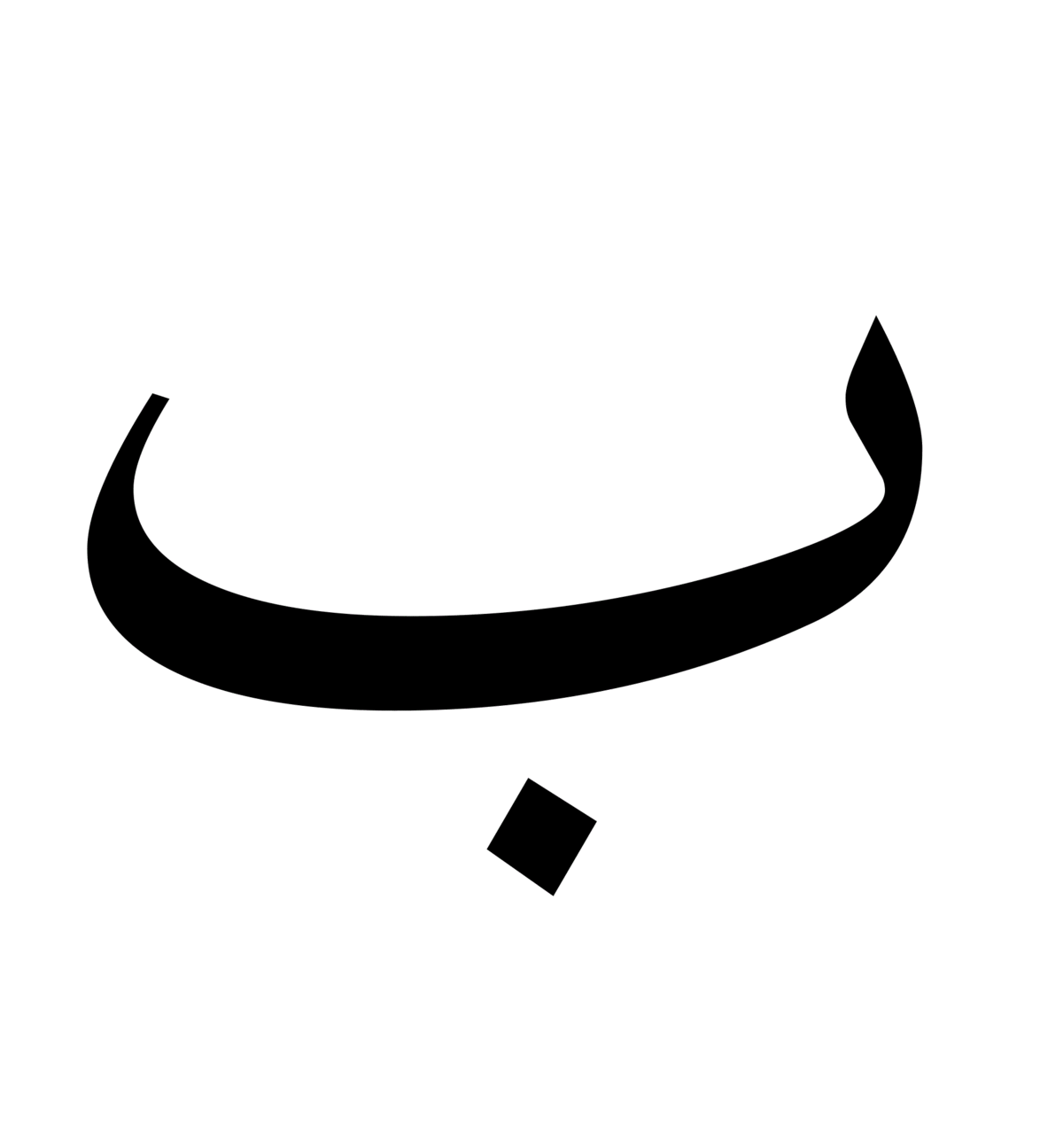
Elsewhere he says that the aim of life is to move the point found beneath the letter ‘b’ above the letter ‘n’. The two signs are composed of an arc; the only difference is indeed the placement of the point. The letter ‘b’, initial of the word bab, the gate, is that of creation. The letter ‘n’, initial of the word nun, the fish, symbolises the resurrection. Prayers for the dead often rhyme in ‘n’.
Let us note in passing the identity of the fish’s signification in the symbolism of early Christianity. To move the point from below to above the arc is to pass from the world of creation to that of the resurrection. The operation amounts to spiritual rebirth, to illumination.
Extract from a text by Nadjm oud Dine Bammate.
References:
- Pierre Lory, La Science des lettres en islam, Dervy, 2005
- Ibn Khaldun, Al-Muqaddima, chap. ‘al-simiya’’
- Amadou Hampâté Bâ, Jésus vu par un musulman
- Pierre Lory, ‘Magie et religion dans l’œuvre de Muhyi al-Din al-Buni’, Horizons maghrébins, n° 7/8 (1986), pp. 4-15