Ghani Alani: calligraphy as an initiatic path
Contents
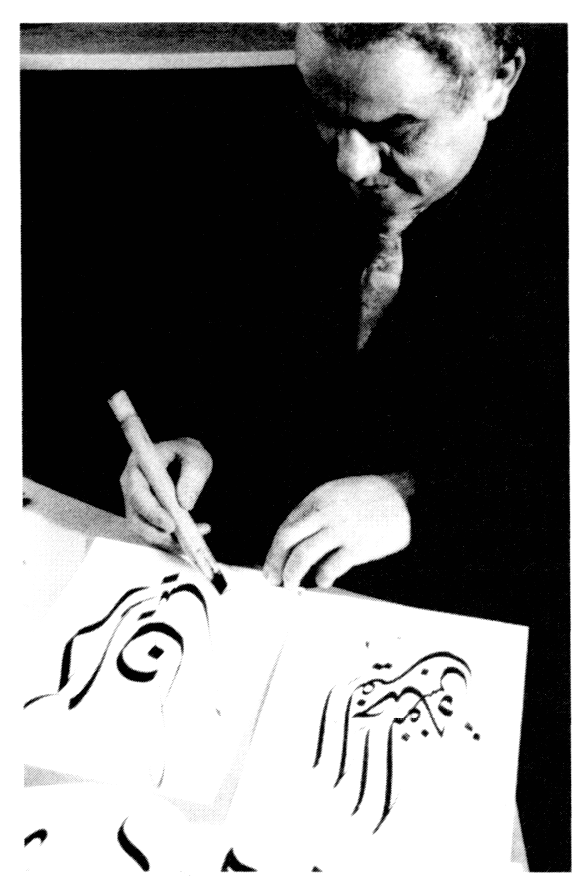
Ghani Alani, an authentic master calligrapher from the school of Baghdad and a doctor of law, has been distilling his knowledge to his disciples across the world for many years. He taught his art at the faculty of letters in Aix-en-Provence then at the Langues orientales in Paris, where he lives. He does not publish and only rarely sells his works. For thirty years he has held numerous exhibitions in Europe and in the Arabo-Muslim countries, accompanied by lectures and workshops. He has often been called upon to speak in schools and in certain socio-cultural centres. In the lines that follow he exchanges a few words that may appear as a veritable initiatic path, whose privileged medium remains the letter.
How did you discover calligraphy?
I was born with the letters; I praised and prayed to God with them. I traced my first letters on my schoolboy’s notebook like all the children of my age at the Qur’anic school (the equivalent in Europe of nursery school) during the holidays. The course in Qur’anic writing is by definition calligraphy, for it embodies what the divine Word is. That course was immediately followed by a course in Qur’anic cantillation (the tajwid). This prompted me to bring these two arts together. Does a hadith not say, after all: ‘He who magnifies the basmala will go to paradise’? One wonders whether the word applies to writing or to cantillation, or why not, to both! It was at that moment that I began to draw a parallel between the oral and the written. For the letter written perfectly, in a well-proportioned manner, carries the right breath.
I never learnt calligraphy the way one learns a trade. I had, in fact, been preparing for a career in law. My calligraphy studies with my masters allowed me to discover the path of the inner life. At the age of thirteen, my first encounter with my master Hashem al-Baghdadi al-Khattat (1917-1973) held out to me the promise of realising that dream, which only gained true impetus with the teaching of shaykh Haydar al-Jawadi, with whom I studied Muslim philosophy, and Avicenna in particular.
How did the initial teaching unfold?
My master Hashem first made me a model of the letters according to the rules of perfect proportion as they had been established by the Brethren of Purity, then in the eleventh century by Ibn Muqla: rules that concerned all the creations of the mind, calligraphy included. The point is a unit of measurement for tracing the alif, for example. In the naskhi style, the same alif has a height of five points. Likewise, in cantillation, the alif measures the lengthening. My master also taught us that, for the rounded letters, one had to look at the curvature of birds’ bodies.
The Prophet himself (peace and blessings be upon him) was unlettered, and yet it was revealed to him in sura XCVI: ‘Iqra’!’ (‘Read’, or ‘Recite’). The meaning of the word iqra’ must be understood in the broad sense: this injunction to read is not limited to a mere deciphering, but calls for a wider interpretation. One may ‘read’ just as well ‘the faces of the believers’ (‘Their marks are on their faces’, Qur’an) as ‘the features of a face’ or ‘the fingerprints of criminals’.
True reading goes well beyond the reading of texts. In essence, he was teaching you openness to the world?
Yes, the world is an inexhaustible source of teaching. That is why I loved watching the craftsmen at work when I crossed the souk on my way to school. I learnt the composition of colours by observing nature (the yellow from pomegranate bark, for instance) and the joinery decorations that have certainly influenced my current work in illumination. I learnt by scrutinising their gestures and drinking in their words, even if, at the time, I did not understand their hidden meaning. But I had a very good memory, and those memories were able to resurface long afterwards to yield up their deep significance to me. It was for me a practical and living course in art.
How did this teaching continue?
I was an adolescent, I had to find a master, for ‘he who has no master has Satan for a master’. I had to take one of the important decisions of my life: to be a mere painter of letters to earn my living or else, and this is what I chose, to become a calligrapher by entering a master’s service and accepting its initiatic trials. During the first three years I had no possibility other than tracing the letters of the alphabet. At the end of three months, he judged my commitment to be total and decided to keep me.
I would visit my shaykh before the Friday prayer. I had permission to listen to Hachem Muhammad al-Baghdadi, who was a great master of the musical maqam. It was there that I met my second master: I wanted to study law, and he could teach me logic, which was then a philosophy, as was the tasawwuf. Being a Sufi was not a title but a discipline. The true Sufis did not say they were.
So there were no barriers, no dichotomy between the teachings. My whole environment was steeped in spirituality: in my neighbourhood there was the Qur’anic school, the mosque, the cemetery where, every Thursday evening, people came to read the Qur’an, which I learnt by heart. As children we played around the tomb of Hallaj: it was a square enclosed by four walls. Even dead, he was put in prison!
Later, in 1970, it was by calligraphing the whole of Hallaj’s prophetic works, the ‘Diwan’, that I learnt it by heart. The four letters of ‘Allah’ set his heart ablaze. The alif is the friend; the lam, the proportion between the horizontal and the vertical; doubled, it expresses the mirror; and the ha’ is the breath and divine unity. Calligraphy thus allowed me to commit numerous texts to memory (the same holds, of course, for the Qur’anic text). I remember that in Baghdad, in the ’Abd al-Qadir al-Jilani mosque, a sentence is calligraphed on the floor that truly struck me and that I had to reproduce endlessly: ‘I am one of those men whose disciples do not fear the vicissitudes of time. Besides, they know not fear. The sun of those who preceded us has set, while ours never disappears below the horizon.’
Did you attend sessions of invocation (dhikr)?
Yes, my father took me to them and I then understood the notion of movement, of the spiral common to the dhikr and to calligraphy, in the way the body turns like the reed pen. Is it not said, besides: ‘The heart of a believer is between the fingers of God, who turns it as the reed pen turns between the calligrapher’s hands, according to His will…’?
How does one become an accomplished calligrapher?
Calligraphy takes a great deal of time and demands a great deal of practice. One begins by imitating the master, one studies the alphabet, the isolated letters then composed into words and sentences, and this in all the forms of calligraphy: thuluth, naskhi, Persian, diwani. When the master observes that his pupil is capable of progressing, he proposes that he embark on personal research in order to grant him a sort of diploma establishing the pupil in the lineage of calligraphers. Such was my case around 1967. I am therefore an heir of the school of Baghdad, which goes back to the founders. The master grants his diploma (ijaza) to only one of his pupils. This ijaza recalls the tariqa, the way in Sufism. A second ijaza was granted to me by the Turkish master Hamid al-Amidi. I am thus also an heir of the Turkish school.
How did you introduce illumination, which holds such a large place in your calligraphies?
If my father in a sense ‘breathed’ the notion of calligraphy into me, the merit of having encouraged me towards illumination belongs rather to my mother. When I showed her a calligraphy, she would say it was beautiful but that something was missing. In 1962, a great master of the Turkish school, Tahsin Aykut Alp, came to Baghdad to teach illumination at the Beaux-Arts. That year I attended his classes and, when I brought a calligraphy accompanied by illuminations, my mother said to me: ‘Twenty years ago I told you: “Something is missing in your work”, it was that!’ It was at that moment that I understood that illumination is in fact the feminine part of Muslim art. They are, besides, the two major arts of Muslim art, which can bring together all cultures, Arab and non-Arab alike.
To find out more about Ghani Alani, see also: ‘Ghani Alani, la calligraphie arabe : sa transmission de maître à élève au cours des siècles’, in Horizons maghrébins*, n° 35/36, 1998, p. 87-99.*