The Reign of Quantity and the Signs of the Times, by René Guénon: a presentation
Contents
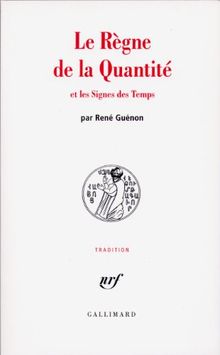
A presentation of The Reign of Quantity and the Signs of the Times (Gallimard, 1945), by René Guénon.

René Guénon was born in Blois in 1886 into a Catholic family and died in Cairo in 1951. Regularly described as an unclassifiable figure of Western thought and refusing all labels, he recalled all his life what his function was: to set out as faithfully as possible the metaphysical doctrines of the East and to revivify the traditional spirit in a West forgetful of all spiritual knowledge. Published in 1945 by Gallimard, The Reign of Quantity and the Signs of the Times sets out, from the traditional standpoint, the cyclical conditions that led to the modern world. The work deepens the findings of The Crisis of the Modern World and analyses the causal chain leading to the exhaustion of the present humanity’s cycle, an ineluctable consequence arising from universal laws. The book divides into two major parts, separated within the very title: The Reign of Quantity, which expounds a metaphysical conception of the historical process subject to the law of cycles, and The Signs of the Times, which describes concretely the effects of that process.
Essence and substance, quality and quantity
Guénon designates the notions of quality and quantity as the respective attributes of ‘essence’ and ‘substance’, the two poles that give body to manifestation. The essential pole (purusha in the Hindu tradition) is active and purely qualitative. It is the pole that ‘illumines’ things from the substantial pole (prakriti), which for its part is purely quantitative and passive. This universal substance, which St Thomas Aquinas calls materia prima, is a pure potency, that is, a potentiality from which there is something to be drawn. However, in a more restricted dimension of manifestation such as the corporeal world of human beings, one speaks of materia secunda, a potential and relative substance, which can never be a pure potency, since it is animated through the essential pole. Determined as it is by the special conditions of this world, this materia secunda becomes materia signata quantitate (designated matter); quantity is thus the sole qualitative property of the corporeal world.
In this connection, Guénon recalls that etymologically the word ‘matter’ can be related to ‘measure’, in the sense of the possibilities of deploying manifestation inherent in spirit (the creative principle, or Atma in Hinduism). It is therefore through measure that the manifested world is organised and proportioned, ordering things within space and time, which are not, for that matter, devoid of qualitative properties. Space is not infinite and deploys through the directions, while time is not linear: several times unfold across several universes and cycles.
The manifested world is therefore an ordered whole, where all the parts are linked to one another by a single creative principle. This balance expresses itself particularly through the property of numbers, which corroborates the great importance accorded to geometry and mathematics in the traditional sciences (in Pythagoras notably). It is likewise according to this balance that the fall of the essential pole towards the substantial pole is organised, entailing direct effects at every level over the different phases of the cycle of manifestation.
The law of cosmic cycles
This degeneration is indeed governed by the law of cosmic cycles, called Manvantara in the Hindu doctrines. Each Manvantara corresponds to a complete cycle divided into four ages (the Yugas), each having particular properties that bear upon the whole of earthly conditions. Each phase of the cycle marks an ever more pronounced descent towards the substantial pole, entailing the progressive exhaustion of all the possibilities of the manifestation in progress. Once the stopping point is reached, the cycle closes with an immediate reversal towards the essential pole, which translates materially into a cataclysm making ‘a clean sweep’ of all that has come to pass, with the exception of an infinitesimal quantity of elements destined to govern the following cycle.
According to this doctrine of cycles, the world is currently in the final phase of the last age, called Kali Yuga (the dark age), which the Greeks designated as ‘the age of iron’. This final phase, which began around the fourth century before Jesus Christ, crowns the advent of the reign of quantity extended to every sphere of existence and the maximal denigration of every qualitative dimension.
The solidification of the world
This distancing engenders progressive modifications in the perception of the universe and, by consequence, in the ways of life. The primordial relation of beings to the Principle, intuitive and direct at the beginning of the cycle, has been eroded by the wear of time, finally leading to its outright negation. This course, the fruit of a progressive degeneration of thought, first leads to erecting reason as the supreme faculty of the human being (whereas it is only the individual faculty proper to his species), entailing the negation of the pure intellect and thus cutting man off from the celestial influences. The reduction of all things to reason entails the materialisation of all human activities. The craftsmanship of the ancient trades disappears in favour of the mechanisation of tasks and of productivity, destroying the initiatic dimension of work. Money loses its role of spiritual influence to be reduced to a mere means of exchanging goods and services.
At the spatial and temporal level, this leads to a solidification of the world, correlated with an acceleration of events. Time literally devours space: nomadic ways of life are gradually absorbed by sedentary structures, breaking the balance between these two types of existence (the story of Cain and Abel is a parable of this). The advent of ever larger and more sprawling cities is a final mark of this fixation. This mode of organisation, which monopolises ever viler resources (the replacement of wood and stone by metals regarded as harmful and requiring strict traditional oversight), limits the fields of perception through ever-increasing artificial constraints. Modern administrative structures, driven by the egalitarian obsession and the reduction of all things to statistical data, reduce beings to uniform, interchangeable entities. The people of the modern world, amputated of their spiritual dimension, become hostages of the myth of ‘ordinary life’, a purely materialist model of existence, devoid of all metaphysical consideration and denying every form of hierarchy and natural law. Humanity shuts itself mentally and physically into preconceived environments, as artificial as its worldview. Guénon compares modern societies to insect hives, where all singularity is annihilated by a mechanistic uniformisation. This tendency reinforces itself, for the sole superiority of the modern world is precisely its capacity to dominate corporeal matter brutally. Simultaneously, the acceleration of time increases the multiplicity of events and phenomena, generating confusion and agitation everywhere, and rendering all inner life extremely difficult.
This narrowness is accentuated by impassable ‘temporal barriers’ between the different phases of the cycle, which gradually reduce the fields of perception. Historical and archaeological discoveries (fruits of modern agitation, according to Guénon) can indicate nothing about the way the ancients perceived the world, these vestiges being likewise subject to the present conditions of the cycle (Guénon speaks of ‘psychic corpses’). Each phase, moreover, entails profound modifications of the terrestrial and mental landscape; it is enough to observe the evolution of the topography of Europe from 20,000 years before our era to today. For this reason, outside initiation, whose finality transcends the temporal framework, it is impossible to draw near to the mentalities of the ancients through a materialist approach.
From anti-tradition to counter-initiation
The advent of materialism is nevertheless only a transitory stage. By reducing everything to reason and by considering the individual as his own end, the modern world has become anti-traditional (a phase begun around the Renaissance and formalised with rationalist philosophy). This progressive negation of every supra-rational form leads to the relativism of knowledge and of the intellect. Cut off from the celestial influences that gave symbols their meaning, spirituality loses its transcendental bearing to become no more than a form of religiosity steeped in sentimentalism. The letter supplants the spirit to become nothing but a morality (or Nietzschean ‘moraline’) without interest or metaphysical finality. This anti-traditional phase, linked to the solidification of the world, nevertheless sees individuals protected by the ‘shell’ that the materialist spirit represents: if it cuts man off from the higher spiritual influences, it simultaneously prevents the lower psychic influences from manifesting. Yet this rigidity, ceaselessly accentuating, must end by cracking under its own contraction, leaving the lower influences the possibility of infiltrating the world with no possible recourse to the higher states.
This phase of dissolution marks the entry into the final phase of the cycle, which takes concrete form in a growing confusion of the psychic and the spiritual. It is the exhaustion of all the inferior possibilities of the being, where the unconscious and the subconscious substitute themselves for the supraconscious, reinterpreting traditional knowledges and symbols counter to their true signification. This subversion is a source of multiple errors, but also of real dangers for the equilibrium of individuals. Psychoanalytic methods imitate initiation by using symbols and myths inversely to their signification, like the Freudian sexualisation of fairy tales or the psychiatrisation of myths by Jung, whereas these writings are hidden sources of spiritual knowledge. From the desiccation of vitality engendered by materialism results a will to return to the spiritual, though a real return to it is not possible for the mass. The very idea of Tradition ends up being perverted, confused with custom and folklore. Most of those who resist and wish for a return to tradition are in fact traditionalists, who confuse Tradition with values and idols dependent on temporality (the nation, the fatherland, exoteric religion). Philosophical approaches to the spiritual remain confined to speculations limited to the sensible and psychic world (quietism, for instance, which confuses non-action with passivity, or Bergson’s intuitionism). The danger becomes real, for the risks of being confronted by subtle influences multiply, but there is no longer any protection or safeguard to forestall their effects.
The end of the cycle
The terminal phase of the cycle must see the lowest psychic forces take control of the world, leading to a return to quality through the establishment of a hierarchy and a spirituality in total reversal of the natural equilibrium. To this anti-tradition is joined counter-initiation: as the world no longer has, or has very little, access to the spiritual poles (the masters), it witnesses the multiplying appearance of false prophets, charlatans and puppet traditions guided entirely by the psychic. This final descent must conclude with the ephemeral reign of the Antichrist, a symbolic force that marks the acme of counterfeit. Guénon indicates, in keeping with the eschatological accounts, that the Antichrist will be at once a system, an epoch, but also a person who will in a way be its ‘synthesis’. This phase of maximal error will retain its artificial and mechanical character, the logical effect of the spirit of imitation and ‘aping’ that animates it. This ‘cadaverous’ vision of the golden age will be at once its closest likeness from without and its furthest remove from within. The cycle ends with the overthrow of the Antichrist by the principle of restoration (Christ in Christianity and islam, the avatara Kalki in Hinduism, the Messiah in Judaism). The advent of a new cycle therefore passes through the eradication of the previous one and the reconditioning of the terrestrial environment.
Although it may appear dark and pessimistic at first sight, René Guénon does not envisage this process under a moral or intentional character.
Degeneration is part of the universal laws to which all things are subject. Though monstrous from the relative standpoint, these phenomena contribute to the global equilibrium and are neither beneficial nor maleficent. For the one who has managed to free himself from form, these considerations no longer have any place, for morality and duality belong to the domain of relativity. In the perception of unity, there is only the sequence of cyclical laws, on which Guénon concludes by affirming that ‘“end of a world” is never and can never be anything other than “the end of an illusion”’.
‘Brahma bears no resemblance to the world, and apart from Brahma there is nothing; all that seems to exist outside him is an illusion.’ Shankaracharya.
Further reading
- The Cairo-Amiens Guénon correspondence (series)
- In the company of Shaykh ’Abd al-Wahid Yahya (René Guénon)