On the Seal of the Saints (Khatm al-awliya')
Contents
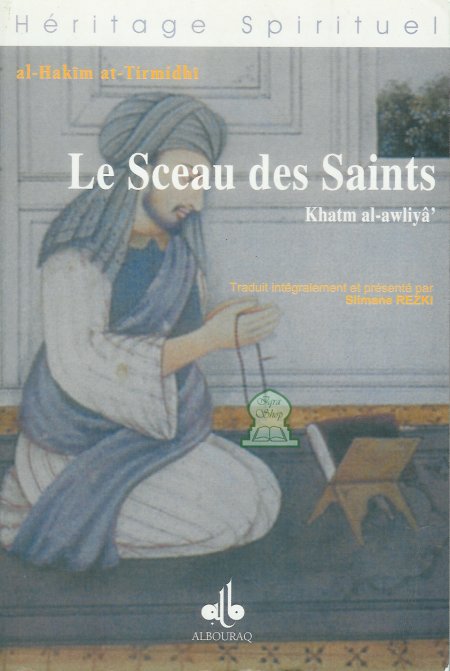
The work entitled The Seal of the Saints1, by the famous mystic of Khurasan Hakim Tirmidhi (d. 898), is rightly regarded as an original work that counts among the very first monuments of Islam’s mystical literature. This book develops the fundamental question of spiritual realisation in its two distinct modes: sidq (sincere human effort) and minna (the action of grace). The author sets out this master idea with the help of all his knowledge, at once psychological, theological and metaphysical. In the same breath, several problems pertaining to mysticism are evoked: the knowledge possessed by the saints (awliya’) and its links with profane knowledge, the time factor and its role in spiritual experience, the nature of sainthood and that of prophecy, their mutual relations, the distinction between contemplation and action, the reward of deeds and that of the progress of hearts…
Spiritual experience and its different modes
Mystical realisation operates, according to Hakim Tirmidhi, in two clearly distinct modes: the mode based on the rule of sidq and the mode based on the action of grace. The distinction thus established corresponds to the very nature and the envisaged aim of each of these two modes of spiritual life, both of which take their rank in the hierarchy of the degrees of the sphere of sainthood. The terms that define the multiple states of spiritual realisation assume, under Tirmidhi’s pen, a great precision that reveals lived experience, the experience of a fine psychologist and a metaphysician.
The saint according to the law of Allah is the one who follows the rule of sidq. The rule of sidq is realised in two complementary operations. First, the aspirant on this way, becoming aware of the meaning of his life as a human being, of his destiny, imposes on his limbs the strict observance of the rites. This is the preliminary phase, consisting in the perfect and scrupulous accomplishment of the commandments of the established law. To this phase succeeds the inner operation, which consists solely in watching over and setting right the individual soul, the pivot of the rule of sidq. Tirmidhi describes for us the wrenching, dramatic struggle that the spiritual man must undertake against his carnal soul in order to kill its passionate desires and inclinations. […] For Tirmidhi, the carnal soul is the principle of evil, the source of all deviations. That is why the spiritual man will have to wage a merciless struggle against it and extirpate, down to the root, the passions it arouses. Watching over the outward limbs, mastering the inner being: these are the two successive operations that illustrate the struggle of body and spirit with a view to restoring a harmony destroyed in the multiplicity of everyday life.
The final goal towards which the one who realises the sidq tends is the accomplishment of his individuality and his personal salvation. In religious terms, it is conformity to the obligations of worship here below, in exchange for the paradisiac state in the hereafter.
Spiritual experience based on the action of grace likewise rests upon mastery of the outward limbs and of the passionate soul, but the perspective is different. Certainly, the being touched by grace is more aware than any other of the need to purify his inner being and to master his limbs. As grace irradiates the being with its light, the being responds with a greater purification of his soul, a deeper consciousness of his duties, a more ardent effort of sincerity, precisely so as to be worthy of bearing the divine deposit and of reflecting the light of heaven. But while the being of sidq is crushed beneath the weight of the struggle to be waged against his carnal soul and wholly absorbed in the observances he must accomplish, the being touched by grace frees himself from his corporeal bonds and sees his task made easier. Whereas the being of sidq is in a sense determined by his individual dimensions (which he cannot go beyond), the being of grace soars out of the limits of his individuality and attains total deliverance.
The beings of sidq are the labourers of the spiritual life. They aim at immediate reward and profit, and are wholly absorbed in action. They have no access to pure contemplation. They could in no way go beyond the limits of individuality, for in the hereafter they aspire only to reach the paradisiac state. The beings touched by grace, by contrast, are called the Free, the Noble. Their goal is total deliverance, the surpassing of the individual condition. Their aspiration is directed towards God alone, and they disdain the reward, in the hereafter, of paradisiac delights. And on earth, they already live in the vast field of divine unicity, and in the depths of their heart resides the lordly throne.
For Tirmidhi, the being of sidq cannot totally escape the grip of his individual soul. He may perhaps manage to detach himself from the pleasures of sin, but he will never manage to erase from his soul the sweetness of worship. Now the sweetness of worship, like the pleasures of sin, is the concrete manifestation of the presence of the individual soul. The ego refuses to die and exercises its authority subtly and indirectly. So the man of sidq, even if he reaches a certain degree of spiritual perfection, is not safe from the influence of his carnal soul. He remains subject to its temptations and its treachery.
If the being favoured by grace does manage to free himself from his soul, it is because a superior force, that of the Almighty, opposes the force of his ego. The experience of the being of grace differs from that of the being of sidq in that he comes to live here below, integrally, all the possibilities of existence, not by his own effort, but by God. Tirmidhi, in this regard, comments marvellously on the famous hadith qudsi recited and meditated by so many spiritual masters in Islam:
And when I love My faithful servant,
I am the eye by which he sees,
the hearing by which he hears,
the hand by which he touches,
the heart by which he meditates.
It is by Me that he sees,
by Me that he hears,
by Me that he touches,
by Me that he meditates.
It is therefore, in a sense, an act of identification of the being with God or, more exactly, an act of transcendence of the being by the Principle. His life thus becomes the expression of love, of faith, of knowledge.
Sainthood and prophecy
Sainthood is at once presence and intimacy with God. It could be represented in the form of a sphere in which the totality of the believers is ranged in hierarchical order. For there is a sainthood of the general order and a sainthood of the particular order. On the general plane, sainthood embraces the great family of believers whose relation with God is effected through the utterance of the shahada. It is the common link of every faithful one who believes in God’s message and in His presence among us. But on the particular plane, sainthood is reserved for God’s elect, for His intimates who communicate with Him by means of effective and transcendent union. These are the beings of converse, of communication and of deep peace (sakina). They freely accede to the divine counsels and speak to God face to face.
These two planes or conditions of sainthood express, in a sense, the distinction that exists between the virtual and the real. Whereas the simple believer possesses within him the germs of a future realisation through faith, the saint properly so called effectively realises, through sanctifying grace, divine intimacy and proximity, in a word, life in God. Thus the problem of deliverance and of the beatific vision is resolved by anticipation, for the saint properly so called, here below, whereas it remains to be resolved for the simple believer in the life of the hereafter.
The sphere of sainthood encompasses not only the whole of the believers but also the prophets and the apostles, for these bear within themselves, besides their particular function, sainthood. The personality of the apostle, like that of the prophet, comprises multiple functions. It presents itself both in an outward form, which is prophecy, and in an inward form, which is sainthood. Yet every prophet or apostle is a saint, and not the reverse. It may be, however, that Allah grants a saint favours He refuses to a prophet or an apostle. Such are, for example, the cases of Solomon and his companion who holds the knowledge (Qur’an XXVII, 40), and of Moses and Khidr (Qur’an XVIII, 65-82).
In itself, sainthood is therefore superior to prophecy and apostleship. On the one hand, because it is common to messengers, prophets and saints; and on the other, because its nature being timeless, it is intimate and transcendent union with God.
Prophecy is of an eschatological nature. It is determined by the existential cycle. Apostleship is of a social nature. Prophecy and apostleship are therefore situated on a temporal plane, whereas sainthood is situated on a divine plane where it is attribute and perfection. We find, moreover, among the divine attributes and names, that of wali and not that of nabi or rasul… But the primacy of sainthood over prophecy and apostleship does not mean that the saint is superior to the prophet or the apostle, for these are saints as well.
The prophet and the apostle are protected from error by virtue of the Revelation, and the saint by virtue of truth (haqq) and of sakina. However, the prophet’s function being salvific, it requires the adherence of creatures, and whoever refuses his message is regarded as unfaithful. For the saint, although the whole universe sings his sainthood, adherence is not required, only invited. Certainly, whoever refuses to recognise the saint incurs no formal penalty, but he deprives himself thereby of the divine light.
Just as prophecy, symbolically represented in the form of a sphere in which the prophets are ranged, is completed by the ‘Seal of the Prophets’, so too sainthood, which manifests itself on the stage of history through the luminous figure of the saints, is completed by the ‘Seal of the Saints’. Sainthood, like prophecy, finds its complete blossoming in the Seal. Yet whereas prophecy is sealed with the last prophet, Muhammad, sainthood wells up until the end of the worlds2.
By Osman Yahia, doctor of al-Azhar University in Cairo and research master at the CNRS. This article first appeared in the journal of the École pratique des hautes études, religious sciences section, 1959 (www.persee.fr).

Further reading
Footnotes
-
Khatm al-awliya’, translation by Slimane Rezki, éd. Albouraq. ↩
-
Ibn ’Arabi (1165-1240) and the emir ’Abd al-Qadir (1808-1883) distinguish three ‘seals of sainthood’: the ‘Seal of universal sainthood’, said to be incarnated by Jesus; the ‘Seal of Muhammadan sainthood’, said to be incarnated by Ibn ’Arabi himself; and the ‘Seal of the children of Adam’, who will be the last saint of the human cycle. ↩