On the barzakh (1/3): the isthmus between the two seas
Contents
A very explicit example of the double sense of symbols is given by the use of the expression ‘barzakh’ in Sufism. The word barzakh is generally known, in theology, as designating a certain intermediate state in the posthumous evolution of the human being. But Sufi doctrine gives it a far less restricted signification, while basing itself strictly, moreover, on the metaphysical interpretation of the Qur’anic verses containing this term. One of the verses is found in the sura ar-Rahman: ‘He produces the two seas which meet and, between the two, there is an isthmus (barzakh) which they do not transgress’ (Qur’an LV, 19-20). Another is found in the sura al-Furqan: ‘And it is He who produces the two seas, one sweet and drinkable and the other salty and bitter. He made between the two an isthmus and a closed barrier’ (Qur’an XXV, 53).
According to certain interpretations, the two seas symbolise respectively quiddity and qualities, or, in other acceptations, the manifested and the non-manifested, the formless and the formal, immediate knowledge and theoretical knowledge… In the end, the two seas may represent two more or less elevated, but always consecutive, degrees of the hierarchy of Being.
The barzakh: partition or mediator
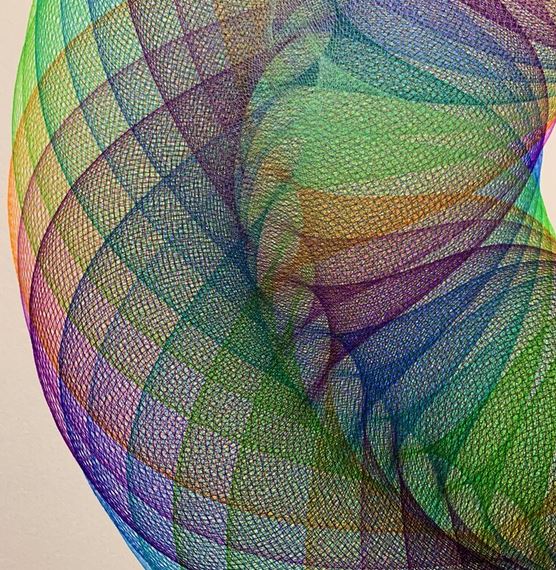
As for the barzakh, which, for an outward perspective, must necessarily have the defined sense of ‘partition’, ‘separating element’, it cannot be only that for a perspective that applies to it the principle of non-otherness. When it is considered from the standpoint of its ontological situation, it can appear as a mere partition only from the point of view of the degree of lesser reality, whereas, seen ‘from above’, it must be the very mediator between the two seas. One could therefore compare it to a prism that decomposes the integral light of a higher world into the varied colours of a lower world, or again to a lens that concentrates the rays from above by filtering them through a single point of inversion. The barzakh is therefore a separation only inasmuch as it is itself the point of birth of a separative perspective, in whose eyes it presents itself as a limit. This has an analogy, moreover, in what is called the ‘blind spot’ in the bodily eye, at the very place where the optic nerve perforates it.
The barzakh as pole (qutb) and the heart
These considerations on the two complementary aspects of the barzakh sufficiently explain why this expression is sometimes employed as a synonym of the pole (qutb). ‘What is called the barzakh of some domain of existence’, says Muhammad Tadili (1870-1957), ‘is none other than the pole that governs that domain and gives it its growth’. As the expression ‘growth’ shows, Tadili was thinking above all of the cosmological applications of the theory of the barzakh: ‘On the model of the hierarchy of the worlds contained in the macrocosm, every world or degree of human individuality is presided over by a barzakh, just as every human faculty is governed by such a pole.’
This is most easily observed in the faculties of mental conception, where the barzakhs constitute the pivots of the complementaries ‘subject’ and ‘object’, as well as in the faculties of sensory perception. ‘All man’s barzakhs’, Tadili says further, ‘depend on his central barzakh, which is the heart (qalb), the mediator between the domains of the Spirit (ruh) and of the individual soul (nafs)’. For its part, the physical aspect of the heart expresses these different characters very clearly for, according to Tadili, ‘one may symbolically picture these barzakhs of the human hierarchy as so many elusive points whence emanates a luminous vibration, alternating concentration and expansion, continually and spontaneously. Each pulsation of a barzakh produces a transformation of the vital light. For this transformation not to reverse itself and become, through individual negligence, fatally “descending”, it must always be determined by spiritual orientation and sustained by means such as dhikr (invocations of the divine names), or by methods belonging to the science of breathing.’ These methods are moreover based, from a certain point of view, on the analogy between the phases of breathing and the pulsation of the barzakhs.
As for dhikr, it should be remarked that this word also means ‘reminder’, ‘remembrance’, which makes it possible to envisage analogies between invocation and the appeal to the barzakh of memory, situated between the ‘seas’ of remembrance and oblivion.
By Titus Burckhardt.

Further reading
Further reading
- L'autorisation divine (idhn)The divine authorisation (idhn): transmission and degrees (1/2)
- L'autorisation divine (idhn)The divine authorisation (idhn): transmission and Qur'anic sources (2/2)
- The allusive science (ishara), by Kalabadhi
- The heart of the path: the spiritual guide and the transmission of the secret