Traits of Sufi humour: Shibli, Kharaqani and the others
A man in distress was weeping bitterly. Faced with this sad sight, Abu Bakr al-Shibli (861-946) asked him:
“My poor friend, what is it that puts you in such a state?
“I had but one true friend, the man sobbed, and he has just died.
“You wretch! exclaimed Shibli. But why ever did you choose a friend liable to die?”
In the eleventh century, the emperor Mahmud of Ghazni (971-1030), in a fine gesture of charity, entrusted a sack of gold coins to a Sufi master, enjoining him to distribute these riches to the people who deserved them most. The Sufi took the sack and chose to share it out among the richest members of the community.
Hearing the news, the sovereign was irritated by this strange and uncharitable action and demanded the reason from the Sufi, warning him that he had better supply a most convincing explanation, failing which he would be beheaded on the spot.
“Majesty, retorted the Sufi, I strictly fulfilled your wish by giving the gold to those who most deserved it, as you yourself ordered me. I therefore entrusted it to those whom God has already favoured rather than to those deprived by His will.”
A fool of God had the habit of going out bareheaded in the streets of Ghazni (Afghanistan). Someone asked him why he wore no headgear, as local custom stipulated. “Unless He lets one fall on me from up there, he answered, never shall I place such an object upon my head!”
One day, as he was sauntering down a narrow alley, someone, from a high window, threw down the rind of half a melon. This improvised skullcap finished its fall on the crown of his head, where it fitted perfectly. The fool had thus received his celestial hat. But he took it between his fingers, observed it attentively and sent it back in the direction of the sky, exclaiming: “If that is the only headgear Thou canst send me, take it back and wear it Thyself!”
Abu’l-Hasan al-Kharaqani (963-1033), the lover of God, was deeply collected and meditating in a great silence. Suddenly, the divine Voice was heard:
“O Abu’l-Hasan! Dost thou wish Me to inform everyone of what I know of thee, so that they turn away from thee and stone thee?
“O Lord! answered Kharaqani, desirest Thou that I tell people what I know of Thy indulgence and Thy mercy, so that they cease performing their prayers?
“In that case, said the Voice, I keep silent about thee and thou keepest silent about Me.”
One day, Shibli paid a visit to Abu’l-Husayn al-Nuri (840-907). He found him in a state of complete meditation, absolutely motionless. Of his body, not a hair, not an eyelash, not a whisker stirred. When he had come out of this state, Shibli asked him who had taught him such perfect stillness. He answered: “I learnt it from a cat watching a mouse. But it attained an immobility far superior to that which I merely approach.”
Shibli saw two children fighting over a walnut. He took the nut, explaining that he was going to divide it into two equal parts, one for each of them. He then broke the shell, which proved empty. At that moment a celestial Voice intervened: “Now then, Shibli, try sharing the walnut fairly, since you claim to be a fair divider!”
The Sufi master felt ashamed before such a dilemma, but he found the strength to declaim: “O Lord! Truly, all this dispute between two children over an empty shell, and now this quarrel between Thee and me over a fair divider who has nothing to share…”
Junayd’s chicken
One of Junayd’s disciples (830-910) was treated particularly well by him, which did not fail to arouse reactions of jealousy. The other disciples finally complained to Junayd about the favours he reserved for his protégé. He then said to them: “My dear friends, I do indeed love this man more than you, for he has attained a deeper understanding. If you do not believe me, we are going to carry out an experiment…”
Junayd had twenty live chickens brought, distributed them one by one to each of his disciples and proclaimed: “Now, let each of you go and kill his chicken in a place where no one sees him!” They all came back shortly afterwards with their fowl slaughtered. All but one: the master’s favourite returned with his chicken still alive. He was asked why he had not sacrificed his fowl and how he had dared disobey Junayd. He then addressed him: “Master, you specified that the chicken had to be put to death in a place where no one could see me. Now I could not find such a place, for wherever I went, I felt upon me the ardour of His gaze.”
Ibrahim al-Khawwas (died 904) recounted that he was wandering in the desert and had lost his way. Suddenly, a cock crowed in the distance. Ibrahim rejoiced at it and headed in its direction. But in doing so, he met a most unsavoury person who picked a quarrel with him and manhandled him.
In despair, Ibrahim turned back, imploring God: “But why dost Thou permit such a mishap to befall me, when I have placed all my faith in Thee?” The divine answer was not long in coming: “As long as thou trustest in Me, I protect thee. But if thou puttest thy trust in the cry of a mere fowl, thou reapest what thou deservest!”
One day, Junayd saw Shibli prey to the keenest agitation.
“My friend, Junayd murmured to him, if you placed your worries in God’s hands, you would assuredly find tranquillity!
“My brother, Shibli replied, I would feel infinitely better if God would kindly leave me alone with my problems!”
A Sufi master was walking, accompanied by his disciples, through the streets of a town. From atop a terrace, someone threw ashes, which fell on the master’s head. Scandalised, the disciples wanted to chastise the disrespectful man. “But no! exclaimed the master. God must be thanked a thousand times: instead of annihilating me by fire, He only punished me with ashes!”
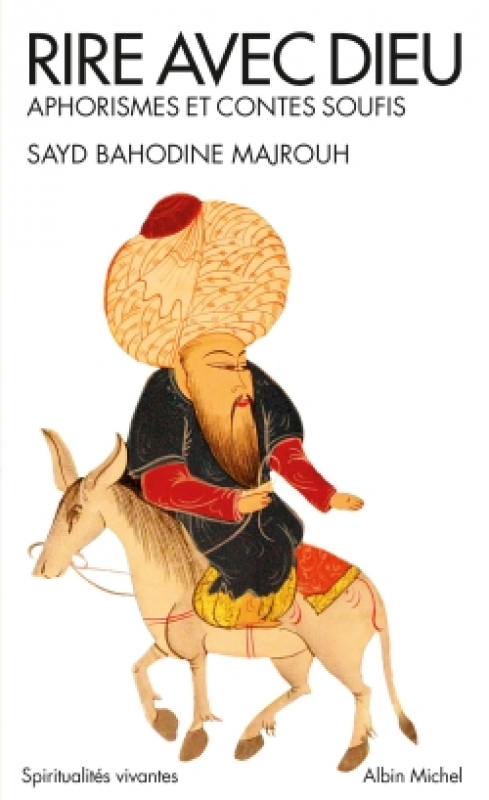
Tales drawn from the work Rire avec Dieu (Albin Michel).

Further reading
Further reading
- Spiritual courtesy (adab) in the believers' relationship to the Prophet of God
- The Hikam of Ibn 'Ata' Allah, commented by Ibn 'Ajiba
- Les Hikam d'Ibn 'Atâ' Allâh (commentaire d'Ibn 'Ajîba)Hikam no. 1: not counting on one's works (Ibn 'Ata' Allah, commentary by Ibn 'Ajiba)
- Wisdom of Ibn 'Ata' Allah al-Iskandari: invocation without the heart's presence